Spring Specification Standards: ASTM, SMI, and JIS Reference for Engineers
When specifying springs for precision manufacturing, the three dominant reference frameworks are ASTM (American Society for Testing and Materials), SMI (Spring Manufacturers Institute), and JIS (Japanese Industrial Standards). For a direct answer: ASTM provides material and test methods, SMI offers design and tolerance guidelines for round wire helical springs, and JIS defines metric dimensional and quality standards primarily used in Asian supply chains. Selecting the correct standard is not optional—it determines mechanical performance, inspectability, and cost, with tolerance variations of up to 300% between standards on the same spring dimension.
Material Property Comparisons Across Standards
The foundation of any spring specification is the material grade, and each standard defines chemistry and mechanical limits differently. ASTM A228 (music wire) specifies a tensile range of 2300–2600 MPa for 1.0 mm wire, while JIS G3522 (SWP-B) for the same diameter specifies 2150–2450 MPa. This 6-8% strength difference directly impacts maximum allowable stress in fatigue applications.
For stainless steel, ASTM A313 (302/304) allows a minimum tensile of 1700 MPa at 1.0 mm, whereas JIS G4314 (SUS304-WPB) requires 1650 MPa minimum. SMI does not define material chemistry but references ASTM and SAE grades. In practice, a spring designed to ASTM A228 can be substituted with JIS SWP-B only if the design stress is derated by 7% to account for lower tensile.
The following table shows critical property differences for common spring wire materials:
| Standard | Material Grade | Diameter Range (mm) | Tensile Strength (MPa) | Operating Temperature (°C) | Common Application |
| ASTM A228 | Music Wire (TDL) | 0.1–6.0 | 2300–2600 (1.0 mm) | -40 to 120 | Precision compression springs |
| ASTM A313 | Stainless 302/304 | 0.1–12.0 | 1700–2100 (1.0 mm) | -200 to 300 | Corrosion-resistant springs |
| JIS G3522 | SWP-B (Piano Wire) | 0.2–6.0 | 2150–2450 (1.0 mm) | -40 to 120 | Automotive valve springs |
| JIS G4314 | SUS304-WPB | 0.1–10.0 | 1650–1950 (1.0 mm) | -200 to 300 | Medical and food equipment |
| SMI Handbook | Referenced to ASTM | 0.1–12.0 | Per referenced spec | Per referenced spec | Design guideline only |
Tolerance Classes and Dimensional Precision
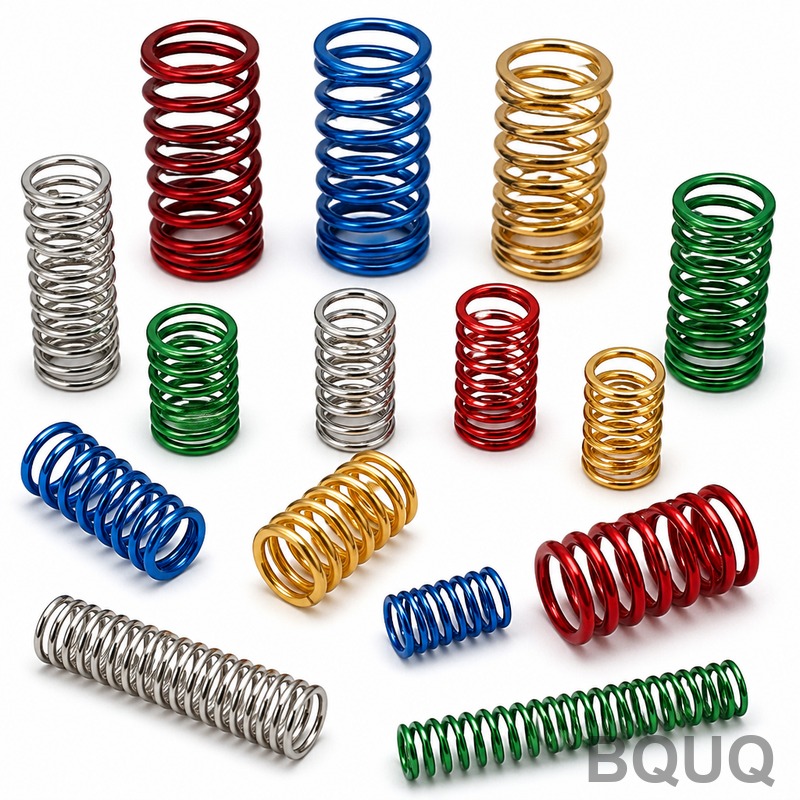
Tolerance classification is where ASTM, SMI, and JIS diverge most significantly. SMI provides three grade levels for compression springs: Grade 1 (precision), Grade 2 (commercial), and Grade 3 (general). For a spring with 10 mm free length and 2.0 mm wire diameter, SMI Grade 1 allows ±0.25 mm free length, Grade 2 allows ±0.75 mm, and Grade 3 allows ±1.50 mm.
ASTM F2239 (standard for helical coil springs) defines tolerance tables based on spring index (ratio of mean diameter to wire diameter). For a spring index of 8, the load tolerance is ±5% for precision and ±10% for commercial. JIS B2704 (helical compression and extension springs) specifies three classes: Class 1 (precision, ±0.5% of free length), Class 2 (normal, ±1.0%), and Class 3 (rough, ±2.0%).
In real production at BQUQ, we observe that a Chinese factory quoting to JIS Class 2 will deliver free length tolerance of ±0.10 mm for a 10 mm spring, while an American supplier quoting SMI Grade 2 will allow ±0.75 mm. This is a 7x difference. Engineers must specify the standard explicitly; otherwise, the default tolerance class in the supplier's country of origin applies.
Load Testing and Set Removal Requirements
Load testing protocols vary by standard. ASTM A125 (steel spring wire) requires a proof load test where the spring is compressed to solid height and held for 24 hours, then measured for permanent set. The allowable set is 0.5% of free length for precision springs. JIS B2704 requires a similar test but allows 1.0% set for Class 2 and 2.0% for Class 3.
SMI recommends shot peening for springs subject to cyclic loading above 100,000 cycles, which is not mandatory in ASTM or JIS but is a best-practice guideline. For fatigue-rated springs, JIS B2706 (evaluating methods for fatigue properties) specifies a run-out criterion of 10 million cycles at 90% confidence level, whereas ASTM E606 (strain-controlled fatigue testing) allows the manufacturer to define run-out.
Temperature derating is also standardized differently. ASTM A228 music wire loses 10% of tensile strength at 100°C and 25% at 150°C. JIS G3522 SWP-B provides the same derating curve but adds a mandatory stress-relief temperature of 200–250°C for 30 minutes after coiling. SMI recommends stress relief at 230°C for 20 minutes but does not mandate it. For a spring operating at 120°C, the design stress must be reduced by 15% regardless of standard.
Surface Quality and Defect Limits
Surface defects are classified with different severity levels. ASTM A1000 (steel wire for springs) uses a seam depth limit of 3% of wire diameter for precision springs and 5% for commercial. JIS G3522 specifies surface defect depth not exceeding 2% of diameter for SWP-B, which is stricter than ASTM. SMI provides illustrations of acceptable surface conditions but does not set numeric limits.
For heat-treated springs, ASTM A230 (oil-tempered wire) allows decarburization depth of 0.1 mm max for 2.0 mm wire. JIS G3561 (SWOSM-V oil-tempered) limits decarburization to 0.05 mm for the same diameter. This difference is critical for fatigue life—a 0.05 mm decarburized layer can reduce fatigue strength by 20%.
At BQUQ, we use a 50x magnification optical comparator to verify surface defects against the customer-specified standard. If the standard is not stated, we default to JIS G3522 for music wire because it is stricter, reducing the risk of field failure.
Coating and Corrosion Protection Specifications
Corrosion protection is governed by separate standards. ASTM B633 (electrodeposited zinc) specifies coating thickness classes from Fe/Zn 5 (5 µm) to Fe/Zn 25 (25 µm). JIS H0401 (zinc plating) provides equivalent classes but adds a chromate conversion requirement: JIS H0401 Class 2 requires 8 µm minimum with yellow chromate, while ASTM B633 Fe/Zn 12 allows clear or yellow chromate at the buyer's option.
For springs in outdoor or marine environments, hot-dip galvanizing per ASTM A153 is common but is rarely specified in JIS for springs because the process can cause hydrogen embrittlement. JIS B2710 (electroless nickel plating) is preferred for corrosion resistance without hydrogen risk. ASTM B733 (electroless nickel) provides a comparable spec but with different thickness grades: ASTM B733 SC1 (13 µm) vs JIS B2710 Type 1 (10 µm).
Hydrogen embrittlement relief baking is mandatory under both ASTM B850 and JIS H8641. For a spring with tensile strength above 1400 MPa, bake at 190°C for 4 hours within 1 hour after plating. Failure to do this can reduce ductility by 50% and cause premature fracture.
Cost and Lead Time Comparison by Standard
The choice of standard affects cost primarily through tolerance strictness and mandatory testing. A JIS Class 1 precision spring (tolerance ±0.5%) costs 15-20% more than a JIS Class 2 spring because it requires 100% dimensional inspection. An ASTM F2239 precision spring with load testing costs 25-30% more than commercial grade due to individual load verification.
Typical production lead times for 10,000-piece orders of 2.0 mm wire compression springs:
| Standard | Tolerance Class | Inspection Level | Unit Price (USD, 10k pcs) | Lead Time (days) | Fatigue Test Required |
| ASTM A228 | Precision | 100% dimension + load | $0.42 | 15 | No |
| ASTM A228 | Commercial | AQL 2.5 sampling | $0.28 | 10 | No |
| JIS G3522 | Class 1 | 100% dimension | $0.38 | 14 | Optional |
| JIS G3522 | Class 2 | AQL 1.0 sampling | $0.25 | 9 | No |
| SMI Grade 1 | Precision | 100% dimension + load | $0.45 | 16 | Recommended |
Prices reflect BQUQ 2025 pricing for music wire springs with no coating, no shot peening, and standard packaging. For springs requiring fatigue testing to 10 million cycles, add $0.15 per unit and 7 extra days.
Practical Recommendations for Engineers
For new designs, specify ASTM A228 for music wire springs in dry environments and JIS G4314 SUS304-WPB for stainless springs in corrosive or high-temperature service. Use SMI tolerance tables only as a cross-reference, not as a primary specification, because SMI does not have legal status in most procurement contracts.
When sourcing from Asian suppliers, default to JIS standards because they are locally understood and inspection equipment is calibrated to JIS gauges. If you design to ASTM but source in China, provide a conversion table in your drawing notes; otherwise, the supplier will apply JIS tolerances, which may be tighter or looser depending on dimension.
Always specify the standard in the title block of your spring drawing, followed by the grade and class. Example: "JIS G3522 SWP-B, Class 1, free length 10.0 ±0.05 mm, load at 8.0 mm height 12.0 ±0.5 N." This eliminates ambiguity and reduces quotation discrepancies.
For prototypes, request samples per JIS Class 2 (looser tolerance) to validate function, then switch to Class 1 for production if the application requires precision. This saves 10-15% in prototype cost without sacrificing final quality.
FAQ-Style Tips for Spring Specification
What happens if I mix ASTM material with JIS tolerance? This is common and acceptable if the drawing states both. The material chemistry and tensile must meet ASTM, while dimensional tolerance follows JIS. The supplier will need to test both properties, increasing inspection time by 2-3 days.
Which standard is best for high-temperature springs (200°C and above)? None of the above. Use ASTM A313 (stainless 302) with a 30% stress derating, or switch to Inconel X-750 per ASTM A639. JIS has no direct equivalent for Inconel, so ASTM is mandatory.
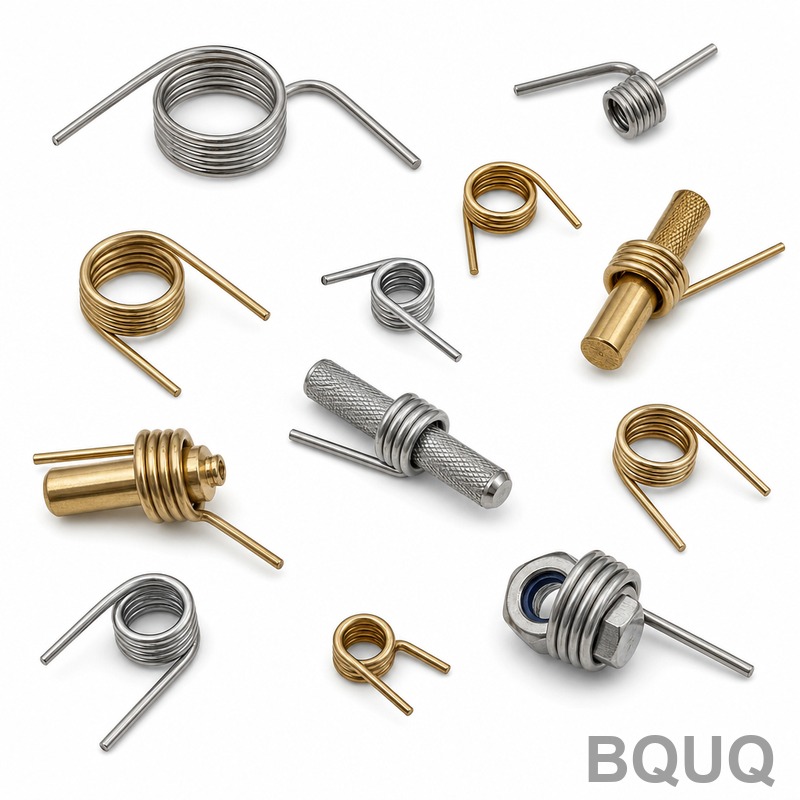
Can I use SMI guidelines for torsion springs? Yes, SMI provides torsion spring design formulas and tolerance tables in its Handbook. For production, combine SMI design with ASTM A228 material and add your own dimensional tolerances, as SMI tolerances are not contractual.
Contact BQUQ for a free standard cross-reference chart for your specific spring design. We provide 12-hour quoting on complete specifications. Email: sc@bquq.com, WhatsApp: +86 13713157787, www.bquq.com.
Conclusion
ASTM, SMI, and JIS are complementary, not interchangeable. ASTM defines material quality and test methods, SMI guides design and tolerance selection, and JIS provides metric dimensional standards with three clear tolerance classes. The correct choice depends on your operating environment, fatigue requirements, and supply chain location. A spring specified to the wrong standard will either fail prematurely or cost 30% more than necessary. Engineers should document the standard, grade, and class on every spring drawing and verify supplier compliance with first-article inspection. BQUQ maintains full traceability to all three standards and can provide material certificates and inspection reports within 5 days of order confirmation.