What Are the Essential Spring Design Calculations for Precision Manufacturing?
The essential spring design calculations are the spring rate (k), shear stress (τ), and deflection (δ), which are determined using the wire diameter, mean coil diameter, number of active coils, and material shear modulus. For a standard compression spring, the spring rate is calculated as k = (G × d⁴) / (8 × D³ × Na), where G is the shear modulus, d is wire diameter, D is mean coil diameter, and Na is the number of active coils. These calculations form the foundation for ensuring that a spring meets its required load, deflection, and fatigue life within the tight tolerances of precision manufacturing.
What Basic Formulas Define Compression Spring Design?
The fundamental compression spring calculations involve three interrelated equations. The spring rate formula is k = (G × d⁴) / (8 × D³ × Na), where G for common spring steels like ASTM A228 music wire is 79.3 GPa (11.5 × 10⁶ psi). The shear stress at the inner fiber is τ = (8 × F × D × Kw) / (π × d³), where F is the applied load and Kw is the Wahl correction factor accounting for curvature and direct shear. The deflection is simply δ = F / k, which allows engineers to predict how much a spring compresses under a given load. For example, a spring with d = 2.0 mm, D = 15 mm, and Na = 6 active coils made from music wire yields a spring rate of k = (79,300 × 2.0⁴) / (8 × 15³ × 6) = 7.84 N/mm, meaning a 50 N load produces a deflection of 6.38 mm.
How Do You Calculate the Wahl Correction Factor for Curvature?
The Wahl correction factor (Kw) is critical because it accounts for the increased stress on the inner surface of a coiled spring due to curvature and direct shear. The formula is Kw = (4C - 1) / (4C - 4) + 0.615 / C, where C is the spring index (D/d). For a spring index of 7.5 (C = 15/2.0), the Wahl factor calculates to Kw = (30 - 1) / (30 - 4) + 0.615 / 7.5 = 1.115 + 0.082 = 1.197. This means the actual maximum shear stress is 19.7% higher than the simple torsion formula would suggest, a difference that can mean the difference between a spring lasting 1,000,000 cycles and failing at 50,000 cycles. In precision applications, ignoring Kw can lead to premature fatigue failure, especially in high-cycle springs used in automotive valve trains or medical devices.
Why Is the Spring Index (C) Critical for Manufacturability?
The spring index (C = D/d) directly affects both performance and manufacturability, and optimal values typically range from 4 to 12. A spring index below 4 creates excessive stress concentration and makes coiling difficult, while an index above 12 leads to buckling instability and inconsistent coil spacing. For CNC coiling machines at BQUQ, we hold spring index tolerances to ±0.25 for indices between 5 and 10, which ensures consistent spring rates within ±2%. For example, a spring with d = 1.5 mm and D = 12 mm has C = 8, which is ideal; the same wire with D = 30 mm gives C = 20, which is prone to lateral buckling under compression. When C exceeds 12, we recommend adding internal or external guides, or redesigning with a larger wire diameter and smaller coil diameter.
How Do You Determine the Maximum Allowable Shear Stress for Fatigue Life?
Maximum allowable shear stress depends on the material and the required fatigue life, and values are typically 45% to 60% of the material's ultimate tensile strength for static applications. For ASTM A228 music wire with a tensile strength of 2,300 MPa at 2.0 mm diameter, the allowable static shear stress is approximately 1,150 MPa (50% of tensile), but for 10⁷ cycle fatigue life, this drops to about 350 MPa. The Goodman diagram approach is standard: τ_max = τ_allowable / (1 - τ_min / τ_ultimate), where you must know both the minimum and maximum operating stresses. For a precision spring operating between 100 N and 200 N, the mean stress and alternating stress must be plotted against the material's endurance limit, which for spring steels is approximately 0.3 × ultimate tensile strength. BQUQ recommends a design safety factor of 1.5 for fatigue-critical springs, meaning the calculated stress should not exceed 233 MPa for a 10⁷ cycle life in music wire.
Which Materials Offer the Best Performance for Precision Springs?
Material selection drives both cost and performance, and the table below compares common spring materials used in precision manufacturing:
| Material | Shear Modulus (GPa) | Max Service Temp (°C) | Tensile Strength (MPa) | Relative Cost Factor | Typical Applications |
| ASTM A228 Music Wire | 79.3 | 120 | 2,100–2,500 | 1.0 | Precision instruments, automotive |
| ASTM A313 302 Stainless | 68.9 | 260 | 1,200–1,800 | 1.8 | Corrosive environments, medical |
| ASTM A401 Chrome Silicon | 79.3 | 225 | 1,800–2,100 | 1.5 | High-stress shock loads |
| Inconel X-750 | 75.8 | 540 | 1,000–1,400 | 8.0 | High-temperature aerospace |
| Beryllium Copper | 48.3 | 200 | 1,200–1,400 | 6.5 | Electrical contacts, non-magnetic |
The choice of material dramatically affects the spring rate calculation because the shear modulus (G) changes the stiffness proportionally. For example, switching from music wire (G = 79.3 GPa) to 302 stainless steel (G = 68.9 GPa) reduces the spring rate by 13.1% for identical geometry, requiring a redesign to maintain the same load characteristics. In high-temperature environments above 120°C, music wire loses its tensile strength rapidly, making chrome silicon or Inconel necessary despite the higher material cost.
How Do You Calculate Buckling Stability for Long Compression Springs?
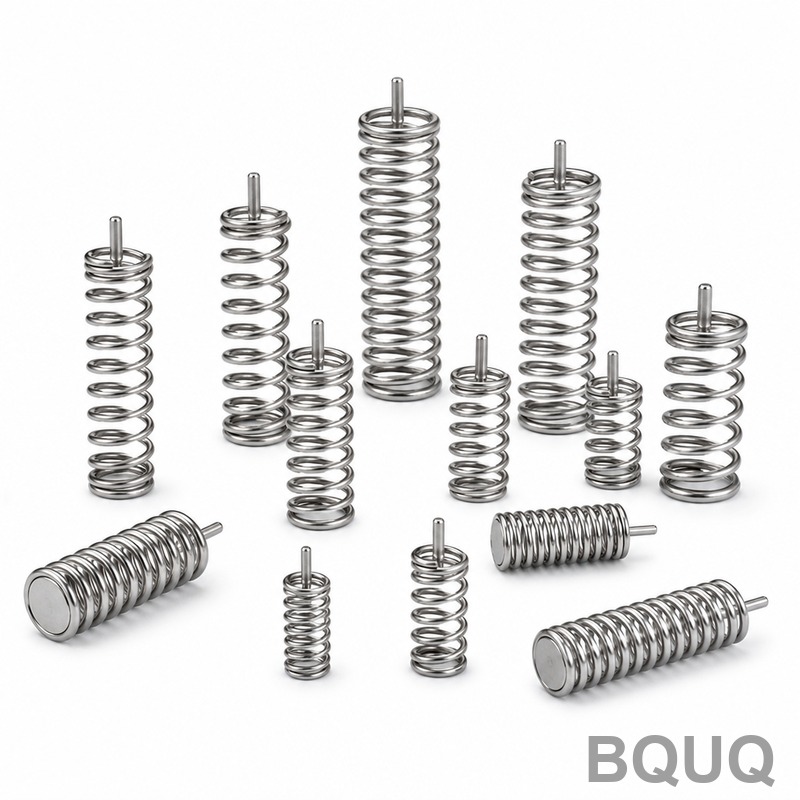
Buckling is a critical failure mode for compression springs with a free length (Lf) to mean diameter (D) ratio exceeding 4, and the critical buckling load is calculated using the slenderness ratio. The critical load (Fcr) is Fcr = (π² × EI) / (4 × Lf²), where E is the modulus of elasticity (206 GPa for steel) and I is the second moment of area of the wire (πd⁴/64). For a spring with d = 3.0 mm, D = 24 mm, and Lf = 120 mm, the slenderness ratio is 5.0, which requires checking: I = π × 3.0⁴ / 64 = 3.98 mm⁴, so Fcr = (π² × 206,000 × 3.98) / (4 × 120²) = 140.3 N. If the working load exceeds this value, the spring will bow laterally, so we recommend adding a guide rod or sleeve whenever Lf/D > 4 and the load exceeds 60% of Fcr. In practice, BQUQ uses an end-condition factor of 2 for springs with squared and ground ends, which allows a 12% higher critical load compared to plain ends.
How Do You Calculate the Number of Active Coils for a Target Spring Rate?
To achieve a specific spring rate, the number of active coils (Na) is calculated by rearranging the spring rate formula: Na = (G × d⁴) / (8 × D³ × k). For example, if you need a spring rate of 10 N/mm using 2.5 mm wire with a mean diameter of 18 mm in music wire, Na = (79,300 × 2.5⁴) / (8 × 18³ × 10) = (79,300 × 39.06) / (8 × 5,832 × 10) = 3,097,458 / 466,560 = 6.64 active coils. Since active coils must be a half-coil increment for proper end seating, you would use 6.5 or 7.0 coils, and the actual spring rate would be 10.20 N/mm or 9.46 N/mm respectively. Total coils (Nt) equals active coils plus 2 for squared and ground ends, so a 6.5 active coil spring has 8.5 total coils, and the solid height is Hs = Nt × d = 8.5 × 2.5 = 21.25 mm, which must be less than the maximum compressed height in your design envelope.
What Are the Tolerance Standards for Precision Spring Manufacturing?
Precision springs typically require tighter tolerances than general industrial springs, and BQUQ manufactures to DIN 2095 Grade 1 and 2 standards depending on application. For wire diameters between 1.0 and 3.0 mm, the diameter tolerance is ±0.02 mm for Grade 1 and ±0.05 mm for Grade 2, while the free length tolerance is ±1.0% for Grade 1 and ±2.0% for Grade 2. The spring rate tolerance is typically ±5% for precision applications, but we can achieve ±2% with CNC coiling and 100% load testing on every spring. Load tolerance at a specified deflection is ±5% for Grade 1 and ±10% for Grade 2, which is critical for matching springs in matched sets for valve applications. For high-volume metal stamping of spring clips and washers, we hold flatness tolerances of 0.05 mm and burr height below 0.03 mm.
What Is the Difference Between Active and Total Coils in a Spring?
Active coils (Na) are the coils that actually deflect under load and contribute to the spring rate, while total coils (Nt) include the inactive end coils that are squared and ground for seating. For a spring with squared and ground ends, Nt = Na + 2, and the two end coils do not contribute to deflection because they are in contact with the seating surfaces. The solid height is calculated using total coils, and the maximum deflection before coil binding is the free length minus the solid height.
How Does Shot Peening Improve Spring Fatigue Life?
Shot peening introduces compressive residual stresses on the spring surface, which can increase fatigue life by 30% to 50% compared to unpeened springs. The process involves bombarding the spring surface with small steel shots at high velocity, creating a compressive layer that resists crack initiation and propagation. For precision springs operating above 200 MPa alternating stress, BQUQ recommends shot peening with an intensity of 0.15 to 0.25 mm Almen A and full coverage of at least 98%.
Can Spring Rate Be Adjusted After Manufacturing?
Yes, spring rate can be adjusted by changing the number of active coils, wire diameter, or mean coil diameter, but these are permanent changes that require re-manufacturing. The most common field adjustment is setting (pre-stressing) the spring by compressing it to solid height, which can increase the load capacity by 5% to 15% due to induced residual stresses. However, for precision applications, we recommend ordering springs with a slightly higher spring rate and then removing material from the end coils to fine-tune, though this is only practical for low-volume prototype runs.
When Should You Use a Spring with Closed and Ground Ends?
Closed and ground ends are required when the spring must stand perpendicular to its seating surface or when the load must be uniformly distributed across the end coil. This end finish adds approximately 10% to 15% to the manufacturing cost but is essential for precision applications where angular misalignment of less than 1 degree is required. For springs with a free length to diameter ratio above 4, closed and ground ends also reduce the risk of buckling by providing a stable flat seating surface.
What Is the Maximum Operating Temperature for Standard Spring Materials?
The maximum continuous operating temperature for music wire is 120°C, above which the material begins to lose its tensile strength and set permanently. Chrome silicon steel can operate up to 225°C, while 302 stainless steel is rated for 260°C, and Inconel X-750 can handle 540°C. For temperatures above 540°C, you would need ceramic or refractory metal springs, which are typically not cost-effective for commercial applications.
How Do You Calculate the Natural Frequency to Avoid Resonance Failure?
The natural frequency of a spring in Hertz is f = (1/2π) × √(k / m_effective), where m_effective is one-third of the spring mass plus any attached mass. For a spring with k = 10 N/mm and a total mass of 0.05 kg, the natural frequency is approximately f = (1/6.283) × √(10,000 / 0.0167) = 123.4 Hz. If the operating frequency is above 80% of the natural frequency, the spring will experience surging and premature failure, so you must either increase the spring rate, reduce the mass, or add internal damping.
For precision spring design, always verify your calculations with finite element analysis for complex geometries and rely on empirical testing for new materials. At BQUQ, our 20 years of experience in CNC machining, metal stamping, and spring manufacturing ensures that we can produce springs with spring rate tolerances of ±2% and wire diameters from 0.1 mm to 12 mm. We recommend providing your full operating envelope, including minimum and maximum loads, deflection range, operating temperature, and fatigue life requirements, so our engineers can optimize the design for both performance and manufacturability. Contact us for a free design review and quotation within 12 hours at sc@bquq.com or WhatsApp +86 13713157787, and visit www.bquq.com for our full manufacturing capabilities.