What Are the Key Trends and Technologies Shaping Spring Manufacturing?
Spring manufacturing has evolved from a purely mechanical craft into a precision-driven industry integrating metallurgy, CNC coiling, and automated inspection. The key trends are the adoption of CNC multi-axis coiling, the use of high-performance alloys, and a shift toward in-process statistical quality control to achieve tolerances of ±0.01 mm. These changes are driven by demand from automotive and electronics sectors for higher fatigue life and miniaturization.
What Are the Primary Spring Manufacturing Processes Used Today?
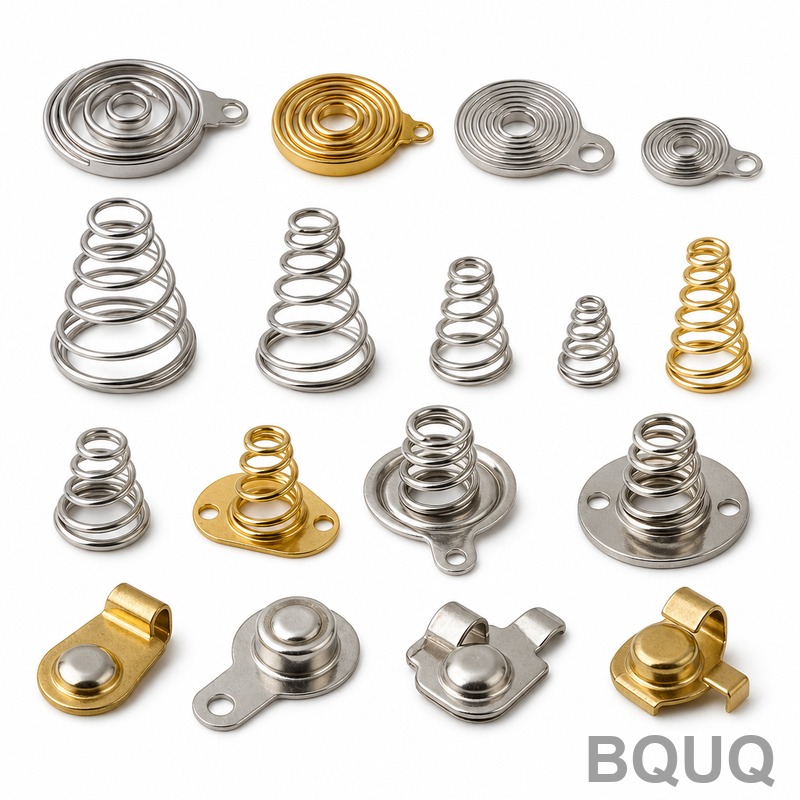
The dominant processes are CNC coiling (both compression and extension), CNC torsion spring winding, and four-slide forming for complex wire forms. CNC coiling machines now handle wire diameters from 0.05 mm to 20 mm at production speeds of up to 120 parts per minute for small springs. For high-volume runs, multi-station die-less coiling machines reduce setup time to under 15 minutes, a 70% reduction compared to conventional cam-operated machines from a decade ago. Precision grinding remains essential for compression springs requiring squareness within 0.5 degrees and flatness of 0.02 mm on bearing surfaces.
How Has Spring Metallurgy Advanced to Improve Fatigue Life?
Modern alloys have shifted from standard carbon steel to micro-alloyed steels and precipitation-hardening stainless steels. For example, 17-7 PH stainless steel springs achieve a tensile strength of 1,650 MPa after heat treatment at 480°C, compared to 1,200 MPa for standard AISI 302. Shot peening with ceramic beads at 0.6 mm diameter and 8-12 A intensity can double fatigue life by introducing compressive residual stress of 600-800 MPa on the surface. Additionally, vacuum heat treatment at 1,040°C with nitrogen gas quenching reduces decarburization to less than 0.01 mm, preserving surface integrity critical for cyclic loading above 10 million cycles.
Which Industries Are Driving the Latest Spring Technology Demands?
The electric vehicle (EV) and medical device sectors are the primary drivers. EV battery contact springs require electrical conductivity above 20% IACS and contact resistance below 15 milliohms, pushing manufacturers toward beryllium copper and silver-nickel composites. Medical springs, such as those in insulin pens and surgical staplers, demand biocompatible materials like MP35N and Elgiloy, with surface finish requirements of Ra 0.4 µm and zero burrs. The aerospace industry is pushing for springs that operate at 300°C continuously, leading to adoption of Inconel X-750 with a stress relaxation rate below 2% after 100 hours at 260°C.
How Does Automation and AI Impact Spring Quality Control?
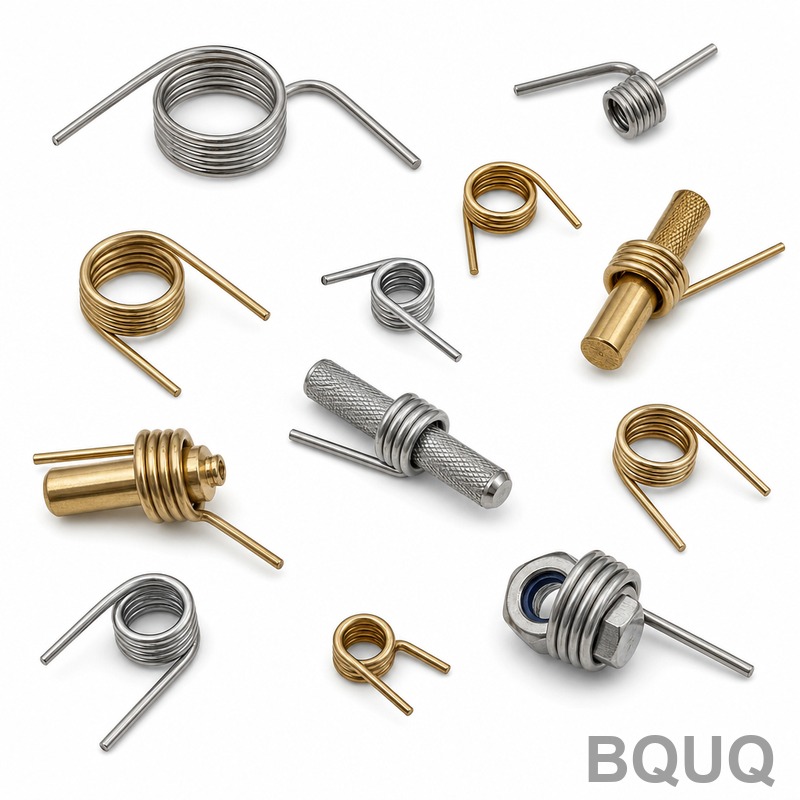
Vision inspection systems now measure coil diameter, pitch, and free length at rates of 300 parts per minute with an accuracy of ±0.005 mm. AI-based process control uses real-time data from laser micrometers to adjust CNC coiling parameters such as feed rate and mandrel position within 50 milliseconds. This reduces scrap rates from the historical 3-5% down to 0.8% for complex torsion springs. Furthermore, statistical process control (SPC) software tracks up to 14 dimensional characteristics per spring, enabling CpK values consistently above 1.67 for automotive-grade parts.
What Are the Cost Drivers for Modern Spring Production?
Material cost is the largest driver, accounting for 40-60% of total piece price, followed by tooling and heat treatment. For a typical 2 mm diameter compression spring, material costs range from $0.05 to $0.15 per piece, while CNC coiling adds $0.02 to $0.08 per piece depending on tolerance class. Tooling for a new spring design varies from $500 for simple coiling forms to $5,000 for complex four-slide tooling with multiple bending stages. Heat treatment and surface finishing, such as zinc plating or electropolishing, add $0.01 to $0.05 per piece. Lead times for prototypes are 3-5 days, while production runs of 50,000 pieces require 2-3 weeks.
Why Is Surface Treatment Critical for Spring Performance?
Surface treatments extend fatigue life and provide corrosion resistance. Zinc plating with trivalent passivation offers 100 hours of salt spray resistance, while zinc-nickel alloy coating extends this to 500 hours. For high-temperature applications, black oxide or phosphate coatings provide a lubricating layer that reduces friction during compression by 15%. Electropolishing removes 0.01-0.02 mm of surface material, eliminating micro-cracks that initiate fatigue fractures. The choice of treatment depends on operating temperature, with PTFE coatings recommended for temperatures below 260°C and molybdenum disulfide for higher temperatures.
Which Emerging Technologies Will Define the Next Decade of Spring Manufacturing?
Additive manufacturing, specifically laser powder bed fusion, is emerging for prototype springs with complex geometries that cannot be coiled, such as variable-pitch springs with integrated end hooks. However, production costs remain 10-20 times higher than CNC coiling, limiting use to aerospace and medical prototyping. Digital twin technology is being implemented to simulate spring performance under cyclic loading, predicting fatigue failure within 5% accuracy before physical testing. Additionally, wire arc additive manufacturing is being explored for large springs above 20 mm wire diameter, where conventional coiling equipment is limited.
| Process Parameter | Typical Value | Tolerance / Accuracy | Notes |
| Wire diameter range | 0.05 - 20 mm | ±0.002 mm | Dependent on machine model |
| Coiling speed (small springs) | 80 - 120 parts/min | ±1% | For wire diameter below 1.0 mm |
| Free length tolerance (compression) | Up to 50 mm | ±0.05 mm | Precision class per DIN 2095 |
| Heat treatment temperature | 300°C - 480°C | ±5°C | For 17-7 PH and carbon steels |
| Shot peening intensity | 8 - 12 A | ±0.5 A | Almen strip verification |
| Vision inspection rate | 300 parts/min | ±0.005 mm | For coil diameter and pitch |
| Scrap rate with AI control | 0.8% | - | Down from 3-5% without AI |
| Prototype lead time | 3 - 5 days | - | For CNC coiling without tooling |
How Should Engineers Select a Spring Manufacturer for Future-Ready Products?
Engineers should verify the manufacturer’s capability in three areas: metallurgical expertise, machine versatility, and data traceability. First, request material certifications and heat treatment curves to ensure the alloy matches your fatigue requirements. Second, confirm that the manufacturer has both CNC coilers and four-slide presses to handle design iterations without tooling changes. Third, require SPC data for each production lot, including CpK values for critical dimensions. A manufacturer with in-house wire straightening and surface treatment facilities will reduce lead times by 5-7 days per order. Finally, ask for a failure mode and effects analysis (FMEA) on your specific spring design to identify potential fatigue or relaxation issues before committing to tooling.
FAQ Section
Can Springs Be Manufactured to a Tolerance of ±0.005 mm?
Yes, but only for specific dimensions such as wire diameter and coil inner diameter, using CNC coiling with laser feedback. Full dimensional tolerance at this level is achievable for springs under 10 mm in length, but production costs increase by 40-60%. For most industrial applications, ±0.01 mm on free length and ±0.02 mm on outer diameter is considered precision grade.
What Is the Minimum Order Quantity for Custom Springs?
Most CNC spring manufacturers accept a minimum order quantity of 100 pieces for standard designs without tooling. For complex springs requiring new tooling, a minimum of 500 pieces is common to amortize tooling costs. Some manufacturers offer prototype services at 10-50 pieces, but the per-piece price will be 3-5 times higher than production pricing.
How Long Does a Spring Tool Last Before Replacement?
A CNC coiling mandrel typically lasts for 200,000 to 500,000 cycles before wear affects dimensional accuracy. For four-slide forming tools, the lifespan is shorter, around 100,000 to 200,000 cycles, due to bending and stamping wear. Hardened tool steel with titanium nitride coating can extend tool life by 50% compared to uncoated tools.
Which Spring Material Is Best for High-Temperature Environments?
Inconel X-750 is the preferred choice for continuous operation at 300°C to 650°C, maintaining 80% of its room-temperature strength. For temperatures below 300°C, 17-7 PH stainless steel offers a cost-effective alternative with good corrosion resistance. Elgiloy is recommended for temperatures up to 400°C with excellent fatigue resistance but at a higher material cost.
When Is Shot Peening Required for Springs?
Shot peening is required for springs subjected to cyclic loading above 100,000 cycles or operating at high stress levels exceeding 50% of tensile strength. It is particularly critical for valve springs in automotive engines and suspension springs in heavy-duty vehicles. For static applications or springs with low stress, shot peening can be omitted to save cost.
How Does Spring Rate Change with Temperature?
Spring rate decreases linearly as temperature increases, with a typical reduction of 0.03% per degree Celsius for carbon steel. For Inconel X-750, the reduction is only 0.01% per degree Celsius, making it suitable for precision applications at elevated temperatures. Engineers should specify the operating temperature range in the design to ensure the manufacturer selects the appropriate alloy.
Can Springs Be Manufactured with Non-Circular Wire Shapes?
Yes, rectangular and square wire springs are manufactured using specialized coiling machines with pre-rolled wire. These springs offer higher load capacity in limited space, with a 20-30% increase in stiffness compared to round wire of the same cross-sectional area. Tolerance on wire width and thickness is typically ±0.01 mm, and rectangular wire springs require careful stress relief to prevent torsional warping.
The spring manufacturing industry is entering an era of data-driven precision, where AI process control and advanced metallurgy enable performance levels previously unattainable. To remain competitive, product designers must partner with manufacturers that invest in CNC automation, in-process inspection, and material science expertise. For your next spring project, request a design review and quotation to validate feasibility and cost.
Contact BQUQ for a 12-hour quote: Email us at sc@bquq.com or reach us on WhatsApp at +86 13713157787. Visit www.bquq.com to explore our 20-year track record in CNC machining, metal stamping, springs, and heat sinks.
Related Articles
- Size control and online intelligent detection technology of precision spring
- In-depth analysis of technology and process in the hardware spring industry in 2026: a full-dimensional interpretation of high stress, functional integration and engineering certification
- From "standard parts" to "functional parts": 2026 hardware spring industry technology trends and functional innovation engineering direction