What Is a Conical Spring and How Does It Save Space?
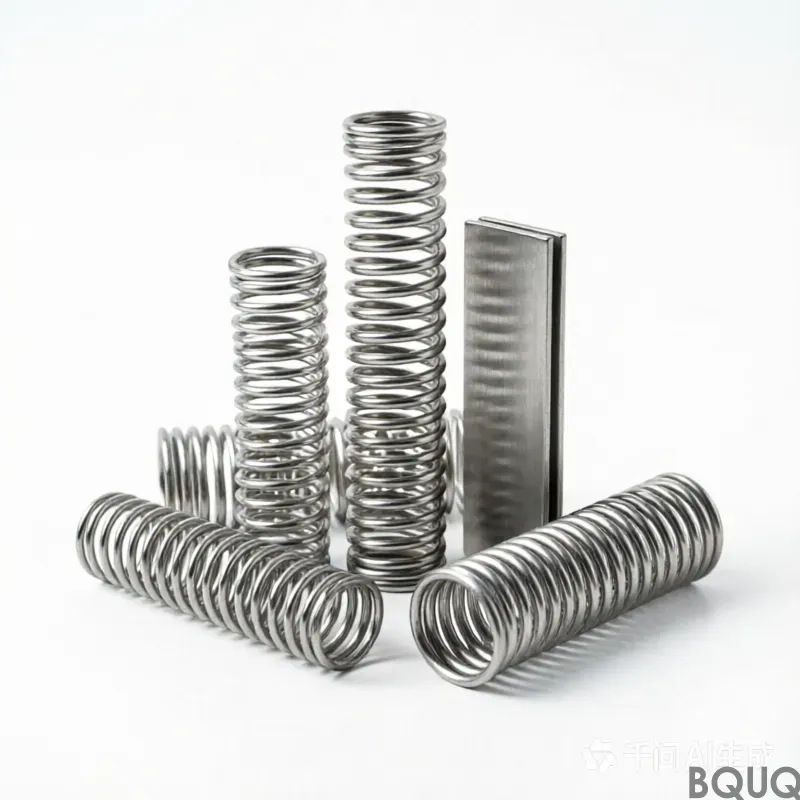
A conical spring is a coil spring wound with a progressively decreasing or increasing diameter along its length, resembling a cone shape. Unlike cylindrical springs, its coils nest into one another when compressed, allowing the spring to achieve a much shorter solid height than its free height. This unique geometry provides a progressive spring rate, meaning resistance increases as the spring compresses, making it ideal for applications with limited axial space and variable load requirements.
What Are the Key Dimensions and Tolerances of a Conical Spring?
Conical springs are defined by four critical dimensions: the large end diameter, the small end diameter, the free length (uncompressed height), and the wire diameter. For precision applications, BQUQ manufactures conical springs with a large end diameter ranging from 3 mm to 200 mm, while the small end diameter can be as small as 1.5 mm. The standard tolerance for coil diameter is ±0.1 mm for wire diameters under 1.0 mm, and ±0.2 mm for larger wires.
Free length tolerances are typically held to ±1% of the nominal dimension, or ±0.15 mm, whichever is greater. The wire diameter itself follows standard spring wire tolerances, such as ±0.02 mm for 0.5 mm wire and ±0.05 mm for 3.0 mm wire. Surface finish requirements often specify a maximum roughness of Ra 1.6 micrometers for fatigue-critical applications. For high-volume production, optical sorting machines verify these dimensions at a rate of 100 parts per minute, ensuring statistical process control within a Cpk value of 1.33 or higher.
How Does a Conical Spring Achieve a Progressive Spring Rate?
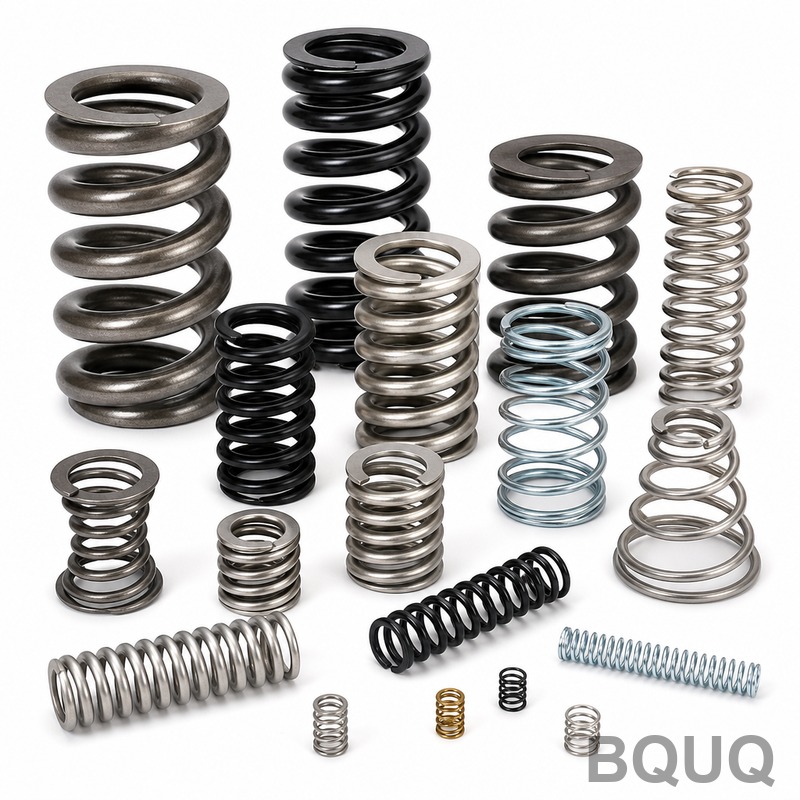
The progressive rate is achieved through the varying coil diameters, which cause the smaller coils to touch (go solid) before the larger coils. When the spring is compressed, the tightly wound smaller-diameter coils at one end begin to stack against each other, effectively removing those active coils from the load path. This reduces the number of active coils, which mathematically increases the spring rate (k) for the remaining active portion.
For example, a conical spring with 8 active coils might have only 5 active coils remaining after the first 20% of its deflection. The initial rate might be 10 N/mm, but after the first 5 mm of travel, the rate can jump to 25 N/mm. This nonlinear behavior is precisely calculated using finite element analysis, and BQUQ typically holds the rate tolerance to ±5% of the calculated value at any given deflection point. The design can be tailored so that the rate increases linearly, parabolically, or in a custom curve, depending on the coil pitch and diameter progression.
Which Materials Are Best Suited for Conical Spring Manufacturing?
The material choice depends on the operating environment, required fatigue life, and cost constraints. Oil-tempered chrome silicon wire (ASTM A401) is the most common choice for automotive and industrial applications due to its high tensile strength (up to 2,100 MPa for 2.0 mm wire) and excellent fatigue resistance. Stainless steel grades like 302 and 316 are preferred for corrosive environments, offering a maximum operating temperature of 290°C for 302 grade.
For high-temperature applications above 300°C, Inconel X-750 is used, maintaining its spring properties up to 650°C, though the material cost is approximately 8 to 10 times that of chrome silicon. Music wire (ASTM A228) offers the highest tensile strength (up to 2,500 MPa for thin wires) but is limited to temperatures below 120°C. The table below compares the typical properties of common conical spring materials:
| Material | Tensile Strength (MPa) | Max Temp (°C) | Relative Cost | Common Application |
| Music Wire ASTM A228 | 2,300 - 2,500 | 120 | 1.0x | Precision electronics, small mechanisms |
| Oil-Tempered Chrome Silicon | 1,800 - 2,100 | 230 | 1.3x | Automotive suspension, industrial valves |
| Stainless Steel 302 | 1,500 - 1,800 | 290 | 2.0x | Medical devices, food processing |
| Stainless Steel 316 | 1,200 - 1,500 | 300 | 2.5x | Marine, chemical exposure |
| Inconel X-750 | 1,000 - 1,200 | 650 | 9.5x | Jet engines, high-temp exhaust systems |
Why Use a Conical Spring Instead of a Standard Cylindrical Spring?
The primary advantage is space efficiency. A conical spring can compress to a solid height nearly equal to the wire diameter multiplied by the number of coils, whereas a cylindrical spring's solid height is the same, but its free length-to-solid ratio is limited by the need to avoid buckling. For a given force and deflection, a conical spring can be up to 40% shorter in free length than a cylindrical spring performing the same job.
Additionally, the progressive rate provides a dual-function capability: a soft initial rate for vibration isolation at low loads, and a stiffer rate for bottoming-out protection at high loads. This eliminates the need for a secondary spring or a bump stop, reducing assembly complexity and part count. For example, in a valve train, a conical spring can control valve bounce at high RPM while still providing sufficient seat pressure at idle, something a linear-rate cylindrical spring cannot achieve without additional components.
When Does a Conical Spring Require Special Tooling or Manufacturing Considerations?
Custom tooling is required when the spring's free length-to-mean-diameter ratio exceeds 4:1, as this creates coiling instability. In such cases, BQUQ uses CNC coiling machines with servo-controlled pitch tools that can adjust the pitch in real-time, maintaining accuracy to ±0.05 mm per coil. When the small end diameter is less than 3 times the wire diameter, special mandrels are needed to prevent wire distortion during coiling.
For springs requiring a ground flat surface on both ends, a double-disc grinding process is used, achieving a squareness tolerance of 2 degrees or better. When the spring operates at high cyclic frequencies (above 10 Hz), shot peening is recommended to induce compressive residual stresses, increasing fatigue life by up to 300%. This process adds approximately $0.50 to $2.00 per part depending on size and quantity. Heat setting (pre-stressing) is another option for conical springs that must maintain their dimensions under continuous load at elevated temperatures.
How Much Does a Custom Conical Spring Cost?
The cost of a custom conical spring is driven by wire diameter, material, quantity, and finishing requirements. For a typical chrome silicon conical spring with a 2.0 mm wire diameter, expect a unit price of $0.80 to $2.50 for quantities of 10,000 pieces. Low-volume prototypes (10 to 50 pieces) will cost between $50 and $150 each due to setup and tooling amortization. Tooling (coiling cams, mandrels, and feed rolls) for a custom conical spring typically ranges from $300 to $1,200, which is significantly lower than stamping or machining tooling.
| Quantity | Unit Price (USD, 2.0mm wire) | Lead Time (Days) | Tooling Cost |
| 10 - 50 (Prototype) | $50 - $150 | 5 - 7 | Included |
| 500 - 1,000 | $5 - $12 | 10 - 14 | $300 - $800 |
| 5,000 - 10,000 | $1.50 - $4.00 | 15 - 20 | $300 - $800 |
| 50,000+ | $0.80 - $2.50 | 20 - 30 | $500 - $1,200 |
The price variation depends on whether the spring requires shot peening, grinding, or a specialized surface coating such as zinc nickel plating, which adds $0.10 to $0.30 per part. For high-volume orders, BQUQ can reduce costs by using multi-station former machines that produce 60 to 120 parts per minute, compared to 15 to 30 parts per minute on standard CNC coiling machines.
Can a Conical Spring Be Designed for Extreme Deflection Ratios?
Yes, conical springs can be designed to compress to 15% to 20% of their free length, whereas a cylindrical spring typically bottoms out at 50% to 60% of its free length. This extreme deflection capability is achieved by designing the coil pitch so that the small-diameter coils nest completely inside the larger-diameter coils. The maximum compression ratio is physically limited by the wire diameter and the number of coils; with 10 active coils, a solid height of 10 times the wire diameter is the theoretical minimum.
For example, a conical spring with a free length of 100 mm and a wire diameter of 2.0 mm can be designed to compress to a solid height of only 20 mm, a 5:1 deflection ratio. This is critical in applications like electric vehicle battery contact systems, where space is at a premium and a high contact force is needed in a short travel distance. BQUQ has produced conical springs with deflection ratios up to 6.5:1 using specially annealed wire and precision ground ends, though such extreme designs require rigorous prototype testing to validate stress levels.
FAQ Section
What Is the Maximum Load Capacity of a Conical Spring?
The maximum load capacity depends on the wire diameter, material, and the stress at solid height. For a 3.0 mm chrome silicon wire conical spring, the maximum load can reach 2,500 N, while a 0.5 mm music wire spring may only handle 50 N. The design stress limit is typically set at 60% of the material's tensile strength to ensure a minimum fatigue life of 10 million cycles.
How Long Does a Conical Spring Last in Cyclic Applications?
A properly designed conical spring with shot peening can achieve over 10 million cycles at a stress amplitude of 50% of tensile strength. Without shot peening, the fatigue life drops to approximately 1 to 2 million cycles. Operating temperature also affects fatigue life; at 150°C, chrome silicon springs lose about 20% of their fatigue strength compared to room temperature operation.
Which Industries Commonly Use Conical Springs?
Conical springs are widely used in automotive transmissions, valve trains, and suspension systems, as well as in aerospace landing gear, medical devices, and electrical switchgear. They are also found in vibration isolators for industrial machinery and in battery contacts for portable electronics. Their space-saving design makes them a first choice in any application where axial length is restricted.
Can Conical Springs Be Made with a Variable Wire Diameter?
Yes, although it is a specialized process, tapered wire conical springs can be manufactured. The wire is ground or rolled to a smaller diameter at one end before coiling, which allows for an even more controlled stress distribution. This process increases cost by 30% to 50% compared to standard conical springs and extends lead time by 3 to 5 days.
What Are the Common Failure Modes of Conical Springs?
The most common failure is fatigue fracture at the inner surface of the smallest active coil, where stress concentration is highest. Surface defects such as scratches or pits from poor handling can reduce fatigue life by 50%. Another failure mode is stress relaxation (loss of free length) when operating above the material's maximum temperature for extended periods.
How Should a Conical Spring Be Specified on an Engineering Drawing?
A complete specification must include: large and small outside diameters, free length, wire diameter, total coils, active coils, spring rate at specific deflection points, material grade, surface finish, and end condition (closed and ground or closed not ground). You should also specify the direction of helix (right or left hand) and any required presetting or shot peening processes.
Does BQUQ Provide Free Design Assistance for Conical Springs?
Yes, BQUQ offers free engineering consultation and design review for any conical spring application. Our engineers can provide a preliminary design and cost estimate within 24 hours of receiving your load, deflection, and space requirements. We are happy to recommend material and finishing options to optimize performance and cost.
Conclusion
Conical springs are the optimal solution when axial space is limited and a progressive spring rate is required. By allowing coils to nest at solid height, they achieve up to a 5:1 compression ratio, far exceeding cylindrical springs, while providing a variable rate that adapts to changing load conditions. With proper material selection and manufacturing processes like shot peening, these springs deliver reliable, long-lasting performance in demanding applications. When you need a custom conical spring with tight tolerances and fast turnaround, BQUQ's 20 years of precision manufacturing experience ensures your design is produced right the first time. Contact us for a quote within 12 hours at sc@bquq.com or WhatsApp +86 13713157787, or visit www.bquq.com to submit your drawings.
Related Articles
- Size control and online intelligent detection technology of precision spring
- In-depth analysis of technology and process in the hardware spring industry in 2026: a full-dimensional interpretation of high stress, functional integration and engineering certification
- From "standard parts" to "functional parts": 2026 hardware spring industry technology trends and functional innovation engineering direction