What Is Burr in Metal Stamping and How Do You Control It?
A burr in metal stamping is an unwanted raised edge or small piece of material that remains attached to a workpiece after the cutting or shearing process. Burrs form when the punch and die clearance is incorrect, tooling becomes worn, or the material exceeds its tensile strength during fracture, and they are controlled through optimized die clearance, regular tool maintenance, and secondary deburring processes that can achieve edge radii under 0.05 mm.
What Are the Different Types of Burrs Found in Stamped Parts?
In metal stamping, burrs are classified primarily by their formation mechanism and location on the part. The most common types are roll-over burrs, which form on the punch entry side as the material bends before fracture; fracture burrs, which occur on the die exit side where the material separates; and tear burrs, which appear when the material is pulled rather than sheared cleanly. For high-strength steels over 600 MPa tensile strength, fracture burrs dominate and can reach heights of 10% to 15% of the material thickness if clearance is not optimized. Additionally, you may encounter edge burrs along sheared contours, punch-out burrs inside holes, and progressive burrs that accumulate when a stamping die runs beyond its recommended 200,000 to 500,000 stroke maintenance interval.
How Does Die Clearance Affect Burr Formation?
Die clearance, defined as the gap between the punch and die opening, is the single most influential factor in burr control. For mild steel (SPCC, Q235) with a thickness of 1.0 mm, optimal clearance is typically 5% to 8% of material thickness per side, or 0.05 mm to 0.08 mm. If clearance is too small (under 4%), the material undergoes excessive compression, creating secondary shear zones and large roll-over burrs that can exceed 0.15 mm. Conversely, if clearance is too large (over 12%), the material bends excessively before fracture, producing tall fracture burrs that may reach 0.20 mm or more. For stainless steel (SUS304), clearance should be increased to 8% to 10% per side due to its higher work-hardening rate, while for aluminum (5052-H32), clearance of 4% to 6% per side is recommended to minimize tearing. In precision stamping operations at BQUQ, we maintain clearance tolerances of ±0.01 mm using wire-cut die inserts to keep burr height below 0.03 mm for automotive components.
Why Does Tooling Wear Increase Burr Size Over Time?
Tooling wear progressively dulls the cutting edges of the punch and die, increasing the radius of the cutting edge from an ideal 0.01 mm to 0.10 mm or more after extended production runs. As the edge radius grows, the material is pushed rather than sheared, causing plastic deformation that results in larger roll-over burrs and inconsistent fracture lines. For example, a progressive die stamping 2.0 mm thick cold-rolled steel will produce burrs under 0.05 mm for the first 150,000 strokes, but without maintenance, burr height can triple to 0.15 mm by 400,000 strokes. The wear rate accelerates with abrasive materials like galvanized steel, which can reduce tool life by 30% compared to uncoated steel, and with stamping speeds above 200 strokes per minute where heat at the cutting edge exceeds 300°C. Regular maintenance, including re-grinding of punch faces every 100,000 to 200,000 strokes and replacement of worn die bushings, is essential to maintain burr control and part quality.
Which Materials Are Most Prone to Burr Defects?
Materials with high ductility and work-hardening rates are inherently more prone to burr formation during stamping. Copper alloys (C1100, C2600) and aluminum alloys (6061-T6, 5052) exhibit significant roll-over burrs because they deform plastically before fracture, often producing burrs 8% to 12% of material thickness even with optimal clearance. Stainless steel grades like SUS301 and SUS304 are also challenging due to their tendency to tear rather than shear cleanly, especially in thinner gauges under 0.5 mm. Conversely, brittle materials such as high-carbon steel (SK5, 65Mn) and spring steel (C75S) fracture more predictably and produce smaller burrs when clearance is set at 10% to 12% per side. For heat sinks made from aluminum 6063-T5, which BQUQ manufactures for electronics cooling, burr control requires specialized die coatings like titanium nitride (TiN) to reduce friction and maintain sharp edges, as even a 0.1 mm burr can affect thermal interface contact.
How Can You Measure Burr Height Accurately in Production?
Measuring burr height in production requires both contact and non-contact methods depending on the required precision and part geometry. For burrs above 0.1 mm, a dial indicator or digital caliper with a depth probe can be used, but for burrs below 0.05 mm, an optical comparator with a 10x to 50x magnification lens is necessary to achieve measurement accuracy of ±0.01 mm. For automated inline inspection, laser profilometers can measure burr height across the entire part edge at speeds up to 10 parts per second, with a resolution of 0.005 mm. At BQUQ, we implement a sampling plan of 5 parts per hour for burr measurement on high-volume stamping runs, using a toolmaker's microscope with digital readout. The acceptable burr height standard for most stamped parts is defined by ISO 13715, which specifies a default limit of 0.2 mm unless otherwise noted, but our internal standard for precision parts is 0.05 mm maximum.
What Deburring Methods Are Most Effective for Stamped Parts?
The choice of deburring method depends on burr size, material hardness, part geometry, and production volume. For small burrs under 0.1 mm on flat parts, vibratory finishing with ceramic media is cost-effective, processing batches of up to 500 parts per hour at a cost of approximately $0.01 to $0.03 per part. For burrs up to 0.3 mm on edges and holes, abrasive brushing with nylon-impregnated brushes is effective, achieving edge radii of 0.1 mm to 0.3 mm at a rate of 200 to 400 parts per hour. For high-precision parts requiring burr-free edges below 0.05 mm, electrochemical deburring (ECD) or thermal energy deburring (TED) is recommended, with TED capable of removing all burrs in seconds using a combustion chamber reaching 3,000°C, though this process costs $0.10 to $0.50 per part. For stamped heat sinks with intricate fin arrays, BQUQ uses a combination of tumbling and manual inspection to ensure no burr remains between fins, as burrs there can reduce airflow efficiency by up to 15%.
| Material Type | Thickness (mm) | Optimal Clearance (% per side) | Expected Burr Height (mm) | Recommended Deburring Method |
| Mild Steel (SPCC) | 1.0 | 5-8% | 0.03-0.08 | Vibratory finishing |
| Stainless Steel (SUS304) | 1.5 | 8-10% | 0.05-0.12 | Abrasive brushing |
| Aluminum (5052-H32) | 2.0 | 4-6% | 0.04-0.10 | Vibratory or manual |
| Copper (C1100) | 0.8 | 5-7% | 0.06-0.15 | Electrochemical |
| Spring Steel (C75S) | 1.2 | 10-12% | 0.02-0.06 | Thermal energy |
| Galvanized Steel (SGCC) | 1.0 | 6-8% | 0.04-0.09 | Abrasive brushing |
How Can You Prevent Burrs During the Stamping Process Design?
Preventing burrs starts at the design stage, where part geometry, material selection, and stamping process parameters are defined. Designers should avoid sharp internal corners with radii under 0.5 mm, as these concentrate stress and promote tearing, and instead specify minimum corner radii of 1.0 mm for materials under 2.0 mm thickness. The cutting clearance should be calculated using the formula C = (0.005 to 0.010) × t × (material tensile strength / 400 MPa), where t is thickness in mm, to account for material strength variations. Additionally, using shear angles on the punch face, such as a 5 to 10 degree angle, can reduce the impact force and minimize burr formation, though this increases tooling cost by approximately 15%. For high-volume production, consider using fine-blanking instead of conventional stamping, which uses a V-ring to compress material before shearing, achieving burr-free edges with dimensional tolerances of ±0.01 mm, but at a tooling cost of $20,000 to $50,000 versus $5,000 to $15,000 for standard stamping dies.
Can Burrs Be Removed After Stamping Without Damaging the Part?
Yes, post-stamping deburring can remove burrs without affecting the part's dimensional integrity, but the method must be matched to the part's tolerance requirements. Mechanical methods like barrel tumbling or vibratory finishing are safe for parts with tolerances above ±0.05 mm, as they remove material uniformly but can round edges by 0.02 mm to 0.05 mm. For parts with tight tolerances under ±0.02 mm, non-abrasive methods like thermal energy deburring or electrochemical deburring are preferred because they selectively remove only the burr material without affecting the parent surface. For example, a stamped connector with a critical hole diameter of 3.00 mm ±0.01 mm can be electrochemically deburred to remove a 0.1 mm burr without changing the hole diameter by more than 0.005 mm. At BQUQ, we validate deburring processes using coordinate measuring machines (CMM) and surface profilometers to confirm that critical dimensions remain within specification after processing.
What Are the Cost Implications of Burr Control in Metal Stamping?
Burr control adds 5% to 20% to the total part cost depending on the required burr limit and deburring method. For standard parts with a 0.2 mm burr allowance, no deburring is needed, keeping cost at $0.05 to $0.50 per part for stamping alone. For parts requiring burrs under 0.05 mm, manual or automated deburring adds $0.02 to $0.10 per part, while precision methods like electrochemical deburring add $0.10 to $0.50 per part. Tooling cost also increases with tighter burr requirements, as higher-grade die steels like powdered metallurgy (PM) steel cost $80 to $150 per kg versus $20 to $40 per kg for standard D2 tool steel, and coatings like TiN add $500 to $2,000 per die set. In a typical automotive stamping project with a production volume of 500,000 parts per year, reducing the burr limit from 0.2 mm to 0.05 mm increases total project cost by approximately 12%, which must be justified by functional requirements such as sealing surfaces or electrical contact points.
How Do You Set Up a Burr Control Plan for a New Stamping Project?
Establishing a burr control plan involves defining burr limits, selecting tooling materials, and implementing inspection protocols before production begins. First, specify the maximum allowable burr height based on part function, using 0.05 mm for precision components and 0.2 mm for general-purpose parts, and document this on the engineering drawing per ISO 13715. Second, select tooling materials based on production volume, using D2 tool steel for runs under 100,000 strokes, M2 high-speed steel for 100,000 to 500,000 strokes, and carbide or PM steel for runs above 500,000 strokes. Third, establish a preventive maintenance schedule with burr height checks every 10,000 strokes and tool re-grinding when burr height exceeds 50% of the allowable limit. Fourth, validate the process with a pilot run of 300 parts, measuring burr height at 10 locations per part, and adjust clearance or lubrication as needed. This systematic approach ensures consistent quality, reduces scrap rates from 2% down to 0.5%, and extends tool life by up to 30%.
How Does Burr Affect the Performance of Stamped Heat Sinks?
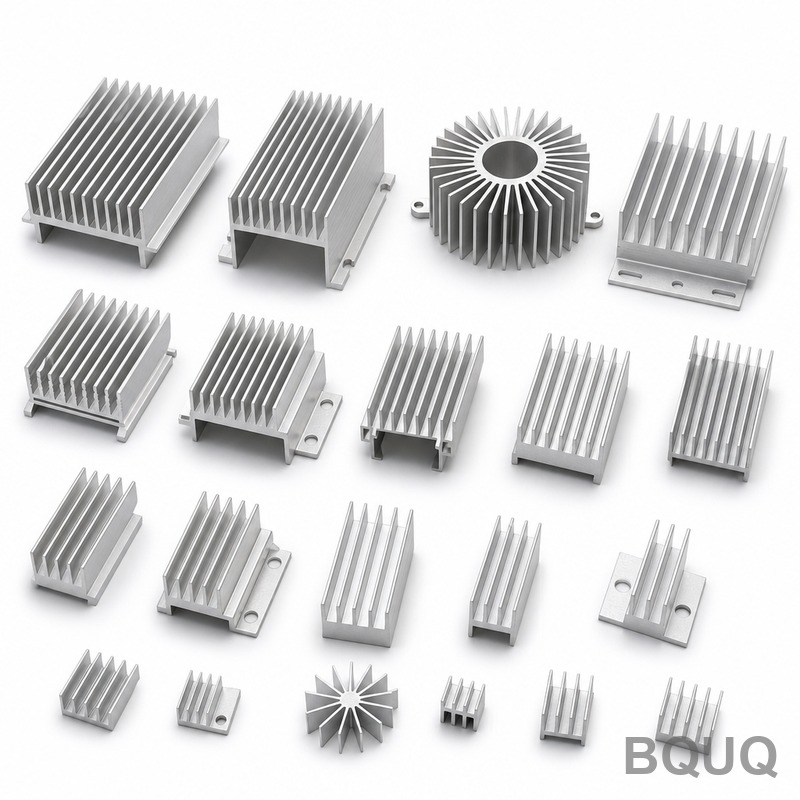
In stamped heat sinks, burrs on fin edges and mounting surfaces directly degrade thermal performance and assembly reliability. Burrs on fin edges increase air flow resistance, reducing convective heat transfer efficiency by 5% to 15% depending on burr height and density, as measured in wind tunnel tests at air velocities of 2 to 5 m/s. Burrs on the base plate can create gaps between the heat sink and the CPU or IGBT, increasing thermal resistance by 0.1 to 0.3°C per watt, which can cause junction temperatures to rise by 5°C to 15°C at high power loads. Additionally, burrs can scratch or damage thermal interface materials (TIM) during assembly, further reducing heat transfer. For a typical 100W processor heat sink made from 1.5 mm aluminum 6063-T5, reducing burr height from 0.15 mm to 0.03 mm improves thermal performance by 8%, which is critical for meeting junction temperature limits of 85°C. At BQUQ, we use precision dies with laser-cut clearance holes and a final tumbling process to achieve burr-free edges on all heat sink products, ensuring consistent thermal performance across batches.
What Is the Difference Between Burr and Flash in Metal Stamping?
Burr and flash are often confused but are distinct defects with different causes and solutions. A burr is a raised edge or sliver of material formed during the shearing or cutting process, typically 0.02 mm to 0.2 mm in height, and is caused by clearance issues or worn tooling. Flash, on the other hand, is excess material that squeezes out between the punch and die during forging or coining operations, and it appears as a thin, irregular fin around the part perimeter. Flash is more common in progressive stamping where material is drawn or extruded, and it can reach thicknesses of 0.1 mm to 0.5 mm depending on the process pressure. While burrs are removed by deburring, flash requires trimming or shaving operations, and controlling flash involves reducing die clearance and increasing blank holder pressure. Understanding this distinction is critical for selecting the correct corrective action in production.
How Often Should You Inspect Tooling for Burr-Related Wear?
Tooling inspection frequency for burr control depends on production volume, material type, and the required burr limit. For high-volume stamping of mild steel at 100 strokes per minute, tooling should be inspected every 8 hours or 50,000 strokes, with burr height measured on 5 sample parts per inspection. For abrasive materials like stainless steel or galvanized steel, inspection intervals should be shortened to every 4 hours or 25,000 strokes, as wear rates are 30% to 50% faster. For precision parts with burr limits under 0.05 mm, we recommend in-process monitoring using a laser sensor that measures burr height on every 100th part, triggering an alert if burr height exceeds 70% of the limit. At BQUQ, we use a predictive maintenance system that tracks tooling stroke count and material type, scheduling re-grinding automatically at 150,000 strokes for standard tools and 80,000 strokes for tools processing high-strength steel, reducing unplanned downtime by 40%.
FAQ
What is the acceptable burr height for most stamped metal parts?
The default acceptable burr height is 0.2 mm per ISO 13715, but many industries require tighter limits. For automotive safety components, 0.1 mm is common, while precision electronics parts often require 0.05 mm or less.
Can burr be completely eliminated in metal stamping?
Complete elimination is theoretically impossible, but burrs can be reduced below 0.01 mm using fine-blanking or secondary processes like electrochemical deburring. For practical purposes, burrs under 0.02 mm are considered burr-free for most applications.
How does stamping speed affect burr formation?
Higher stamping speeds above 200 strokes per minute increase heat at the cutting edge, which can soften the tool and accelerate wear. This leads to faster burr growth, so slower speeds are recommended for high-strength materials.
What is the typical cost of deburring per stamped part?
Deburring costs range from $0.01 per part for vibratory finishing of simple parts to $0.50 per part for electrochemical deburring of complex geometries. The cost depends on burr size, material, and required edge quality.
When should you use thermal energy deburring instead of mechanical methods?
Thermal energy deburring is preferred when burrs are located in internal cavities or thin-walled sections where mechanical tools cannot reach. It is also ideal for high-volume parts requiring consistent removal of all burrs, though it is not suitable for thin parts under 0.5 mm that may deform.
Can burrs be prevented by changing the material grade?
Yes, selecting a material with lower ductility, such as higher carbon content steel, reduces burr formation, but this may compromise other properties like formability. Material selection should balance burr control with the part's functional requirements.
How do you document burr requirements on engineering drawings?
Burr requirements are documented using ISO 13715 notation, which specifies the maximum burr height and direction. For example, the symbol "0.05" with an arrow indicates a maximum burr height of 0.05 mm on that edge.
Burr control in metal stamping is a fundamental quality issue that directly affects part performance, assembly, and cost, with solutions ranging from optimized die design to post-processing deburring. By understanding the mechanisms of burr formation, selecting appropriate materials and clearances, and implementing systematic inspection and maintenance, manufacturers can achieve burr limits as tight as 0.02 mm reliably. For precision stamping projects requiring burr-free parts with rapid turnaround, contact BQUQ for engineering support and a free quote within 12 hours. Email us at sc@bquq.com, reach us on WhatsApp at +86 137