What Is Spring Rate and How Do You Calculate It?
Spring rate is the measure of a spring’s stiffness, defined as the amount of force required to compress or extend it by one unit of distance, typically expressed in Newtons per millimeter (N/mm) or pounds per inch (lbf/in). To calculate it, divide the applied force by the resulting deflection, using the formula k = F / x for linear springs, or more complex equations for variable-rate and torsion designs. For precision manufacturing, understanding spring rate is critical because it determines load capacity, fatigue life, and whether a spring will function correctly in your assembly at BQUQ’s typical production tolerances of ±0.05 mm.
How Do You Calculate Spring Rate for a Compression Spring?
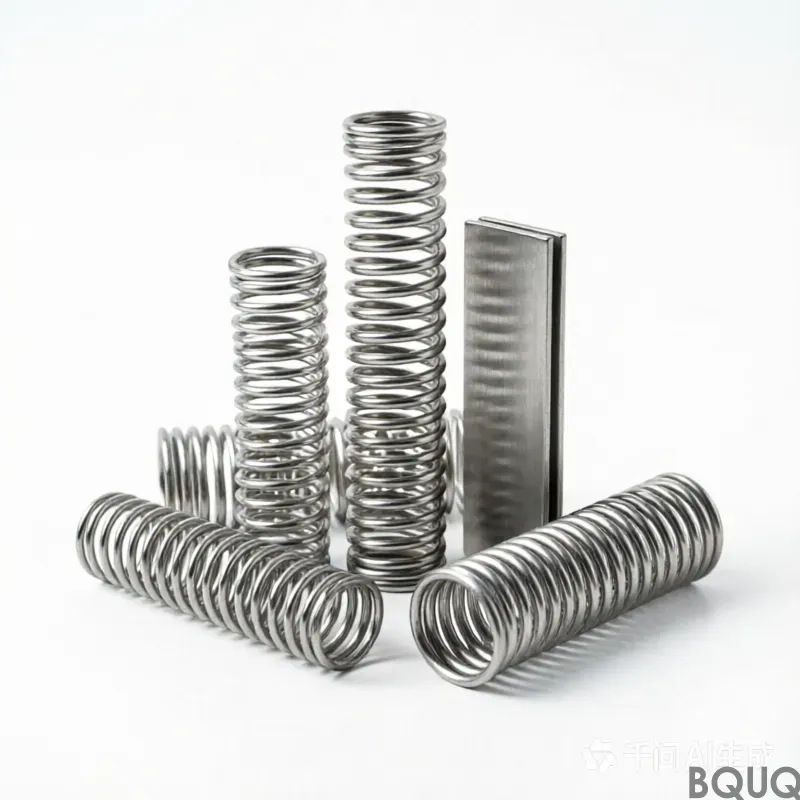
For a standard helical compression spring, the spring rate (k) is calculated using the formula: k = (G × d⁴) / (8 × D³ × N), where G is the shear modulus of the material (e.g., 79,300 N/mm² for stainless steel 302), d is the wire diameter in mm, D is the mean coil diameter in mm, and N is the number of active coils. For example, a spring with d = 2.0 mm, D = 12 mm, N = 8, and G = 79,300 yields k = (79,300 × 16) / (8 × 1,728 × 8) = 1,268,800 / 110,592 = 11.47 N/mm. In practice, you can also measure spring rate empirically by applying known loads (e.g., 100 N and 200 N) and recording deflection, then dividing the load difference by the deflection difference.
What Is the Difference Between Spring Rate and Spring Constant?
Spring rate and spring constant are often used interchangeably, but there is a subtle distinction in engineering contexts. Spring constant (k) is the general term for any elastic body’s stiffness, defined as F = k × x, while spring rate specifically refers to the stiffness per unit length of a spring, usually measured over its working deflection range. For linear springs, the two values are numerically identical, but for progressive-rate springs (e.g., automotive valve springs), the spring rate changes with deflection, so you must specify rate at a particular load point, such as 50 N/mm at 10 mm compression.
Why Does Spring Rate Matter in Precision Manufacturing?
Spring rate directly affects functional performance, including force output, resonant frequency, and fatigue life, which is why BQUQ specifies it on every spring drawing within ±5% tolerance. A spring with too high a rate will transmit excessive force, causing premature wear on mating components, while too low a rate leads to insufficient preload and possible rattling or failure under vibration. In our 20 years of production for heat sinks and CNC-machined assemblies, we have seen that a 10% deviation in spring rate can reduce fatigue life by up to 40%, especially in high-cycle applications above 1 million cycles.
How Does Wire Diameter Affect Spring Rate?
Wire diameter has the most significant influence on spring rate because it is raised to the fourth power in the calculation formula, meaning a small change creates a large effect. For instance, increasing wire diameter from 1.5 mm to 1.65 mm (10% increase) raises the spring rate by approximately 46% (1.1⁴ = 1.4641), assuming all other dimensions stay constant. This sensitivity means that during manufacturing, wire diameter must be controlled to ±0.01 mm for precision springs, and BQUQ uses laser micrometers to verify this on every production batch.
Which Materials Provide Predictable Spring Rates for High-Temperature Applications?
For temperatures above 150°C, standard music wire (ASTM A228) loses its elastic modulus and relaxation resistance, so you should use Inconel X-750 or 17-7 PH stainless steel, which maintain spring rate stability up to 400°C and 315°C, respectively. Beryllium copper (C17200) offers excellent conductivity and a consistent spring rate up to 200°C, making it ideal for electrical contacts in heat sink assemblies. Below is a comparison table of common spring materials with their shear modulus values and maximum operating temperatures, based on BQUQ’s material certification data:
| Material | Shear Modulus (N/mm²) | Max Temperature (°C) | Typical Spring Rate Stability | Corrosion Resistance |
| Music Wire (A228) | 79,300 | 120 | ±3% up to 80°C | Poor |
| Stainless Steel 302 | 79,300 | 260 | ±5% up to 200°C | Good |
| Chrome Silicon (A401) | 79,300 | 230 | ±4% up to 180°C | Fair |
| Inconel X-750 | 77,200 | 400 | ±6% up to 350°C | Excellent |
| Beryllium Copper (C17200) | 48,300 | 200 | ±5% up to 150°C | Good |
How Do You Measure Spring Rate Accurately in a Factory Setting?
To measure spring rate accurately, use a calibrated compression tester with a load cell accuracy of ±0.5% and a deflection indicator with resolution of 0.01 mm, following the ASTM A125 test standard. Place the spring between flat platens, apply an initial preload of 10% of the estimated maximum load to seat the coils, then record force at two deflection points (e.g., 25% and 75% of total travel) and calculate the slope. For production verification, BQUQ measures spring rate on 5% of each batch, and we reject any spring that deviates more than ±5% from the specified value, which aligns with ISO 10243 requirements for die springs.
Can Spring Rate Be Adjusted After Manufacturing?
Yes, spring rate can be adjusted after manufacturing through processes like shot peening, stress relieving, or altering the free length, but these methods have limitations and trade-offs. Shot peening can increase fatigue life by up to 30% without changing spring rate significantly, while grinding the ends flat can reduce the number of active coils and thus increase the rate. If you need a different spring rate, it is usually more economical to redesign the spring with new wire diameter or coil count, as post-manufacturing adjustments often require re-heat-treatment and re-testing, adding 3-5 days and 15-20% cost versus a new production run.
How Does Coil Count Change Spring Rate in a Helical Spring?
The number of active coils (N) has an inverse linear relationship with spring rate: doubling the coil count halves the spring rate, assuming wire diameter and coil diameter remain unchanged. For example, a spring with 6 active coils and a rate of 20 N/mm will have a rate of 10 N/mm if you increase to 12 active coils, because the formula k = (G × d⁴) / (8 × D³ × N) divides by N. In practice, reducing active coils by one (e.g., from 8 to 7) increases spring rate by approximately 14.3%, which is why BQUQ’s engineers always calculate the exact coil count to hit your target rate within ±3%.
What Is the Cost Impact of Tight Spring Rate Tolerances?
Tighter spring rate tolerances, such as ±2% instead of the standard ±5%, increase manufacturing cost by approximately 25-35% due to the need for 100% inspection and more precise wire diameter control. For high-volume orders above 10,000 pieces, a ±5% tolerance costs around $0.08 to $0.15 per spring, while ±2% tolerance raises that to $0.10 to $0.20 per spring, plus a one-time setup fee of $150 to $300 for custom tooling. We recommend specifying ±5% unless your application has a critical safety function, because most assemblies can absorb a 5% variation in force without functional degradation.
FAQ Section
What Is the Formula for Spring Rate in SI Units?
The SI formula is k = F / x, where k is in Newtons per millimeter (N/mm), F is force in Newtons, and x is deflection in millimeters. For helical compression springs, use k = (G × d⁴) / (8 × D³ × N) with G in N/mm², d and D in mm, and N dimensionless.
How Do You Calculate Spring Rate for a Torsion Spring?
For torsion springs, the rate is calculated as k = (E × d⁴) / (10.8 × D × N), where E is the elastic modulus (e.g., 206,000 N/mm² for steel) and d, D, N are the same variables as compression springs. The result is expressed in N·mm per degree of rotation, not N/mm.
What Is a Good Spring Rate for a Valve Spring in an Engine?
A typical automotive valve spring has a rate between 30 and 60 N/mm, with a seat load of 300-400 N and an open load of 800-1,200 N at maximum lift. The exact rate depends on engine RPM, with higher RPM engines requiring higher rates to prevent valve float above 7,000 RPM.
Can Spring Rate Change Over Time Due to Fatigue?
Yes, spring rate can decrease by 3-8% over its fatigue life due to stress relaxation and microstructural changes, especially at elevated temperatures above 150°C. To mitigate this, specify shot peening and preset (compressing solid for 24 hours) which stabilize the rate within the first few cycles.
Which Spring Rate Is Better for Vibration Isolation: High or Low?
A low spring rate is better for vibration isolation because it reduces natural frequency, moving it away from typical excitation frequencies above 20 Hz. However, a rate that is too low allows excessive static deflection, so you must balance rate against load capacity and available space.
How Do You Convert Spring Rate from N/mm to lbf/in?
To convert N/mm to lbf/in, multiply the value by 5.7101, so a spring rate of 10 N/mm equals 57.1 lbf/in. Conversely, divide lbf/in by 5.7101 to get N/mm.
What Is the Minimum Spring Rate BQUQ Can Manufacture?
BQUQ can manufacture springs with rates as low as 0.05 N/mm for delicate medical devices and as high as 500 N/mm for heavy industrial machinery, with wire diameters from 0.1 mm to 12 mm. Minimum order quantity is 500 pieces for custom springs, and we provide free design review within 24 hours.
For rapid prototyping or production runs, our engineering team can calculate and verify spring rate on your design within 12 hours of receiving your drawing. Contact BQUQ at sc@bquq.com or WhatsApp +86 13713157787, or visit www.bquq.com for a free quotation with full dimensional and performance data.
Related Articles
- Smart Spring Inventory Management Strategies for OEMs
- Size control and online intelligent detection technology of precision spring
- In-depth analysis of technology and process in the hardware spring industry in 2026: a full-dimensional interpretation of high stress, functional integration and engineering certification