What Is the Difference Between Conical and Cylindrical Springs?
Conical and cylindrical springs differ fundamentally in geometry, load distribution, and space efficiency. A cylindrical spring offers a constant spring rate and predictable linear deflection, while a conical spring provides a variable spring rate, a compressed height near solid stack, and superior lateral stability. Choose a cylindrical spring for uniform force over a long travel range, and choose a conical spring when you need a low solid height, progressive resistance, or to fit a tapered cavity.
How Do Conical and Cylindrical Springs Differ in Load Capacity and Deflection?
The primary mechanical difference lies in the spring rate, which is the change in load per unit of deflection. A cylindrical spring has a constant coil diameter, so each coil contributes equally to deflection, resulting in a linear spring rate. For example, a typical cylindrical compression spring made from 2.0 mm music wire (ASTM A228) with a 20 mm outer diameter and 10 active coils will have a rate of approximately 7.8 N/mm, and it will deflect uniformly until coil bind.
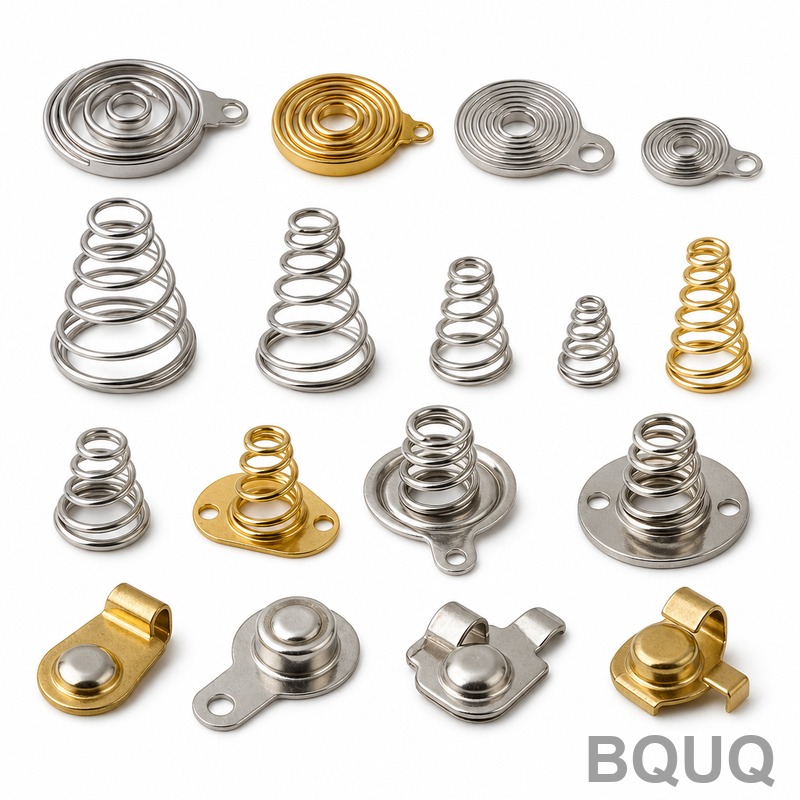
A conical spring, in contrast, has coils of progressively decreasing diameter. As the spring compresses, the larger coils at the base contact the smaller coils above them, becoming inactive. This causes the spring rate to increase progressively, creating a rising rate curve. A conical spring with the same wire diameter and free length can start at a rate of 5.2 N/mm but increase to 14.5 N/mm near full compression. This behavior is crucial for applications requiring shock absorption without bottoming out, such as in automotive valve trains or industrial vibration isolators. The maximum deflection of a conical spring is often 30% to 40% less than a cylindrical spring of the same free length due to the nesting of coils.
When Should You Specify a Conical Spring Over a Cylindrical Spring?
You should specify a conical spring when the primary design constraint is axial space. The solid height of a conical spring is significantly lower than that of a cylindrical spring because the coils nest inside one another at full compression. For instance, a conical spring with a free length of 50 mm and wire diameter of 3 mm can have a solid height of approximately 18 mm, whereas a cylindrical spring of the same free length and wire diameter has a solid height of 30 mm. This 40% reduction in solid height is critical in applications like battery contacts, compact solenoid actuators, and mechanical seals.
Conical springs are also preferred when you need a progressive spring rate to manage resonance or impact. In high-vibration environments, such as in a CNC machine spindle or a heavy-duty stamping die, a conical spring reduces the risk of surging (uncontrolled resonant oscillation) because its natural frequency is higher and its rate changes with deflection. Additionally, conical springs offer better lateral stability; they are less likely to buckle under load compared to a slender cylindrical spring of the same free length and load. If your design has a tapered cavity or a conical seat, a conical spring naturally fits the envelope, eliminating the need for additional guide pins.
What Are the Manufacturing Tolerances and Cost Differences?
Manufacturing tolerances differ notably due to the complexity of coiling. Cylindrical springs are simpler to produce on standard CNC coiling machines, achieving a load tolerance of +/- 5% and a free length tolerance of +/- 1.0 mm on a 50 mm spring. Conical springs require more precise control of the pitch and the rate of diameter change, which increases the difficulty of maintaining tight tolerances. For a conical spring, a typical load tolerance is +/- 8% and a free length tolerance is +/- 1.5 mm on similar dimensions.
In terms of cost, cylindrical springs are the baseline. A standard cylindrical compression spring (2 mm wire, 20 mm OD, 50 mm free length) in quantities of 10,000 units costs roughly USD 0.12 to USD 0.18 per piece. A conical spring of equivalent volume and material costs approximately 25% to 40% more, ranging from USD 0.15 to USD 0.25 per piece, due to slower coiling speeds and more frequent tooling inspection. Tooling for cylindrical springs is a simple collet and pitch tool, costing around USD 500 to USD 800. Conical spring tooling requires a custom cam and variable-pitch former, costing USD 1,200 to USD 2,000. For low-volume prototypes, expect a 30% higher engineering and setup charge for conical designs.
Which Material and Heat Treatment Are Best for Each Spring Type?
Material selection is identical for both geometries, but the heat treatment and surface finishing may require different parameters. For cylindrical springs, common materials include hard-drawn steel wire (ASTM A227) for general use, oil-tempered chrome-vanadium steel (ASTM A231) for fatigue resistance, and stainless steel 302 (ASTM A313) for corrosion resistance. The recommended operating temperature for oil-tempered steel is up to 120°C, while stainless steel 302 can operate up to 260°C.
For conical springs, the material must withstand higher localized stress at the smaller diameter coils. Therefore, chrome-silicon steel (ASTM A401) is often recommended, with a maximum operating temperature of 250°C and a higher tensile strength of 1,900 MPa. Stress relief heat treatment for a conical spring is typically performed at 260°C to 290°C for 30 minutes, whereas a cylindrical spring is stress-relieved at 230°C to 260°C for 20 minutes. If you require a conical spring to have a constant rate, you can grind the ends flat and use a variable pitch, but this is more expensive. For high-cycle applications (over 1 million cycles), shot peening is mandatory for both types, but conical springs require a lower peening intensity (0.15 to 0.20 A) to avoid distortion of the tapered coils.
How Does the Spring Rate Curve Affect Mechanical System Design?
The spring rate curve dictates how force is delivered to the mating components. A cylindrical spring has a linear force-deflection line, meaning if you compress it 5 mm it exerts 39 N, and at 10 mm it exerts 78 N (using the earlier example). This is ideal for applications requiring a predictable return force, such as in a clutch mechanism or a latch.
A conical spring has a progressive curve. It may exert 26 N at 5 mm deflection, 60 N at 10 mm, and 145 N at 15 mm. This non-linear behavior is advantageous in die springs for metal stamping, where you want low force during the initial contact to avoid marking the workpiece, but high force at the end of the stroke to ensure complete shearing. In a CNC machine tool holder, a conical spring provides a low preload for easy tool insertion but a high clamping force once the tool is seated. When designing with a conical spring, you must calculate the force at the specific working height, not just the free length, because a 1 mm adjustment in the installation height can change the rate drastically.
What Are the Practical Size Limits and Lead Times for Custom Springs?
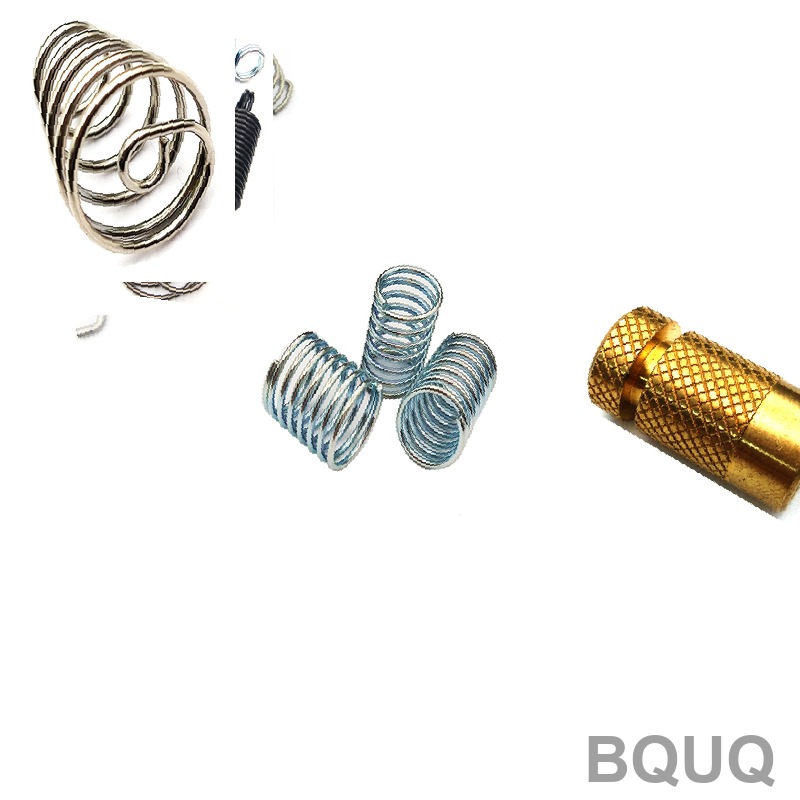
Practical size limits depend on the coiling machine and wire diameter. At BQUQ, we manufacture cylindrical springs with wire diameters from 0.2 mm to 12 mm, outer diameters from 1.5 mm to 150 mm, and free lengths up to 300 mm. Conical springs are limited to wire diameters from 0.5 mm to 8 mm, outer diameters from 4 mm to 120 mm, and free lengths up to 200 mm due to the complexity of the forming mandrel.
Lead times also differ. A standard cylindrical spring in a common material can be sampled in 3 to 5 working days, with production in 10 to 15 working days. A conical spring requires 5 to 7 working days for sampling and 15 to 20 working days for production because each batch requires a separate setup verification for the tapered pitch. For large orders (over 50,000 pieces), cylindrical springs can be produced on high-speed 4-slide machines at rates of 60 to 120 pieces per minute, while conical springs are limited to 30 to 50 pieces per minute on cam-operated coilers.
| Parameter | Cylindrical Spring | Conical Spring |
| Spring Rate | Constant (linear) | Variable (progressive) |
| Solid Height (50 mm free length, 3 mm wire) | 30 mm | 18 mm |
| Typical Load Tolerance | +/- 5% | +/- 8% |
| Unit Cost (10k pcs, 2 mm wire) | USD 0.12 - 0.18 | USD 0.15 - 0.25 |
| Tooling Cost | USD 500 - 800 | USD 1,200 - 2,000 |
| Max Operating Temperature (Chrome-silicon) | 250°C | 250°C |
| Sampling Lead Time | 3 - 5 days | 5 - 7 days |
| Production Lead Time | 10 - 15 days | 15 - 20 days |
| Best Application | Uniform force, long travel | Low solid height, shock absorption |
Can a Conical Spring Replace a Cylindrical Spring in an Existing Assembly?
Yes, but you must verify the installed height and the required force at that height. A conical spring can directly replace a cylindrical spring if the free length is the same and the minimum force is acceptable, but the maximum force will be higher near full compression. For example, if your assembly has a 25 mm bore and a 40 mm working space, a cylindrical spring with a 20 mm OD and 40 mm free length can be replaced by a conical spring with a 24 mm base OD and 40 mm free length. The conical spring will fit better laterally and have a lower solid height, but it will exert more force at the end of the stroke.
You also need to check the natural frequency. Cylindrical springs have a lower natural frequency (often 50 to 100 Hz for large springs) and are prone to surging at high actuation speeds. Conical springs have a higher natural frequency (100 to 200 Hz) and are safer for high-speed applications. However, a conical spring has a higher tangential stress at the inner coils, so you should recalculate the torsional stress using the largest coil diameter as the baseline. If the stress exceeds 45% of the material's tensile strength, you must increase the wire diameter or reduce the free length. In most retrofit cases, a conical spring improves performance, but it is not a drop-in replacement without re-validating the fatigue life.
FAQ
Can conical springs be compressed until they are flat?
Yes, conical springs can be compressed to a nearly flat solid height because the coils nest inside one another. However, you should design for a maximum working deflection of 85% of the travel to solid height to avoid over-stressing the wire and causing premature failure.
What is the main advantage of a cylindrical spring?
The main advantage is a predictable, constant spring rate, which simplifies engineering calculations and ensures uniform force output across the entire deflection range. This makes cylindrical springs ideal for precision mechanisms like valves, switches, and locking pins.
How do I measure the spring rate of a conical spring?
You measure the spring rate between two defined points on the force-deflection curve, typically at 20% and 80% of the total deflection. Because the rate is progressive, you should specify the force at the working height rather than a single rate value.
Are conical springs more expensive to produce?
Yes, conical springs are typically 25% to 40% more expensive per piece due to slower coiling speeds and more complex tooling. The tooling cost is also higher, around USD 1,200 to USD 2,000, compared to USD 500 to USD 800 for a cylindrical spring.
Which spring type has better fatigue life?
Cylindrical springs generally have better fatigue life under the same material and load conditions because their stress distribution is uniform across all coils. Conical springs have higher localized stress at the smallest diameter coils, so they require larger wire diameters or shot peening to achieve equivalent fatigue life.
Can a conical spring provide a constant force?
No, a standard conical spring always provides a progressive (increasing) spring rate. To achieve a near-constant force, you would need a specially designed spring with a variable pitch and non-linear material properties, which is custom-engineered and significantly more expensive.
What is the maximum temperature for a conical spring made of stainless steel?
For stainless steel 302, the maximum continuous operating temperature is 260°C. For higher temperatures up to 350°C, you would need to use a nickel-based alloy such as Inconel X-750, which is available for custom conical spring orders.
In conclusion, the selection between conical and cylindrical springs is a trade-off between linearity, space efficiency, and cost. Cylindrical springs remain the standard for general-purpose linear force, while conical springs are the superior choice for compact assemblies, progressive damping, and high-speed stability. At BQUQ, we recommend sending us your working envelope and required force curve, and our engineers will model both options for you. For a rapid evaluation, contact us for a 12-hour quotation at sc@bquq.com, reach us on WhatsApp at +86 13713157787, or visit www.bquq.com for more technical resources.