What Material Properties Matter Most for Metal Stamping?
The most critical material properties for metal stamping are yield strength, tensile strength, elongation, hardness, and thickness tolerance, as they directly determine bendability, springback, tool wear, and dimensional stability. For example, a material with less than 10% elongation will crack during tight-radius bending, while a yield strength above 500 MPa requires significantly higher press tonnage and causes more springback. Selecting a material without matching these properties to your part geometry and stamping process will result in rejected parts, broken tooling, or excessive trial-and-error costs.
How Does Yield Strength Affect Springback and Dimensional Accuracy?
Yield strength is the stress at which a material permanently deforms, and it is the primary driver of springback in stamped parts. When the punch is removed, the elastic portion of the deformation recovers, causing the part to bend back toward its original shape. A material like DP780 (dual-phase steel) with a yield strength of 450-550 MPa will exhibit approximately 2-3 degrees of springback on a 90-degree bend with a 1.5 mm thickness, whereas mild steel (yield strength 200-280 MPa) will show only 0.5-1 degree under identical conditions. To compensate, you must over-bend the tooling by the predicted springback angle, but this compensation is only valid if the incoming coil's yield strength stays within a tight band, such as plus or minus 30 MPa. If your supplier ships coils with yield strength varying by 100 MPa, your part dimensions will drift outside the typical stamping tolerance of plus or minus 0.1 mm.
What Is the Relationship Between Elongation and Bendability?
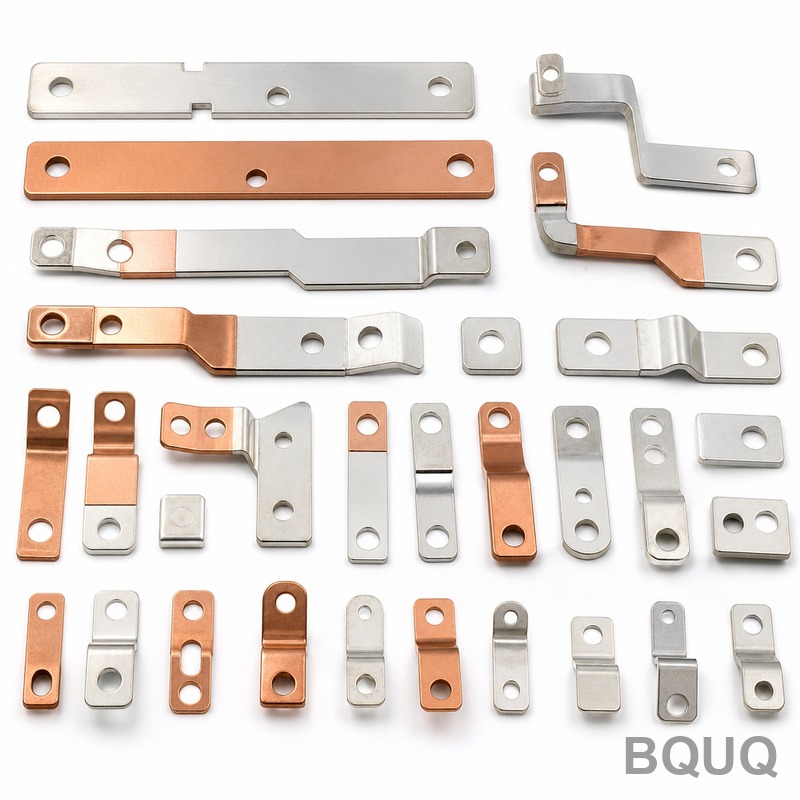
Elongation, measured as a percentage over a 50 mm gauge length (A50), indicates how much a material can stretch before necking or cracking. For a tight 90-degree bend with an inside radius equal to 1x material thickness, you need at least 20% elongation. For an inside radius of 0.5x thickness, which is common in heat sink fins and spring clips, elongation must exceed 30%. Aluminum alloys like 5052-H32 have 12-18% elongation, so they crack when bent sharply, while 3003-O with 30% elongation bends easily. High-strength steels such as DP1000 have only 8-10% elongation, requiring a minimum bend radius of 3x to 4x thickness. In practice, we reject any stamped part design that specifies a bend radius below the material's minimum bend factor, as this produces micro-cracks that reduce fatigue life in dynamic applications like automotive seat springs.
Why Does Hardness Matter for Tool Wear and Part Function?
Material hardness, measured in Rockwell B (HRB), Rockwell C (HRC), or Vickers (HV), controls both how the sheet metal wears the stamping die and how the finished part resists wear in service. Stamping 1.0 mm thick cold-rolled steel with a hardness of HRB 70-80 will yield 500,000 to 1,000,000 hits before requiring a die resharpening, assuming D2 tool steel inserts. If you switch to stainless steel 301 full-hard (HRC 40), tool life drops to 150,000-200,000 hits because the abrasive chromium carbides accelerate die wear. For the part itself, a spring made from 301 stainless hard-tempered (HV 380-420) maintains its load over 1 million cycles, while the same spring in annealed 301 (HV 180) will take a set and lose 30% of its force within 10,000 cycles. Specify hardness on the drawing as a range, for example, HRB 70-85, not a single value, to give the mill a realistic production window.
Which Material Grades Are Most Common in Precision Stamping?
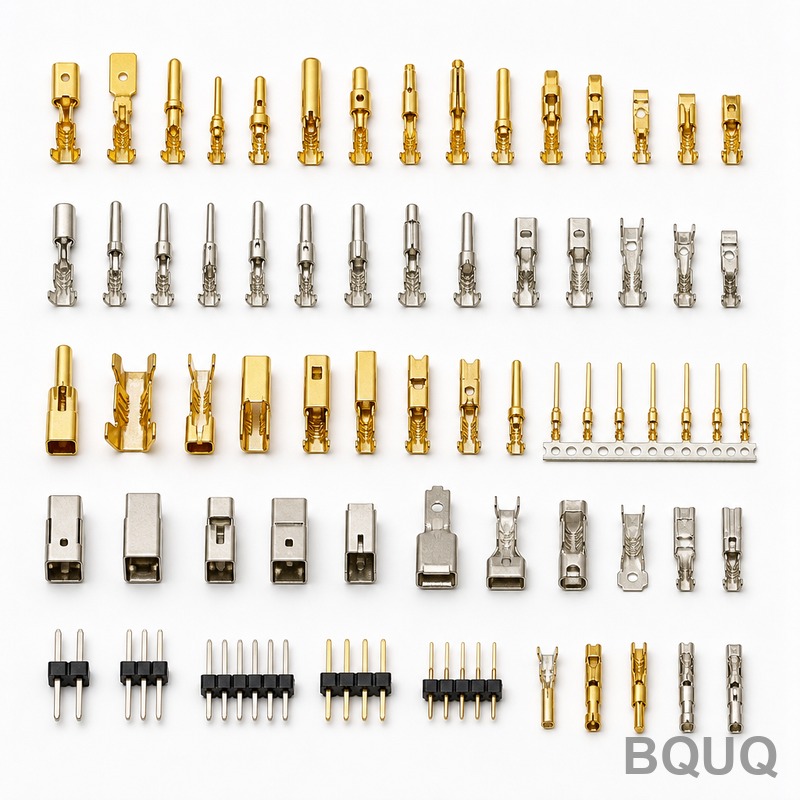
The most common materials in precision stamping are low-carbon steel (SPCC, DC01), stainless steel (301, 304, 430), aluminum (5052, 6061, 1100), copper alloys (C11000, C17200 beryllium copper), and spring steels (C75S, 1095). SPCC cold-rolled steel accounts for roughly 60% of stamped parts in our Dongguan factory because it offers low cost (approximately 0.8-1.2 USD per kg), good formability (35-40% elongation), and consistent thickness within plus or minus 0.03 mm for 1.0 mm sheet. Stainless steel 304 is chosen for corrosion-resistant parts, but its work-hardening rate is high, so it requires 15-20% more press tonnage than mild steel of the same thickness. Beryllium copper C17200, at 25-35 USD per kg, is used only for critical spring contacts because it combines high conductivity (20-25% IACS) with a yield strength of 800-1100 MPa after heat treatment.
How Does Sheet Thickness Tolerance Influence Part Cost?
Thickness tolerance is often underestimated, but it directly affects both bending force and final part weight. A 1.5 mm thick steel sheet with a standard tolerance of plus or minus 0.08 mm will require a bending force variation of roughly plus or minus 5%, which can cause inconsistent bend angles if the press brake is not compensated. For high-volume stamping, we recommend ordering material to a tight thickness tolerance of plus or minus 0.02 mm, which costs 5-10% more per kilogram but reduces scrap rates by up to 40%. In one heat sink project, the customer supplied 2.0 mm aluminum 6061-T6 with a plus or minus 0.10 mm tolerance; the stamped fin heights varied by 0.15 mm, exceeding the assembly spec of plus or minus 0.10 mm. Switching to a precision-rolled coil with plus or minus 0.03 mm tolerance eliminated the issue and reduced rework costs by 0.02 USD per part.
When Should You Choose Hot-Rolled Versus Cold-Rolled Steel for Stamping?
Choose hot-rolled steel (e.g., SPHC, A36) when the part is thicker than 3.0 mm, has large bend radii, and does not require a fine surface finish. Hot-rolled steel costs 10-15% less than cold-rolled, but it has a rough scale surface and wider thickness tolerance of plus or minus 0.15 mm, which shortens die life by 20-30%. Choose cold-rolled steel (SPCC, DC01) for parts under 3.0 mm where surface quality, dimensional accuracy, and tight bend radii are critical. Cold-rolled steel also has a more consistent grain structure, giving more predictable springback, which is essential for progressive die stamping at speeds of 200-400 strokes per minute. For example, a 2.0 mm thick bracket stamped from cold-rolled SPCC holds a flatness of 0.10 mm, while the same bracket from hot-rolled SPHC may bow by 0.30 mm due to residual stress.
How Do You Compare Material Properties for a Specific Stamping Project?
To compare materials, you must evaluate five key parameters: yield strength (for springback and tonnage), tensile strength (for maximum forming force), elongation (for bendability), hardness (for tool wear and wear resistance), and thickness tolerance (for dimensional consistency). Use the table below as a quick reference for common stamping materials at 1.0 mm thickness.
| Material Grade | Yield Strength (MPa) | Tensile Strength (MPa) | Elongation A50 (%) | Hardness (HRB) | Typical Thickness Tolerance (mm) | Relative Cost Index |
| SPCC (cold-rolled steel) | 210 | 330 | 38 | 55-70 | ±0.03 | 1.0 |
| DC01 (deep drawing steel) | 180 | 300 | 40 | 50-65 | ±0.03 | 1.1 |
| Stainless 304 (annealed) | 240 | 590 | 55 | 80-90 | ±0.04 | 2.5 |
| Stainless 301 (full hard) | 960 | 1180 | 8 | HRC 40 | ±0.04 | 3.0 |
| Aluminum 5052-H32 | 190 | 230 | 14 | 55-65 | ±0.04 | 1.8 |
| Aluminum 6061-T6 | 240 | 290 | 12 | 80-90 | ±0.05 | 2.0 |
| Beryllium copper C17200 (aged) | 900 | 1200 | 5 | HRC 38 | ±0.02 | 25.0 |
| Spring steel C75S (hard rolled) | 700 | 900 | 6 | HRC 30 | ±0.03 | 1.5 |
For a new project, we recommend creating a material specification sheet that lists these five values with acceptable ranges, then sending this to 2-3 coil suppliers to confirm availability. If your part requires a bend radius below 1x thickness, we always run a bend test on the actual coil before cutting production tooling, as slight variations in temper can cause cracking. This validation step costs only 50-100 USD for a test coupon but prevents a 5,000-15,000 USD tooling modification later.
What Are the Common Stamping Defects Caused by Poor Material Properties?
Poor material properties cause four main defects: cracking, springback variation, orange peel, and edge burrs. Cracking occurs when elongation is below the required bend factor, especially in aluminum 6061-T6 and high-strength steels. Orange peel, a rough surface texture, appears when the grain size is too large, typically above ASTM grain size 5, during deep drawing of aluminum or brass. Excessive springback variation, where parts from the same batch measure differently, is caused by yield strength variation greater than 50 MPa within a single coil. Edge burrs larger than 0.05 mm indicate that the material's hardness is above the tool steel's recommended range, causing rapid punch wear. In our experience, 70% of stamping quality issues trace back to inconsistent material properties, not tooling problems, which is why we insist on material certificates (EN 10204 type 3.1) for every coil.
FAQ
What is the minimum elongation required for a 90-degree bend?
For a 90-degree bend with an inside radius equal to 1x material thickness, the minimum elongation is 20%. For tighter radii of 0.5x thickness, you need at least 30% elongation. Always verify the actual coil's elongation value, as batch-to-batch variation can be 5-8%.
How much does material cost affect the total stamping part price?
Material typically accounts for 30-50% of the total stamped part cost, depending on the part size and complexity. For a simple flat washer, material may be 70% of cost, while for a complex progressive die part with 10 forming stations, material is closer to 30%. Optimizing material utilization through nesting can reduce material cost by 15-25%.
Can I stamp parts from materials with high yield strength like 700 MPa?
Yes, but you must increase press tonnage by approximately 25-30% compared to mild steel, and you will face 2-3 times more springback. Use a press with a heavier frame and add springback compensation features like coining or bottoming. Tool steel must be upgraded to M2 or PM steel to handle the higher stresses.
When should I use stainless steel instead of cold-rolled steel for stamping?
Use stainless steel when the part requires corrosion resistance, high strength at elevated temperatures, or a clean appearance without plating. Stainless costs 2.5-3 times more than cold-rolled steel and causes 20-30% more tool wear, so only specify it when functional needs justify the cost. For indoor applications with no corrosive exposure, cold-rolled steel with electroplating is a more economical choice.
How do I specify material properties on a stamping drawing?
On the drawing, specify the material grade, thickness with tolerance, yield strength range, elongation minimum, hardness range, and surface finish requirement. Include a note that all properties must be certified with a material test report. For critical parts, add a requirement for a bend test on the actual coil before production.
What is the typical lead time for ordering materials with tight property tolerances?
Standard materials like SPCC and 5052-H32 are available in 1-2 weeks from local distributors. Materials with tight thickness tolerances (plus or minus 0.02 mm) or specific yield strength bands may require a mill order with a 4-6 week lead time. For prototype runs, we recommend using standard tolerance material and adjusting tooling to compensate.
Can heat treatment improve the stamping properties of a material?
Heat treatment is applied after stamping to improve hardness or strength, but it cannot fix poor formability during the stamping process. For example, stamping in the annealed condition and then age-hardening beryllium copper is a standard two-step process. However, heat treatment causes dimensional changes of 0.05-0.15%, so you must account for this in the tooling design.
The key to successful metal stamping is matching the material's mechanical properties to the part's geometry and the press capabilities before committing to tooling. By specifying yield strength, elongation, hardness, and thickness tolerance as ranges, and by verifying these with material certificates and bend tests, you can avoid the most common stamping defects and achieve consistent part quality at high production speeds. At BQUQ, we have 20 years of experience in stamping materials from SPCC to beryllium copper, and we offer a free material selection review within 12 hours of receiving your drawing. Send your part file to sc@bquq.com or contact us on WhatsApp at +86 13713157787, and visit www.bquq.com for more technical resources.