What Spring Manufacturing Tolerances Can You Expect?
For most industrial applications, standard spring manufacturing tolerances range from ±0.05 mm to ±0.25 mm on wire diameter and ±0.5% to ±2.0% on free length and spring rate, depending on the spring type and production method. Precision CNC coiling can achieve tolerances as tight as ±0.01 mm on critical dimensions, while hot-coiled large springs typically hold ±2.0 mm or more. The exact achievable tolerance depends on wire material, spring index, coil geometry, and whether you choose coiling, grinding, or secondary finishing operations.
What Are the Standard Tolerance Classes for Compression Springs?
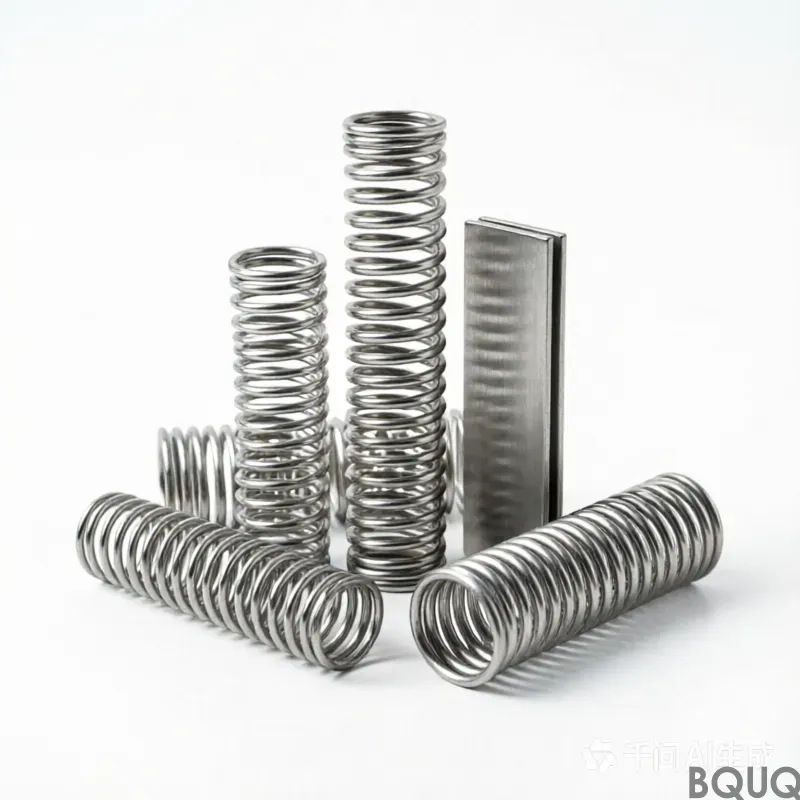
Compression springs are classified into three main tolerance grades per DIN 2095 and ISO 10243 standards: Grade 1 (precision), Grade 2 (normal), and Grade 3 (coarse). Grade 1 tolerances hold free length within ±0.5% or ±0.05 mm (whichever is greater), while Grade 3 allows ±2.0% or ±0.40 mm. For wire diameter up to 1.0 mm, Grade 1 holds ±0.010 mm; for wire from 1.0 mm to 3.0 mm, the tolerance expands to ±0.015 mm; and for wire above 3.0 mm, expect ±0.020 mm. These classifications directly follow European spring standards and are the most widely referenced baseline in global manufacturing.
How Do Spring Rate Tolerances Affect Performance?
The spring rate (k) tolerance is the most critical parameter for functional applications, typically held to ±5% for standard springs and ±2% for precision springs. Spring rate is calculated as k = (G × d⁴) / (8 × D³ × N), where G is shear modulus, d is wire diameter, D is mean coil diameter, and N is active coils. Because wire diameter is raised to the fourth power in this equation, a 0.01 mm variation in a 1.0 mm wire changes the spring rate by approximately 4%, which is why wire diameter control is paramount. For high-volume production, BQUQ uses CNC coiling machines with closed-loop wire feed monitoring to maintain spring rate consistency within ±1.5% on critical automotive and medical components.
Which Spring Types Allow the Tightest Tolerances?
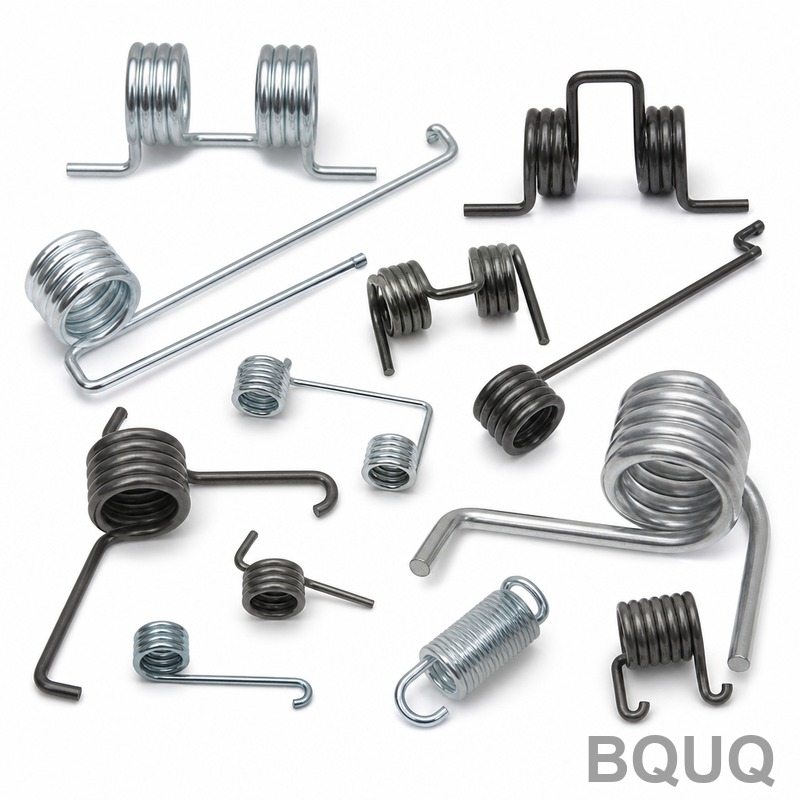
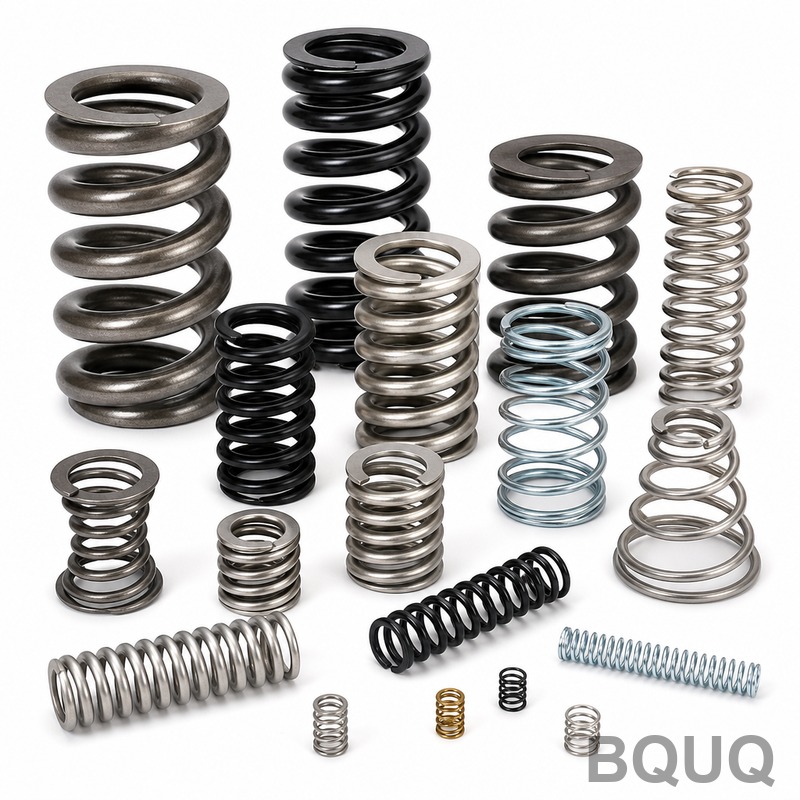
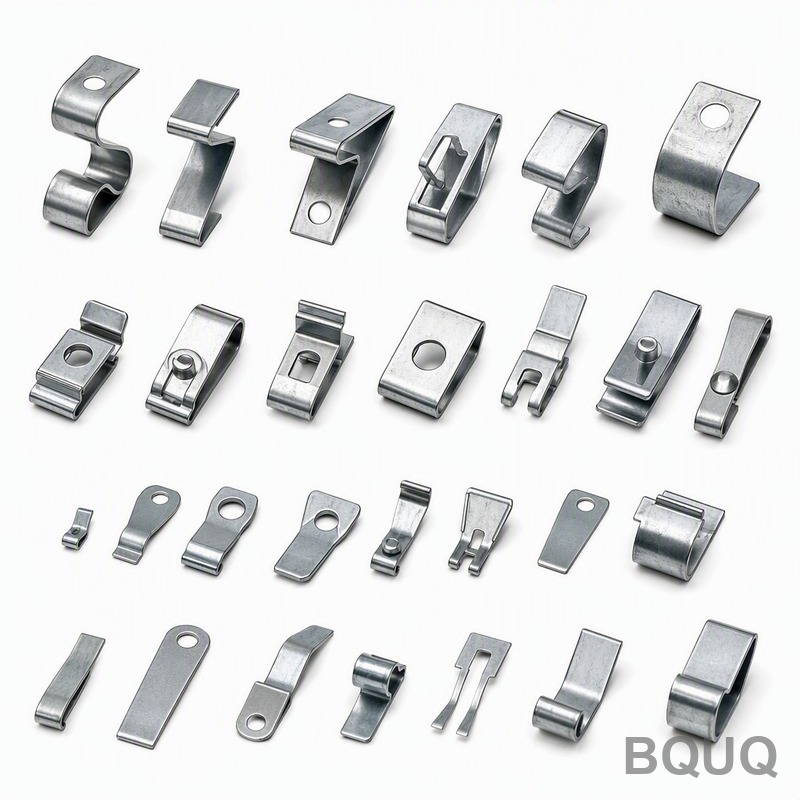
Compression springs and torsion springs consistently achieve the tightest tolerances because their geometry is fully defined by CNC coiling parameters. Compression springs can hold outer diameter to ±0.10 mm for wire under 3.0 mm, while extension springs typically allow ±0.15 mm due to the added complexity of end hooks. Torsion springs achieve ±0.10 mm on leg position and ±0.5 degrees on angular orientation. Conical and barrel springs inherently require looser tolerances, typically ±0.25 mm on diameter, because the variable coil diameter creates additional tooling wear and setup complexity. Wire-formed springs with complex bends (such as clips and retaining rings) should expect ±0.20 mm on bend locations.
What Tolerances Apply to Spring End Grinding and Flatness?
End grinding is a secondary operation that significantly improves load-bearing accuracy, and its tolerances follow specific industry norms. For compression springs with ground ends, squareness (perpendicularity) is held to 2 degrees maximum for precision grades and 4 degrees for standard grades. Flatness of the ground end surface should be within 0.05 mm for wire diameters up to 3.0 mm. The ground end thickness tolerance is typically ±0.10 mm, and the total free length after grinding must account for the material removed, usually 0.25 to 0.50 mm per end. Un-ground springs allow squareness up to 5 degrees, which is acceptable for non-critical seating applications but can cause buckling in high-slenderness-ratio designs.
How Does Wire Diameter Tolerance Influence Overall Spring Accuracy?
Wire diameter tolerance is the single largest contributor to spring performance variability, and it is determined by the wire supplier, not the spring manufacturer. Cold-drawn spring wire per EN 10270-1 (patented and cold drawn) offers diameter tolerances of h9 to h11 grades, translating to ±0.008 mm for 1.0 mm wire and ±0.015 mm for 3.0 mm wire. Oil-tempered wire per EN 10270-2 provides slightly looser tolerances of h10 to h12. Because spring rate varies with d⁴, a wire at the high end of its tolerance range will produce a spring rate 3-5% higher than the same spring made from wire at the low end. BQUQ recommends specifying wire diameter tolerance class h9 when spring rate consistency is critical, even though it adds approximately 8-12% to raw material cost.
What Dimensional Tolerances Can CNC Coiling Achieve in Production?
Modern CNC coiling machines with servo-driven wire feed and laser measurement systems achieve repeatable tolerances far tighter than standard classes. In production at BQUQ, we routinely hold free length to ±0.05 mm on springs with wire diameter under 2.0 mm and total coils under 10. Outer diameter is held to ±0.08 mm, and total coils to ±0.25 coils. The table below summarizes achievable tolerances for common spring parameters across production methods.
| Parameter | CNC Coiled Precision | Standard Coiled | Hot Coiled (Wire > 10 mm) |
| Wire diameter (per EN 10270-1) | ±0.008 mm (h9) | ±0.015 mm (h11) | ±0.20 mm |
| Free length | ±0.05 mm | ±0.25 mm | ±1.50 mm |
| Outer diameter | ±0.08 mm | ±0.20 mm | ±1.00 mm |
| Spring rate | ±1.5% | ±5.0% | ±10.0% |
| Total coils | ±0.15 coils | ±0.50 coils | ±1.00 coil |
| Squareness (ground ends) | 1.5 degrees | 3.0 degrees | 5.0 degrees |
| End flatness | ±0.03 mm | ±0.10 mm | ±0.50 mm |
Why Does Operating Temperature Change the Effective Tolerance?
Spring materials exhibit temperature-dependent shear modulus, which shifts the spring rate outside the measured room-temperature tolerance. Music wire (EN 10270-1 SH) loses approximately 3% of its load capacity at 100 degrees Celsius and 8% at 150 degrees Celsius. Stainless steel 302 maintains better stability, losing only 2% at 150 degrees Celsius, while Inconel X-750 retains 95% of room-temperature properties up to 350 degrees Celsius. If your application operates above 80 degrees Celsius, you must specify the tolerance at operating temperature, not at 20 degrees Celsius, or the effective spring rate will fall outside your design window. For high-temperature environments, BQUQ recommends specifying a load tolerance at operating temperature, which we verify using heated test fixtures calibrated to ±1 degree Celsius.
How Should You Specify Tolerances in Your Engineering Drawing?
Always specify tolerances on functional dimensions (free length, spring rate, and outer diameter) and leave non-functional dimensions to standard classes to control cost. On your drawing, call out DIN 2095 Grade 1 for precision applications or Grade 2 for general use, then add specific tolerance notes for critical parameters. For example, write "Free length 25.0 mm ± 0.05 mm, spring rate 5.0 N/mm ± 2%, per DIN 2095 Grade 1" rather than applying blanket tolerances to every dimension. Include wire diameter tolerance class (h9 recommended) and material standard (EN 10270-1 or ASTM A228) in the material callout, as these directly determine achievable consistency. For high-volume production, request a Statistical Process Control (SPC) report with Cpk values above 1.33, which indicates your process is capable and controlled.
What Are the Cost Implications of Tight Tolerances?
Tighter tolerances increase cost through slower machine speeds, more frequent inspection, and higher scrap rates. Moving from Grade 2 to Grade 1 tolerances typically increases unit price by 15-25% for compression springs under 50 mm length. Achieving spring rate tolerance of ±1.5% instead of ±5% adds approximately 20% to cost because it requires 100% load testing rather than sampling. For very tight tolerances below ±0.02 mm on free length, expect 30-40% cost premiums due to the need for CNC grinding and individual measurement. A practical approach is to apply tight tolerances only to functional dimensions and use standard tolerances elsewhere, which typically limits total cost increase to under 15%.
FAQ
What Is the Tightest Tolerance Achievable for Spring Free Length?
The tightest practical free length tolerance is ±0.02 mm for springs with wire diameter under 2.0 mm and total coils under 8, achieved with CNC coiling followed by precision grinding. Below this threshold, thermal expansion during measurement (±0.005 mm per 10 degrees Celsius) and surface roughness variations make consistent measurement unreliable. For most applications, ±0.05 mm is the recommended practical limit for production repeatability.
Can Spring Rate Tolerance Be Held Below ±1%?
Holding spring rate below ±1% is possible but requires sorting individual springs after production, which adds significant cost. Even with perfect wire diameter control, variations in coil pitch, end seating, and material shear modulus create inherent scatter of approximately 0.8%. Sorting typically yields ±0.5% but doubles the unit cost, so it is only justified for aerospace or precision instrumentation applications.
How Does Spring Index Affect Achievable Tolerances?
Spring index (D/d) below 4 makes coiling difficult because the wire undergoes severe bending, requiring tighter control of wire feed and causing higher tool wear. For spring index below 4, expect tolerances approximately 50% looser than standard values. For spring index above 12, springs become unstable and prone to buckling, which reduces the accuracy of free length measurement.
What Is the Tolerance for Spring Outer Diameter in a Tight Bore?
When a spring must fit into a bore with minimal clearance, specify outer diameter tolerance of ±0.05 mm and request 100% inspection with a go/no-go gauge. This tolerance is achievable for wire up to 3.0 mm but increases cost by 10-15% compared to standard ±0.20 mm. Always provide the bore diameter and operating compression length in your drawing so the manufacturer can check for interference at maximum compression.
How Long Does It Take to Produce Precision Springs?
Standard precision springs (Grade 1, wire under 3.0 mm) have a lead time of 5-7 working days for prototype quantities up to 500 pieces and 10-15 working days for production runs up to 50,000 pieces. Custom tooling for special end configurations adds 3-5 days to the lead time. BQUQ offers 12-hour quoting on spring designs with complete specifications.
Which Spring Material Offers the Best Tolerance Stability?
Oil-tempered chrome-silicon steel (EN 10270-2, grade VDSiCr) offers the best dimensional stability due to its high tensile strength and low relaxation at elevated temperatures. It maintains spring rate within 2% up to 200 degrees Celsius, outperforming music wire which degrades above 120 degrees Celsius. For corrosive environments, stainless steel 302 is preferred but requires 10-15% looser tolerances due to work-hardening characteristics.
What Inspection Reports Should I Request for Precision Springs?
Request a material certificate (EN 10204 3.1), dimensional inspection report with measured values for free length, outer diameter, and total coils, and a load test report at specified deflection points. For critical applications, request SPC data with Cpk values and a capability histogram. BQUQ provides all reports in PDF format with full traceability to heat number and production batch.
For your next precision spring project, BQUQ offers 12-hour quoting with full tolerance analysis and DFM feedback. Contact our engineering team at sc@bquq.com or WhatsApp +86 13713157787, or visit www.bquq.com to upload your drawings and receive a detailed quotation with achievable tolerances and cost breakdown.