What Trends Are Reshaping Automotive Stamping from Body Panels to Battery Components?
The automotive stamping industry is shifting decisively from traditional mild steel body panels toward high-strength aluminum and precision copper busbars for electric vehicle (EV) battery systems. Today, the most significant trend is the integration of ultra-high-strength steel (UHSS) at 1,500 MPa tensile strength for structural safety parts, alongside the adoption of 0.1 mm thick nickel-plated copper for battery interconnect components. This dual focus on crash performance and electrical conductivity demands stamping tolerances of ±0.05 mm and die surface finishes below Ra 0.4 µm, capabilities that BQUQ has refined over 20 years of serving global automotive OEMs.
What Are the Key Material Shifts in Automotive Stamping?
The material landscape has split into two distinct tracks: structural and electrical. For body panels and chassis components, Advanced High-Strength Steels (AHSS) and UHSS now account for over 60% of a modern vehicle's body-in-white weight, with grades like DP980 and martensitic 1500 MPa steel replacing conventional 300 MPa mild steel. For battery electric vehicles (BEVs), stampers are processing 1050 and 6061 aluminum alloys for cooling plates and enclosures, achieving 0.5 mm to 3.0 mm thicknesses with elongation rates of 12% to 18%. Copper C11000 and C10200, often nickel-plated to 2-5 µm, are the dominant materials for busbars and cell connectors, requiring precise burr control under 5% of material thickness to prevent electrical arcing.
How Does Stamping Accuracy Differ Between Body Panels and Battery Components?
Body panels require dimensional accuracy of ±0.5 mm for Class A surfaces, while battery components demand ten times tighter control. Critical battery busbars are stamped to ±0.05 mm on hole-to-hole center distances, and flatness is held within 0.1 mm over a 200 mm length to ensure laser welding consistency. In comparison, structural reinforcements like door beams allow ±0.8 mm but require zero edge cracks when forming 1,500 MPa steel at a 90-degree bend radius of 2.0 mm. Progressive die stamping achieves 200 to 600 strokes per minute for small battery tabs, whereas large body panels run at 8 to 15 strokes per minute on 2,000-ton transfer presses.
Why Is Die Design Critical for Mixed-Material Stamping?
Die design determines whether a stamper can handle the springback of UHSS or the galling of aluminum. UHSS exhibits springback of 3 to 8 degrees on a 90-degree bend, so dies must include over-bend compensation of 2 to 5 degrees and use carbide inserts with a hardness of 88 HRA to withstand abrasive wear. Aluminum alloys, conversely, gall easily; thus, dies for battery enclosures use D2 tool steel with titanium nitride (TiN) coating, plus a low-friction lubricant applied at 0.5 to 1.0 g/m². For copper busbars, dies require a clearance of 5% to 8% of material thickness per side, compared to 10% for steel, to produce a clean shear zone and minimize burr height below 0.03 mm.
Which Stamping Processes Are Emerging for EV Battery Components?
The dominant emerging processes are high-speed progressive stamping, micro-stamping, and hybrid forming. High-speed progressive stamping, running at 400 to 1,000 strokes per minute, is used for nickel-plated copper cell tabs (0.1 to 0.3 mm thick) with a pitch accuracy of ±0.02 mm. Micro-stamping handles features under 1.0 mm, such as fuse elements in battery management systems, using wire EDM-machined dies with a 0.02 mm corner radius. Hybrid forming combines stamping with laser cutting for final trimming of aluminum cooling plates, where a 3 kW fiber laser achieves a cut width of 0.15 mm, eliminating secondary deburring operations. Furthermore, in-die riveting and clinching are being integrated to assemble battery cell spacers without additional fasteners, reducing cycle time by 15%.
How Do Tolerances and Lead Times Compare Across Applications?
The table below quantifies the difference in requirements, tooling costs, and lead times for typical automotive stamping projects, based on BQUQ's 2024 production data for a mid-volume EV platform (100,000 parts per year).
| Application | Material Grade | Thickness Range | Typical Tolerance | Tooling Cost Range | Tooling Lead Time |
| Body Panel (Door Outer) | DC05 Mild Steel | 0.7 - 1.0 mm | ±0.5 mm | $80,000 - $150,000 | 8 - 12 weeks |
| Structural B-Pillar | USIBOR 1500 MPa | 1.2 - 2.0 mm | ±0.8 mm | $120,000 - $200,000 | 10 - 14 weeks |
| Battery Cooling Plate | AA6061-T6 | 1.0 - 2.5 mm | ±0.1 mm | $60,000 - $110,000 | 6 - 10 weeks |
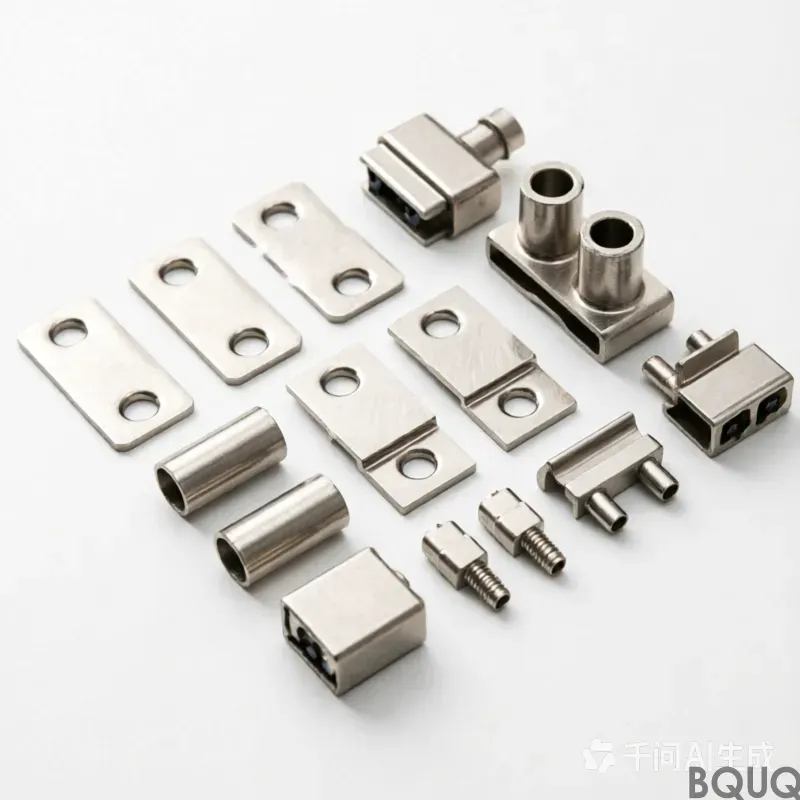
| Battery Busbar | C11000 Copper, Ni-plated | 0.3 - 1.0 mm | ±0.05 mm | $25,000 - $50,000 | 4 - 6 weeks |
| Cell Connector Tab | C10200 Copper | 0.1 - 0.3 mm | ±0.02 mm | $15,000 - $30,000 | 3 - 5 weeks |
What Cost Drivers Affect Automotive Stamping in 2025?
Material cost is the primary driver, representing 45% to 60% of the total part price. Copper prices at $9,200 per metric ton and aluminum at $2,500 per metric ton mean that a 1.0 mm thick busbar (50 g) costs $0.46 in raw material alone. Tooling amortization adds $0.10 to $0.50 per part depending on volume, while secondary operations like tapping, welding, and surface coating add 15% to 25%. To reduce costs, stampers now use in-die sensors to monitor wear in real time, extending die life from 500,000 to over 1 million strokes. For UHSS parts, hot stamping at 930°C forming temperature reduces press tonnage requirements by 30%, lowering capital expenditure for new lines.
How Can Engineers Validate Stamping Quality for Automotive Parts?
Validation combines in-process measurement with destructive testing. For every production lot, coordinate measuring machines (CMM) check critical dimensions on a sample size of 1 to 5 parts per hour, while optical comparators verify hole positions at 20x magnification. Tensile tests are performed on coupons from the same coil to confirm yield strength, e.g., 1,200 MPa for martensitic steel. For battery components, a 100% electrical conductivity test is mandatory, ensuring values above 58 MS/m for copper. Burr height is measured using a dial indicator with a 0.01 mm resolution, and surface roughness is verified with a profilometer to Ra 0.8 µm maximum for sealing surfaces on cooling plates.
What Are the Common Pitfalls in Automotive Stamping Projects?
The most common pitfall is underestimating springback in UHSS, which leads to poor fit-up in body assemblies; engineers should request a simulation report (AutoForm or LS-DYNA) before die cutting. Another issue is galling on aluminum dies, which can be mitigated by using a diamond-like carbon (DLC) coating with a friction coefficient below 0.1. For copper parts, incorrect die clearance causes excessive burrs that can puncture battery insulation layers, so always specify a clearance of 6% of material thickness. Finally, many engineers overlook the need for stress-relief annealing on cold-rolled steel, which must be performed at 650°C for 2 hours when forming complex geometries to prevent delayed cracking.
FAQ Section
What Is the Minimum Tolerable Thickness for Stamped Battery Tabs?
The practical minimum thickness for stamped copper tabs is 0.08 mm, though 0.1 mm is standard for production reliability. Below 0.08 mm, material handling and die alignment become unstable, increasing scrap rates above 5%. For 0.1 mm tabs, BQUQ holds a pitch tolerance of ±0.015 mm using a carbide progressive die with optical alignment.
How Long Does Stamping Tooling for a Battery Busbar Typically Last?
A well-maintained carbide progressive die for copper busbars lasts 1.5 to 2 million strokes before requiring re-sharpening. Re-sharpening removes 0.05 mm from the cutting edge and restores tolerances for another 800,000 strokes. At a production rate of 200 parts per minute, this translates to 125 hours of continuous operation per sharpening cycle.
Can Stamped Parts Replace Machined Battery Housings?
Yes, for high-volume production above 50,000 units per year, stamping is up to 40% cheaper than CNC machining of aluminum housings. Stamped enclosures achieve a wall thickness of 1.5 mm with a tolerance of ±0.1 mm, which is acceptable for non-sealing surfaces. However, for sealing faces requiring flatness under 0.05 mm, a secondary milling or grinding operation is necessary.
Why Is Nickel Plating Applied to Copper Battery Connectors?
Nickel plating, at 2 to 5 µm thickness, prevents oxidation of copper surfaces, which can increase electrical resistance by 15% over time. It also provides a harder surface to resist scratching during assembly, reducing the risk of short circuits. The plating process adds $0.02 to $0.05 per small connector part.
Which Stamping Press Tonnage Is Required for EV Battery Cooling Plates?
Battery cooling plates, typically 300 mm by 200 mm in 1.5 mm thick aluminum, require a press force of 80 to 120 tons. This calculation assumes a tensile strength of 290 MPa and a forming area of 600 cm² with a draw depth of 20 mm. For larger enclosure panels up to 1.2 meters long, a 400-ton press is recommended.
When Should Engineers Use Hot Stamping Instead of Cold Stamping?
Hot stamping is preferred when forming UHSS above 1,000 MPa tensile strength, as cold stamping causes severe springback and cracking. The process involves heating blanks to 930°C, forming in 5 seconds, and quenching in-die to achieve a martensitic structure. This method is cost-effective for volumes above 100,000 parts per year, despite higher energy costs of $0.08 per part.
How Does BQUQ Ensure Consistent Quality Across Large Production Runs?
BQUQ implements statistical process control (SPC) with a Cpk value of 1.67 or higher for critical dimensions on all automotive stampings. We use in-line vision systems that inspect 100% of parts for burr height and hole presence at a rate of 300 parts per minute. Additionally, every die is equipped with sensors that trigger automatic lubrication every 50 strokes, maintaining consistent friction conditions.
Conclusion
The automotive stamping industry is undergoing a structural transformation, driven by the dual demands of lightweighting for range and precision for battery safety. Engineers must adapt to tighter tolerances, new materials like nickel-plated copper, and hybrid processes that integrate stamping with laser and assembly steps. By partnering with a stamper that has proven experience in both body panels and battery components, you can navigate these changes without compromising quality or lead time. For a specific project evaluation, contact BQUQ for a comprehensive feasibility study and quotation within 12 hours. Email sc@bquq.com, WhatsApp +86 13713157787, or visit www.bquq.com.