Collet Chucks for Milling: Rigidity Under Side Load
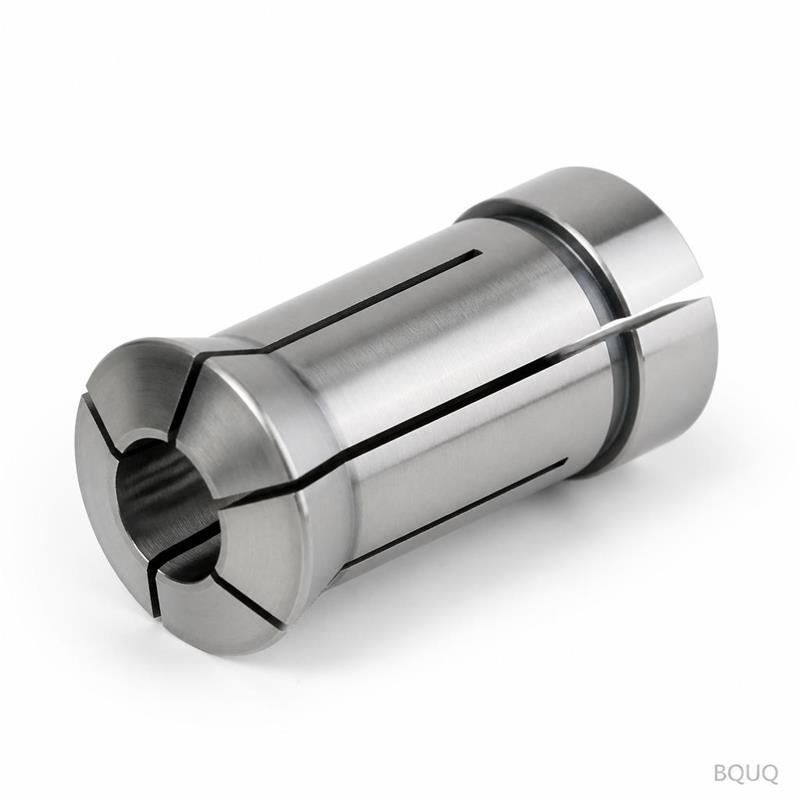
Short answer: A collet chuck holds a milling cutter rigidly only when three things line up — full 2/3-of-bore grip length on the shank, correct nut torque, and a collet that is round and clean. Under side load an ER32 chuck with a 20 mm shank at 60 mm gauge length typically deflects 10-25 µm at 1 kN radial force, and that deflection grows roughly with the cube of overhang. Push the same cutter out to 90 mm and deflection can triple. Buyers should specify TIR (0.005-0.010 mm typical for precision grade), nut torque, and grip length, not just "ER32". BQUQ machines and grinds these chucks in one ISO9001 Dongguan factory and quotes in 12 working hours.
Why side load is the wrong question to ask first
Milling is not drilling. A drill pushes mostly along its own axis, so the collet's job is largely axial grip. A milling cutter sees a radial cutting force that changes direction with every tooth pass, and that force acts as a bending moment on the whole stack: cutter shank, collet, nut, chuck body, spindle taper.
That bending moment is what engineers mean by "side load". It does not break collets. It bends the assembly, and the bending shows up as:
- Tool deflection at the cutting edge — the dominant source of dimensional error and chatter.
- Micro-slippage between shank and collet bore — the source of pull-out and of gradual TIR drift.
- Uneven tooth load — one flute cuts more than the others, which wears the cutter faster and worsens surface finish.
So the useful question is not "can a collet chuck take side load?" It is "how much does this specific chuck assembly deflect, and how much of the load reaches the collet bore instead of the spindle face?"
The geometry that actually controls rigidity
Grip length: the 2/3 rule
A collet grips along its bore. If the cutter shank only enters the front third of the collet, the rear portion of the collet collapses inward without contacting anything, the collet cants in the nut, and the assembly loses both concentricity and stiffness.
The working rule in most shops: insert the shank so it occupies at least two-thirds of the collet bore, and never less than the shank diameter in length. For an ER32 collet (46 mm overall, roughly 40 mm usable bore), a 20 mm shank should sit 26-30 mm deep.
| Collet size | Nominal bore range | Typical usable grip | Minimum grip for a 12 mm shank |
|---|---|---|---|
| ER16 | 1-10 mm | ~24 mm | 12-16 mm |
| ER20 | 1-13 mm | ~30 mm | 12-16 mm |
| ER25 | 1-16 mm | ~34 mm | 14-18 mm |
| ER32 | 2-20 mm | ~40 mm | 16-22 mm |
| ER40 | 3-26 mm | ~46 mm | 18-26 mm |
Figures are typical for standard DIN 6499 collets; verify against the specific supplier drawing.
Overhang: the cubic penalty
Deflection of a cantilever scales with the cube of unsupported length. Going from 50 mm to 75 mm gauge length is a 1.5× length increase and a theoretical 3.4× deflection increase for the same force. This is why a stubby collet chuck often outperforms a longer, nominally "stiffer" holder.
Practical consequence: choose the shortest chuck that clears the workpiece and fixture. If you must reach deep, accept that you are trading rigidity for reach and reduce radial depth of cut accordingly.
Nut type and bearing
The nut does two jobs: it pushes the collet into the chuck's 16° taper, and it must do so without twisting the collet. A plain nut drags on the collet face and can rotate it slightly as it tightens. A bearing nut (needle or ball) decouples rotation from clamping, so the same hand torque produces higher and more consistent clamping force.
| Nut type | Clamping force at equal torque | TIR consistency | Best use |
|---|---|---|---|
| Plain nut | Baseline | Fair | Light finishing, low volume |
| Ball-bearing nut | ~1.3-1.6× baseline | Good | General milling |
| Needle-bearing nut | ~1.5-1.8× baseline | Very good | Heavy roughing, high RPM |
Multipliers are indicative ranges from typical supplier data, not guaranteed values.
What TIR really costs you in a milling cut
Total indicated runout is the sum of chuck taper error, collet error, nut seating error, and shank error. A 0.010 mm TIR at the collet face can become 0.020-0.030 mm at the cutter tip once overhang is added.
In milling, runout means one flute does most of the work. With a 4-flute cutter and 0.020 mm runout, the high flute can carry 40-60% more chip load than the average. That flute chips first, heats first, and sets the wear limit for the whole tool.
For a deeper treatment of measuring and controlling this, see our guide on how to measure and control collet TIR.
Clamping pressure: how much is enough, and when is it too much
More torque is not automatically better. Over-tightening a collet past its elastic range permanently bell-mouths the bore, after which it never grips evenly again — even at correct torque. Under-tightening lets the shank creep under alternating side load.
A practical approach for ER collets:
1. Clean the collet bore, the chuck taper, and the nut threads. A single chip in the taper can add 0.01 mm of TIR.
2. Seat the collet in the nut first, then thread onto the chuck — never press a loaded collet into the taper.
3. Tighten to the holder maker's rated torque with a torque wrench, not by feel.
4. Re-check after the first 30 minutes of cutting; new assemblies often settle.
We cover the mechanics of this in how collet clamping pressure affects accuracy and tool life.
Matching chuck design to the milling job
The chuck body itself matters. Wall thickness at the taper, the accuracy of the 16° angle, the hardness of the taper surface, and the concentricity of the nut thread all feed into the final result. A chuck ground after heat treatment holds its geometry far longer than one ground before.
For a full breakdown of these variables, see collet chuck design: taper, nut and body geometry.
| Milling operation | Suggested holder | Grip length | Typical TIR target |
|---|---|---|---|
| Finishing, small end mills | ER16 / ER20 collet chuck | ≥2/3 bore | 0.005-0.010 mm |
| General purpose milling | ER32 collet chuck | ≥2/3 bore | 0.008-0.015 mm |
| Heavy roughing | ER40 or TG100 collet chuck | ≥2/3 bore | 0.010-0.020 mm |
| Deep reach | Extended collet chuck, reduced depth of cut | ≥2/3 bore | 0.015-0.025 mm |
| High-volume production | Quick-change collet chuck | ≥2/3 bore | 0.005-0.010 mm |
TIR targets are typical values for precision-grade holders; general-purpose grades may be looser.
When a collet chuck is the wrong choice
Collet chucks are excellent generalists, but they are not always the rigid answer:
- Very high radial load with short overhang — a shrink-fit or hydraulic holder usually wins on stiffness and TIR.
- Cutter shanks with flats or weldon ends — a collet grips a round shank; a side-lock holder is designed for the flat.
- Repeated tool changes at high volume — quick-change systems reduce setup error, but add interfaces that must each be controlled.
For most job shops and mid-volume production, though, a well-made ER or TG collet chuck with correct grip length and torque is the best balance of cost, accuracy, and flexibility.
What to specify when you buy
If you are sourcing collet chucks or the collets that go in them, put these on the drawing or PO:
- Collet series and bore size, with tolerance class.
- Body taper accuracy and post-heat-treatment grinding requirement.
- Nut type (plain, ball-bearing, needle-bearing) and rated torque.
- TIR limit measured at a stated distance from the face.
- Material and hardness of the body and the collet.
- Balance grade if the application exceeds roughly 15,000 RPM.
BQUQ produces collet chucks and matching collets on four production lines in one Dongguan factory, with CNC machining held to ±0.005 mm and ISO9001 quality control. MOQ is flexible, which matters if you are validating a new holder before committing to volume. Browse the tool holder collet chuck range and the auto lathe collet series for the sizes we run most often.
Frequently Asked Questions
Q: Can I use an ER collet chuck for heavy milling?
A: Yes, within limits. An ER32 or ER40 chuck with full grip length, a bearing nut at rated torque, and short overhang handles most roughing in steel and aluminium. The constraint is usually deflection, not grip. If you need maximum rigidity at long reach, a shrink-fit or hydraulic holder will outperform a collet. For general milling, a correctly set up collet chuck is entirely adequate.
Q: How much runout is acceptable for a milling collet chuck?
A: For finishing work, aim for 0.005-0.010 mm TIR at the collet face. For general milling, 0.010-0.015 mm is workable. Above roughly 0.020 mm, one flute starts carrying a disproportionate chip load, which shortens tool life and degrades surface finish. Always measure at the cutter tip, not just at the collet, because overhang amplifies runout.
Q: Why does my cutter pull out of the collet during milling?
A: Pull-out almost always comes from insufficient grip length or insufficient clamping force. If the shank sits in only the front third of the collet, the rear bore never contacts it. Combine that with a plain nut tightened by feel, and alternating side load walks the cutter out. Clean the bore, insert to two-thirds depth, and torque the nut to the holder maker's rating.
Q: Does a bearing nut really improve milling rigidity?
A: It improves clamping consistency, which supports rigidity. A bearing nut converts more of your tightening torque into axial clamping force instead of friction against the collet face, typically 1.3-1.8× more at the same hand effort. That means less chance of under-clamping and less chance of twisting the collet during tightening. The chuck body and taper still set the rigidity ceiling.
Q: How often should milling collets be replaced?
A: Replace when TIR drifts beyond your target, when the bore shows scoring or bell-mouthing, or when the collet no longer grips a known-good shank evenly. In mixed production, many shops inspect collets quarterly and retire the ones used for roughing more often. Collets are consumables; a worn one quietly costs you tool life and scrap long before it fails visibly.
Related Resources
- About BQUQ and our Dongguan manufacturing footprint: /about/
- Collet chucks, tool holders and power chucks: /tool-holder-collet-chucks/
- Auto lathe collet series for Swiss-type and cam machines: /auto-lathe-collets/
- Power chucks and Swiss-type workholding: /power-chucks-swiss/
- Industry trends in precision manufacturing: /industry-dynamics/
- Technical articles and engineering guides: /bquq-blog/
- Frequently asked questions: /faq/
- Case studies: /case/
- Contact the engineering team: /contact/
Authored by the BQUQ Engineering Team. BQUQ (Dongguan) runs CNC machining (±0.005 mm), metal stamping, custom springs, and heat sink production in one ISO9001 factory. Source-direct from Dongguan, China — quote in 12 hours: sc@bquq.com | WhatsApp +86 13713157787 | www.bquq.com