Robot gripper return torsion springs: constant torque ±5%, 10-million-cycle life verification, double-torsion formed in one pass, 48-hour samples. BQUQ custom torsion springs.
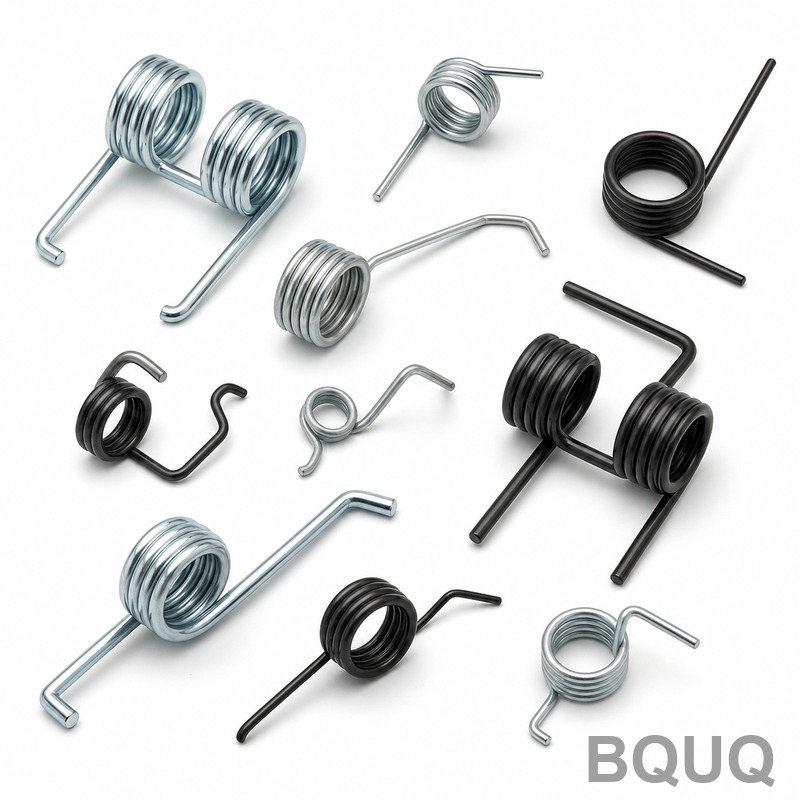
Robot Gripper Torsion Return Spring: Constant Torque ±5%, 10M-Cycle Life, 48H Sample
A robot gripper return torsion spring directly decides repeatability feel and service life: torque that wanders makes grip force unstable; arms at the wrong angle make assembly fight you. Torsion springs are the most demanding of all spring types - they load in three dimensions, and free angle, torque and arm length all interact, so tight tolerances multiply the difficulty.
Project Background & Challenge
A collaborative robot maker was developing the return spring for a two-finger gripper: stainless wire, 0.8mm diameter, 4.5 coils, torque constant within ±5% across the working angle, 10-million-cycle life, and arm angle tolerance of ±2°. Previous samples drifted in torque, so grip force on small parts varied noticeably.
The challenges: torque is tightly coupled to coil count and free angle - small coiling variations shift torque; arm length and angle must be set by a final sizing operation; and the 10M-cycle life requirement means zero coiling scratches - a scratch is a crack starter.
BQUQ Process Solution
Coiling & Sizing
CNC coiling machines with closed-loop control of coil count and pitch. After coiling, both arms are sized on dedicated fixtures to drawing length and angle; stress-relief temper temperature matches material and wire size, and hardness and torque are verified together after temper.
Torque Sorting & Fatigue Verification
Every finished spring is torque-measured at the working angle; anything outside ±5% is rejected. Fatigue testing to 10 million cycles is sampled per batch with life curves; surfaces are 100% visually checked plus sampled magnetic particle inspection so scratched parts never ship.
Key Specifications
| Item | Specification |
|---|---|
| Material | Stainless / music wire / 17-7PH (per drawing) |
| Wire diameter | φ0.3-2.0mm |
| Torque tolerance | ±5%, 100% sorted at working angle |
| Arm angle | ±2° |
| Fatigue life | 10M cycles, batch sampling with curves |
| Samples | 48 hours |
| Inspection | 100% torque sorting + profile projector + fatigue tester |
Quality Control & Delivery
Samples ship in 48 hours; after the customer's build validation the program moves to volume. Per-batch first-article checks, in-process torque sampling and scheduled fatigue tests keep the data trail complete. Material lots are traceable and surfaces are checked part by part.
Related Products & Resources
To see more parts in this category and how we scale them, browse the Torsion Springs category page, or these related products:
Related Q&A: Which Spring Wire Is Better: Music Wire or Oil-Tempered Wire? More Q&A is in our FAQ Center.
For our capabilities, equipment and quality system, visit About BQUQ and Factory Strength.
FAQ
Can you really hold torque within ±5%?
Yes. Closed-loop coiling parameters set the baseline, then every spring is torque-measured at the working angle and sorted - anything out of band is rejected, so every delivered piece is inside tolerance.
How is the ±2° arm angle guaranteed?
Dedicated sizing fixtures set both arms after coiling, parameters are tuned from measured data and locked; a post-temper step prevents arm springback, and angles are verified by profile projector sampling.
What supports a 10-million-cycle life?
Three pillars: incoming wire verification, scratch-free coiling, and documented temper parameters - plus fatigue sampling per batch with curves shipped. No shortcuts on material or surface.