Telecom structural components machined in one setup on a 4-axis center: unified datums, hole positions ±0.008mm, modular fixtures for fast revisions. BQUQ precision CNC.
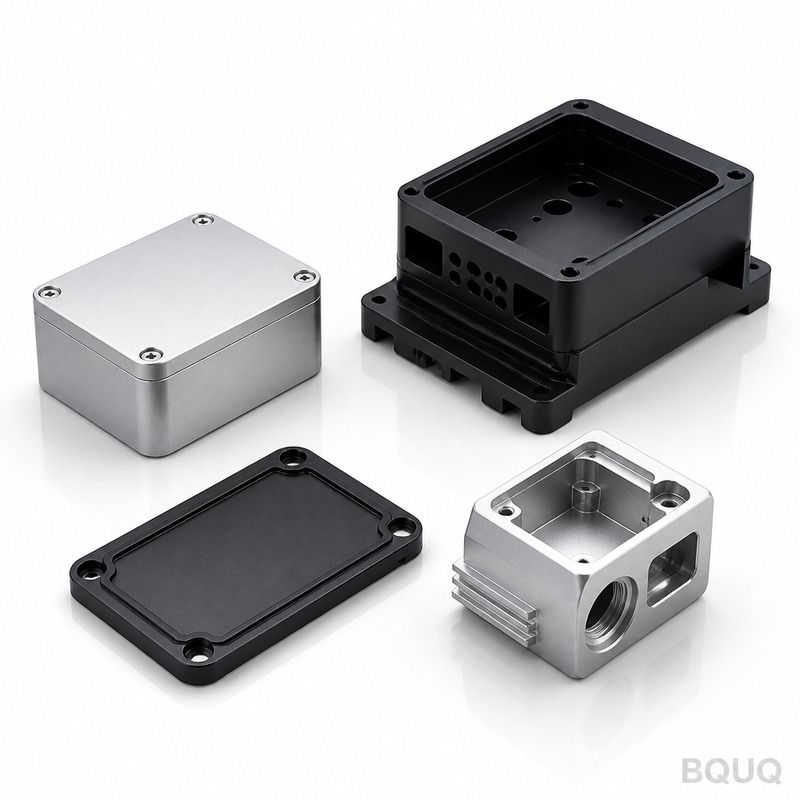
Telecom Structural Component One-Setup CNC Machining: Datum-Based Integration, ±0.008mm
Telecom structural parts are classic "simple to look at, painful to make": a cavity with dozens of holes, three mounting datum faces, threads and dowel holes, where the positional relationship between any two features cannot drift. The real test is not single-hole accuracy - it is datum unity. When the datum faces, holes and slots are all machined in one setup, positional relationships are guaranteed by the machine, not by luck.
Project Background & Challenge
A telecom equipment maker was developing a structural component for its next-generation base station: 6061-T6 aluminum, 260×180×60mm cavity body, positional tolerance of 0.02mm across three mounting datum faces, key hole positions ±0.008mm, including threads, dowel holes and cooling slots, 500 pieces per batch with 3-4 revisions a year. The customer explicitly required one-setup multi-face machining - "machining faces separately and hoping inspection catches the errors" was not acceptable.
The challenges: thin cavity walls tend to chatter; every extra clamping step adds error accumulation on multi-face work; and frequent revisions demand modular programs and fixtures instead of a full new tooling package per change.
BQUQ Process Solution
One-Setup Process Design
A 4-axis machining center with a custom zero-point locating fixture machines the base datum, cavity and side hole patterns in one setup - all features share one coordinate system, removing clamping error from the chain. Thin-wall areas get local supports to suppress chatter.
Modular Programs & Fixtures
Fixtures are built on a zero-point system: revisions only swap the locating module, not the base. Programs are organized by feature modules, so a drawing change touches only the affected module - updated and first-piece verified within 48 hours.
Key Specifications
| Item | Specification |
|---|---|
| Material | 6061-T6 aluminum |
| Datum positional tolerance | 0.02mm |
| Key hole positions | ±0.008mm |
| Machining | 4-axis one-setup multi-face, zero-point fixture |
| Volume | 500 pcs/batch, 3-4 revisions per year |
| Inspection | CMM full layout with positional evaluation, CPK report per batch |
| Delivery | Samples 7 days, production 2 weeks |
Quality Control & Delivery
First article is fully dimensioned and position-checked before release; last-piece re-verification per batch monitors tool-wear drift. On revision changeovers the new drawing is first-article inspected in full before batch switch. Samples in 7 days, production in 2 weeks, revision samples stable at 48 hours.
Related Products & Resources
To see more parts in this category and how we scale them, browse the CNC Milling Parts category page, or these related products:
Related Q&A: What Are Multitasking CNC Machines and Why Are They Now Standard in Precision Manufacturing? More Q&A is in our FAQ Center.
For our capabilities, equipment and quality system, visit About BQUQ and Factory Strength.
FAQ
Can one setup really hold all hole positions?
Yes. On a 4-axis center with a zero-point fixture, every feature is machined in one coordinate system, so positional relationships come from machine accuracy and the program - then verified by CMM sampling with CPK data included per batch.
How do you handle chatter on thin cavity walls?
Adjustable supports brace thin-wall zones to change the dynamic stiffness of the process system; roughing and finishing are separated, and finishing runs at light depth with higher spindle speed to suppress vibration marks.
Will frequent revisions hurt lead time?
No. Zero-point modular fixtures and feature-based programs mean a revision touches only the affected module - first article in 48 hours, batch switch after verification.