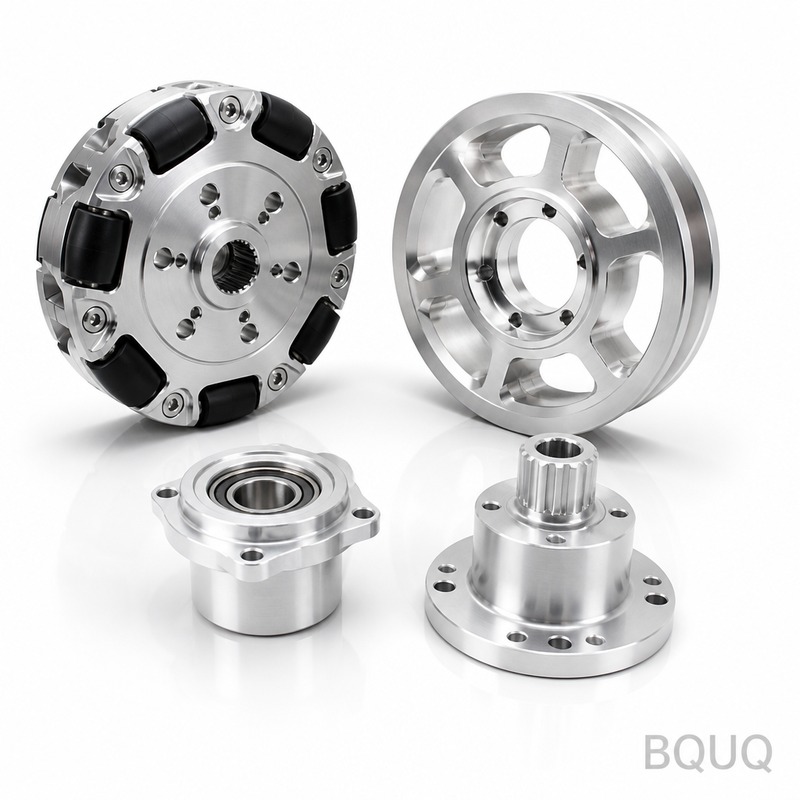
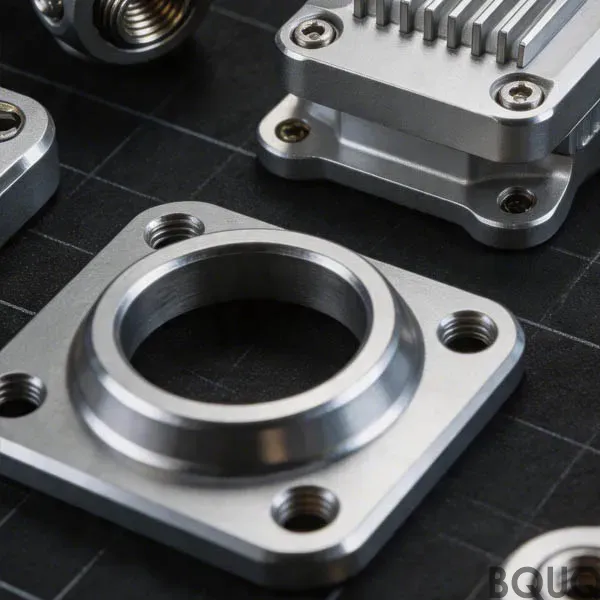
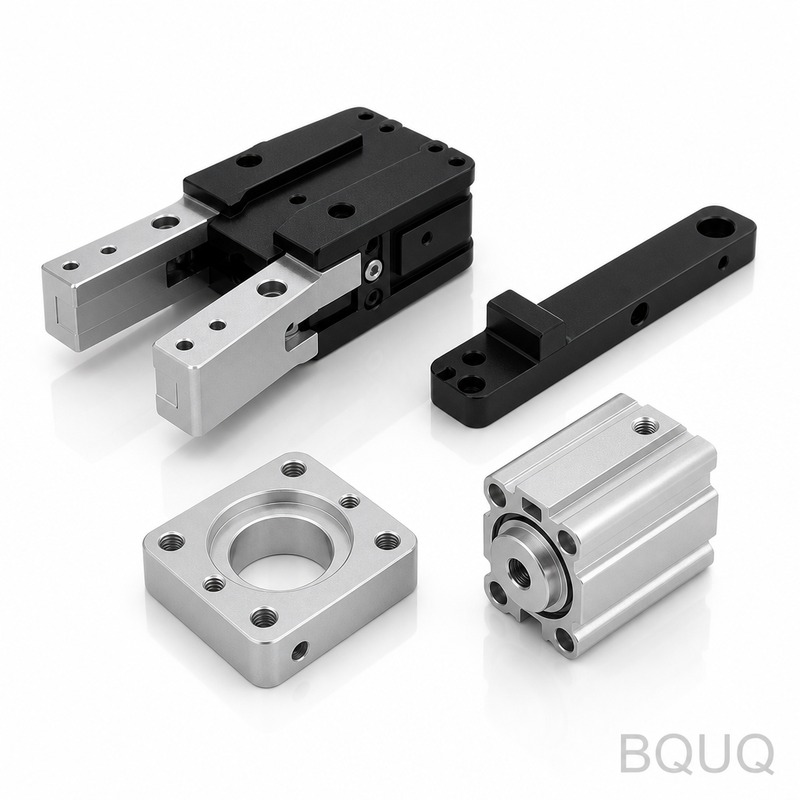
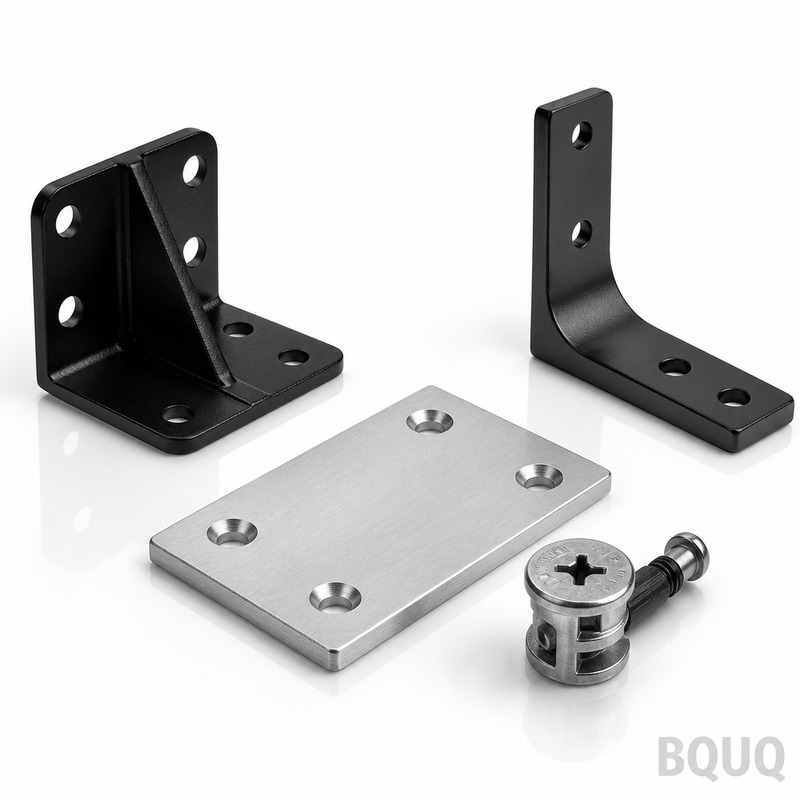
BQUQ’s CNC machined robot wheels hubs are the rotational backbone for AGVs, collaborative arms, and mobile platforms that demand zero-wobble performance at speed. We hold runout t
BQUQ’s CNC machined robot wheels hubs are the rotational backbone for AGVs, collaborative arms, and mobile platforms that demand zero-wobble performance at speed. We hold runout to 0.005 mm and surfa
Get a Fast Quote for This Part
Send us your drawing / quantity / material — reply within 24h.
BQUQ’s CNC machined robot wheels hubs are the rotational backbone for AGVs, collaborative arms, and mobile platforms that demand zero-wobble performance at speed. We hold runout to 0.005 mm and surface finish to Ra 0.8 µm on every hub face, with a standard 15-day lead time after drawing approval. Hardness reaches 32–38 HRC on 7075-T6 aluminum or 48–52 HRC on 4140 steel—so you get a hub that survives 10,000+ hours of start-stop cycles without fatigue cracks.
Runout Control: How We Keep Your Wheel True at 3,000 RPM
Runout is the enemy of every robot wheel. A 0.03 mm wobble at 2,000 RPM creates vibration that kills encoder accuracy and strips gearbox teeth. We machine the bore, the flange face, and the pilot diameter in a single clamping operation on our Mazak 5-axis mills. That means the datum never shifts between cuts. Final inspection uses a Talyrond 365 roundness tester—not a dial indicator—to certify 0.005 mm total indicated runout (TIR) on the tire seat. For dual-wheel differential drives, we match left and right hubs within 0.002 mm of each other so your robot tracks straight without software compensation.
Materials and Heat Treatment: 7075-T6 vs. 4140 vs. Titanium
We stock three hub grades. For weight-critical drones and surgical robots: 7075-T6 aluminum, 32–38 HRC, with a hard anodize (50 µm) that resists wear from set screws. For heavy payload AGVs (over 500 kg): 4140 chromium-moly steel, quenched and tempered to 48–52 HRC, then black oxide coated. For corrosive washdown environments: 6Al-4V titanium, 36–42 HRC, passivated per ASTM A967. Every heat treatment lot comes with a mill certificate—we do not guess hardness. If your hub carries a harmonic drive, we also offer a nitride finish on the bore that drops friction coefficient to 0.05.
A solid hub is a lazy hub. We can remove 40% of the material weight with CNC pocketing while keeping stiffness above 20 kN/mm. Our 5-axis programming creates elliptical stress-relief pockets that follow the load path, not decorative cutouts. For a 200 mm diameter hub, that means 1.2 kg instead of 2.0 kg—your servo motor sees lower inertia and accelerates 18% faster. We verify pocket wall thickness with ultrasonic testing on every fifth piece. If you need a custom spoke pattern for a specific wheel rim bolt circle (e.g., 4x100 mm or 6x139.7 mm), send the rim drawing and we will match it exactly.
Fastener and Keyway Integration: No Slippage, No Backlash
Robot hubs fail most often at the joint—the keyway or the set screw. We machine keyways to ISO 6886 tolerance P9, which gives a 0.00 to +0.012 mm interference fit against a hardened key. For set screw locations, we drill a 60-degree conical dimple so the screw seats into a positive lock, not a flat surface. We also offer spline broaching up to 12 teeth on the hub bore, with a pitch diameter tolerance of 0.008 mm. If you use a collet lock system, our bore finish at Ra 0.4 µm ensures the collet grips without galling. Every hub includes a tapped puller hole (M8 or M10) so maintenance crews can extract the hub without a gear puller damaging the shaft.
Inspection Before Every Shipment: CMM and Runout Report
We do not ship a hub without a paper trail. Each batch goes through a Zeiss CMM for bore diameter, bolt circle position, and concentricity. A separate runout fixture spins the hub at 500 RPM while a laser sensor records TIR at 12 angular points—you get a PDF graph with the maximum deviation. Surface finish is checked with a Mitutoyo SJ-210 profilometer on the flange face and the bore. Material hardness is verified with a Rockwell tester on a sacrificial lug. For critical aerospace or medical hubs, we include a full dimensional report with 100% inspection; for standard AGV hubs, we inspect 30% and keep the rest on statistical process control. All reports are archived for 10 years.
Your robot is not off-the-shelf, so your hub should not be either. We machine bores from 6 mm to 120 mm diameter, with any tolerance from H6 to H8. Bolt patterns can be 3, 4, 5, or 6 holes, with bolt circle diameters up to 300 mm and angular spacing held to ±0.01 degrees. Offset (the distance from the mounting face to the tire center) can be from -10 mm to +80 mm, allowing you to widen the track without changing the chassis. We also cut a chamfer on the outer edge at 45° x 1.5 mm to prevent tire bead damage during installation. Send us your motor shaft drawing and rim spec—we will reverse engineer the rest.
Finishing Options: Anodize, Powder Coat, or Zinc-Nickel
Bare aluminum corrodes in humid warehouse air. We offer three standard finishes. Hard anodize (MIL-A-8625 Type III) to 50 µm thickness, which gives a surface hardness of 60 HRC equivalent—good for set screw torque retention. For steel hubs, we apply zinc-nickel plating (8–12 µm) with a clear trivalent chromate, passing 500 hours of salt spray per ASTM B117. If you need a low-friction surface for a rubber tire, we apply a PTFE-impregnated anodize that reduces coefficient of friction to 0.08. Color options include black, clear, or custom RAL for visual identification of left/right hubs. All finishes are RoHS compliant.
What is the minimum order quantity for CNC machined robot wheels hubs?
We have no MOQ—you can order a single prototype hub for validation, and the price per piece drops as quantity increases (e.g., 1 piece vs. 500 pieces).
Can you machine a hub from my 3D drawing or a sample part?
Yes, we accept STEP, IGES, or PDF drawings, and we can also reverse-engineer from a physical sample using our CMM scanner within 48 hours.
How do you ensure quality for a batch of 1,000 hubs?
First article inspection (FAI) on the first piece, then in-process checks every 50 pieces for bore diameter and runout, with a final CMM report on 30% of the batch.
What is the fastest lead time for a rush order?
For a standard 6061-T6 aluminum hub with no heat treatment, we can ship in 7 days if you approve the drawing within 24 hours; steel with heat treatment takes 12 days minimum.
Why Engineers Choose BQUQ for Precision Manufacturing in China
We are a 20-year-old factory in Dongguan, China, running 34 CNC machines including Mazak 5-axis and Okuma lathes. Our shop floor temperature is controlled to 22°C ±1°C so aluminum does not expand during machining—this is why we hold 0.005 mm runout consistently. We also keep an internal tooling library with over 2,000 inserts and end mills, which means we do not waste days ordering tooling for your job. For a deeper look at how we select cutting tools for hard materials, read our CNC cutting tool selection guide. And if you are wondering how tight we can push your bore tolerance, see our CNC machining tolerances guide.
Get a Firm Quote Within 12 Hours
Send your hub drawing (PDF or STEP) and we will respond with a firm unit price, confirmed lead time, and a DFM (design for manufacturing) note if we spot a potential issue—like a sharp internal corner that will crack under load. We quote in USD or RMB, and we ship DDP to your door if you want no customs hassle. Email us at sc@bquq.com or message our engineer directly on WhatsApp at +86 13713157787. No MOQ, no design fee for the first revision. Attach your drawing now and get a quote before your coffee goes cold.