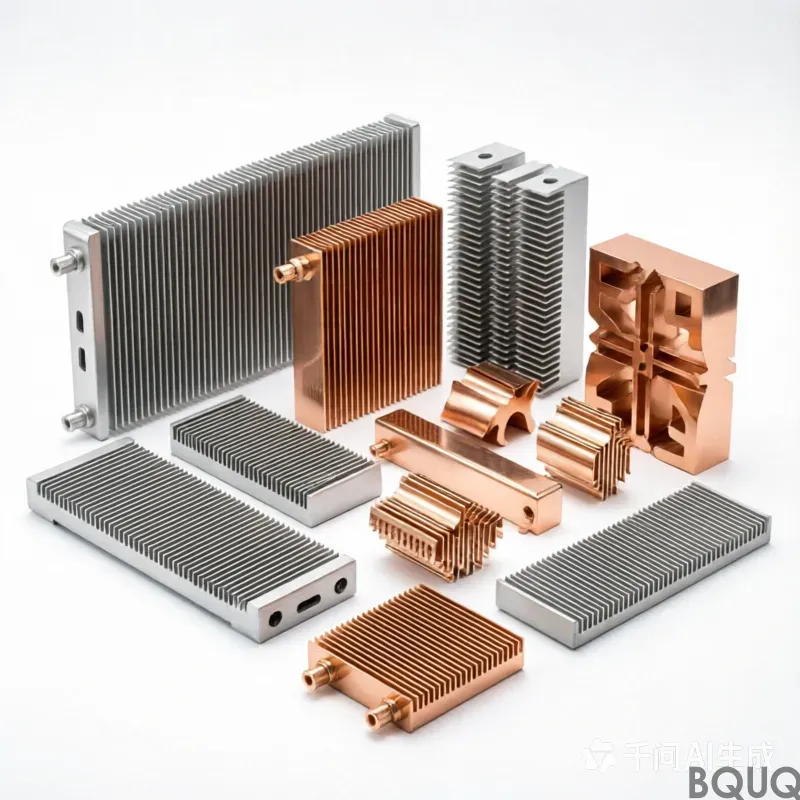
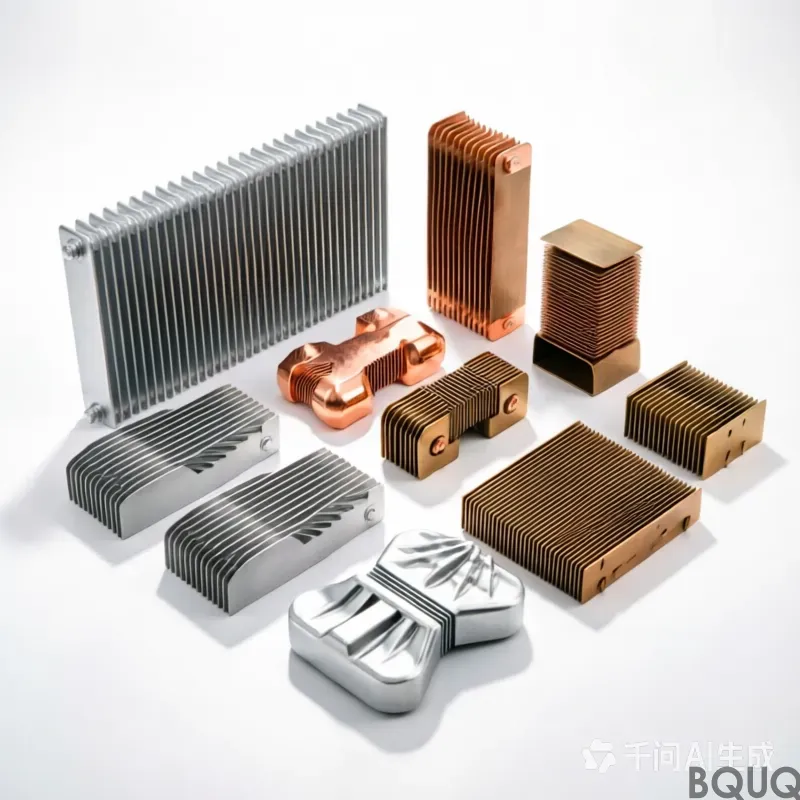
What This Round LED Bulb Heatsink Does and Why It Matters This is a CNC-machined Round LED Bulb Heatsink built for high-wattage retrofit bulbs where plastic housings fail. You get
Round LED Bulb Heatsink Precision CNC Machining | BQUQ China
What This Round LED Bulb Heatsink Does and Why It Matters This is a CNC-machined Round LED Bulb Heatsink built for high-wattage retrofit bulbs where plastic housings fail. You get a guaranteed tolera
Get a Fast Quote for This Part
Send us your drawing / quantity / material — reply within 24h.
What This Round LED Bulb Heatsink Does and Why It Matters
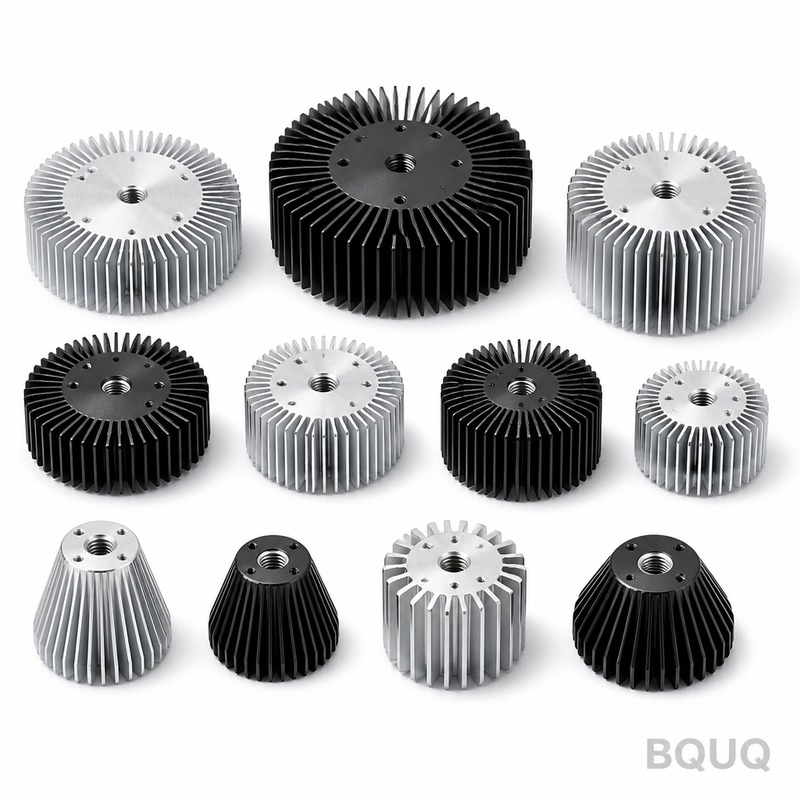
This is a CNC-machined Round LED Bulb Heatsink built for high-wattage retrofit bulbs where plastic housings fail. You get a guaranteed tolerance of ±0.01 mm on all critical diameters, a total runout of 0.02 mm, and a surface finish of Ra 1.6 µm — enough to press-fit a driver without secondary operations. Lead time is 18 days from drawing approval, with no MOQ, so you can validate one unit or order 10,000.
Why Runout of 0.02 mm Keeps Your LED Junction Temperature Stable
Runout is the hidden killer of LED bulb performance. If the heatsink base wobbles more than 0.02 mm relative to the threaded socket, the thermal interface material compresses unevenly — hot spots develop, and the die temperature rises by 8–12°C. Every Round LED Bulb Heatsink we machine is turned between centers on a 5-axis CNC lathe, not a chuck, so the bore, the fin tips, and the NPT thread all reference the same axis. That is the difference between a bulb that lasts 50,000 hours and one that fails at 20,000.
Aluminum Alloy Selection: 6061-T6 vs. 1070 for Your Wattage Range
We machine two alloys depending on your target lumen output. For bulbs under 15W, we use 6061-T6 (hardness 95 HRB, thermal conductivity 167 W/m·K) — it anodizes cleanly and resists corrosion in humid fixtures. For 20W and above, we switch to 1070 pure aluminum (conductivity 226 W/m·K) which pulls heat away from the COB faster, but it is softer — we compensate with a 0.5 mm thicker fin wall to prevent bending during assembly. If you are designing for a 40W retrofit, we will recommend 1070 with an 8-fin geometry and a 45 mm base diameter. Tell us your wattage in the drawing, and we will verify the thermal model for free.
Fin Geometry We Actually Machine: Depth, Pitch, and Draft Angles
Fin pitch on a round heatsink is not cosmetic — it sets the natural convection airflow. We machine fins from 1.0 mm to 2.5 mm pitch, with a depth-to-width ratio up to 8:1 using a 0.8 mm carbide end mill. The draft angle is 1.5° on the inner fins and 2° on the outer, so the part releases from the die without galling. If you need a press-fit of a metal collar, we leave a 0.1 mm interference zone on the outer diameter and polish it to Ra 0.8 µm. Standard fin count is 12 to 24, but we have done 36 fins on a 60 mm bulb — that is a 0.9 mm wall, which requires our 20,000 RPM spindle, not a standard VMC.
Thread and Socket Fit: NPSM, E26, and E27 Without Binding
The threaded base is where most Chinese heatsinks fail — they cut threads with a die, which gives you runout and a sloppy fit. We cut E26 and E27 threads on the CNC lathe with a single-point insert, holding pitch diameter to ±0.05 mm. For US retrofit bulbs, we machine an NPSM thread with a 0.75° taper per side, which seals against the socket shoulder. We also add a 0.2 mm chamfer on the thread start to prevent cross-threading. If you are using a plastic Edison base, we can machine a knurled ring instead — 0.3 mm depth, 45° diamond pattern, which gives you a 30% stronger grip than a smooth cylinder.
Surface Finish Options: Clear Anodize, Black Anodize, or Electroless Nickel
Surface finish is not just cosmetic — it affects emissivity. A clear anodized finish (8–12 µm) gives an emissivity of 0.77, which radiates heat effectively. Black anodize (with a copper sulfate seal) raises that to 0.92, but it adds 3 days to lead time. For outdoor bulbs, we apply electroless nickel (50 µm) which resists salt spray for 500 hours per ASTM B117. We do all three finishes in-house, so you do not pay a third-party markup. Standard is clear anodize — that is what we quote in the 18-day lead time.
Inspection Before Every Shipment: CMM, Surface Profilometer, and Air Gauge
Every Round LED Bulb Heatsink gets a full dimensional report — not a random sample. We use a Zeiss CMM for critical diameters and thread pitch, a Mitutoyo surface tester for Ra on the base, and an air gauge for bore runout. We also check flatness on the LED mounting surface to 0.005 mm — that is the surface that touches your COB. If any dimension is out of spec, the part is scrapped, not reworked. You get the report as a PDF with your packing slip. For orders above 500 pieces, we include a 3D scan of one part from the batch.
Specification
Value
Notes
Available Materials
6061-T6, 1070, 5052-H32
1070 for high wattage
Hardness (6061-T6)
95 HRB
Fully aged, not soft
Dimensional Tolerance
±0.01 mm
On all critical diameters
Runout (TIR)
0.02 mm
Measured on base bore
Surface Finish (Base)
Ra 0.8 µm
Polished for TIM contact
Surface Finish (Fins)
Ra 1.6 µm
As-machined, no secondary
Fin Pitch Range
1.0 – 2.5 mm
Depth ratio up to 8:1
Thread Types
E26, E27, NPSM
Single-point cut, not die
Lead Time
18 days
From drawing approval
MOQ
No MOQ (1 piece)
Prototype to production
How We Avoid Burrs and Sharp Edges That Cut Your Assembly Hands
Burrs on the fin tips are a common injury risk during assembly. We use a 0.2 mm edge break on every external corner — this is a CNC operation, not a hand file. We also tumble the parts for 30 minutes in a ceramic media before anodizing, which removes any micro-burrs inside the fins without changing the dimensions. If you are using automated pick-and-place assembly, we can add a 0.5 mm chamfer on the top edge to guide the feeder. This is included in the standard price — no extra charge.
Packing for Transit: No Bent Fins, No Scratched Anodize
Thin fins bend easily in cardboard boxes. We pack each Round LED Bulb Heatsink in a separate EPE foam sleeve, then place them in a rigid corrugated box with a 5-layer partition. For orders over 1,000 pieces, we use a vacuum-formed tray that locks each unit in place. We test-drop our packaging from 1.2 meters onto concrete — no fin deformation, no anodize scratches. This is standard practice, not a premium option.
What is the minimum order quantity for a custom Round LED Bulb Heatsink?
There is no MOQ — you can order one prototype to test fit or 10,000 units for production, and the unit price only drops slightly due to setup amortization.
Can you match my existing heatsink design if I only have a sample, not a drawing?
Yes, we can reverse-engineer a physical sample using our 3D scanner with ±0.005 mm accuracy, and we will send you a CAD file for approval before cutting any metal.
How do you guarantee quality on a small batch of 50 pieces?
Every single part is inspected on the CMM and air gauge, regardless of batch size — we do not use AQL sampling for heatsinks because a single bad part can fail in the field.
What is the fastest lead time for a rush prototype?
For a standard 6061-T6 heatsink with clear anodize, we can ship a prototype in 7 days if you approve the drawing by 10 AM China time — the 18-day lead time applies to production batches.
For your Round LED Bulb Heatsink project, we offer a firm quote within 12 hours of receiving your drawing — no hidden tooling costs, no surprises. Email us at sc@bquq.com or reach us on WhatsApp at +86 13713157787. Send your drawing (STEP, IGES, or PDF) and we will respond with pricing, a DFM check, and a lead time. If you are still selecting tooling or tolerances, read our CNC cutting tool selection guide and our CNC machining tolerances guide to understand what we can hold on your design. BQUQ is a precision manufacturing factory in Dongguan, China, with 20 years of CNC machining, stamping, and spring experience — your heatsink is machined in-house, not outsourced.