OEM extruded heat sink service: copper-alloy CuZn37, 1.0 mm fins at 4.0 mm pitch, 0.05 mm over 100 mm flatness, 0.35 K/W thermal resistance. MOQ 500 pcs, shi...
OEM extruded heat sink service
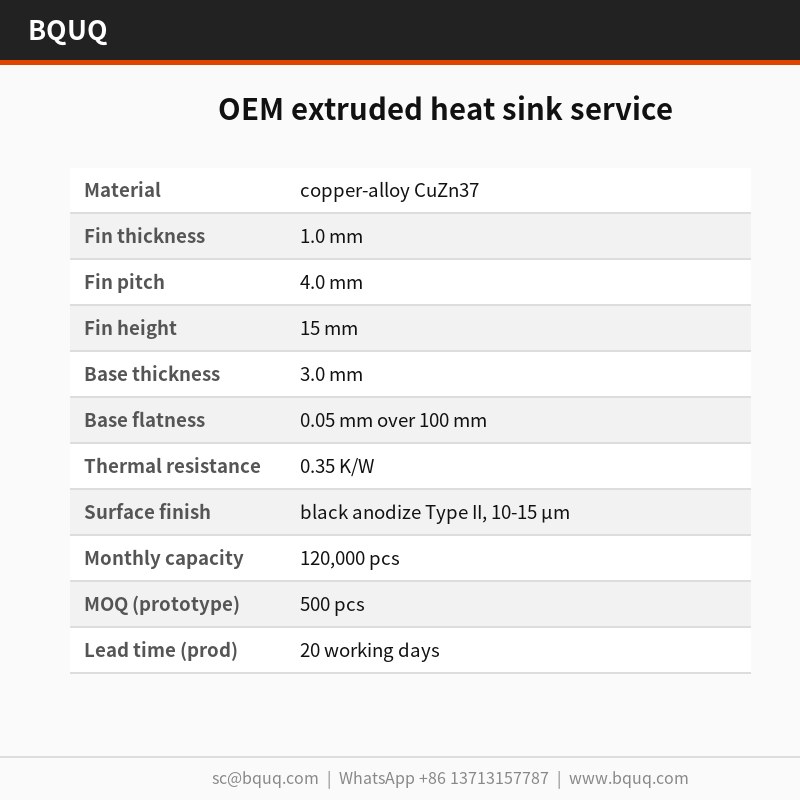
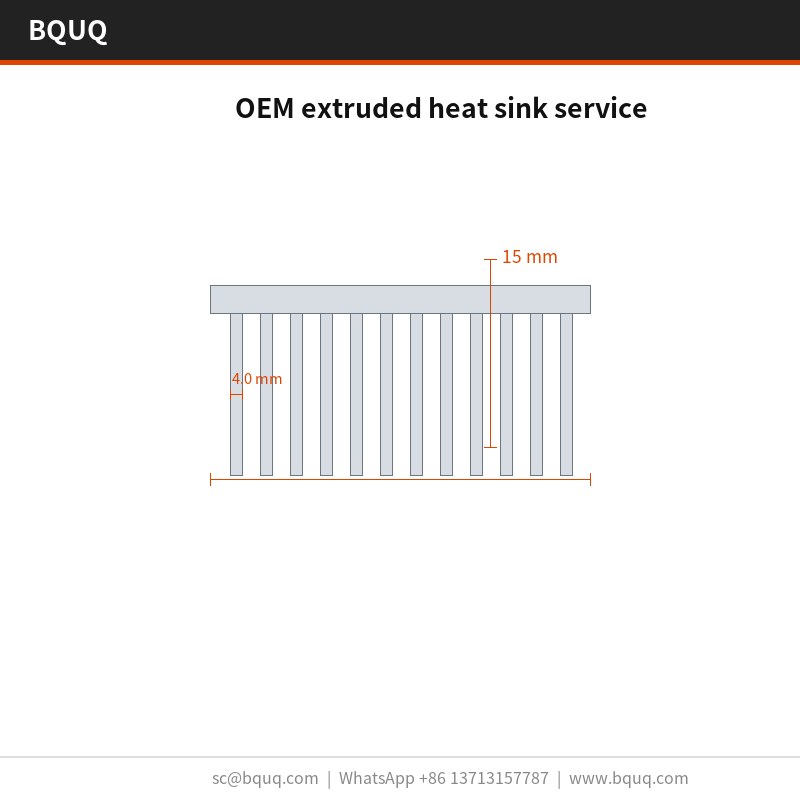
OEM extruded heat sink service: copper-alloy CuZn37, 1.0 mm fins at 4.0 mm pitch, 0.05 mm over 100 mm flatness, 0.35 K/W thermal resistance. MOQ 500 pcs, shi...
Get a Fast Quote for This Part
Send us your drawing / quantity / material — reply within 24h.
OEM extruded heat sink service from BQUQ uses CuZn37 copper alloy with 1.0 mm fins and a 3.0 mm base flat to 0.05 mm over 100 mm, rated 0.35 K/W at ΔT = 60 K. Stamping holds fin pitch within ±0.03 mm across a 120,000 pcs run on a 160 T press with an 18 s cycle. Black anodize Type II, 10-15 µm is standard.
Key Takeaway
OEM extruded heat sink service from BQUQ uses CuZn37 copper alloy with 1.0 mm fins and a 3.0 mm base flat to 0.05 mm over 100 mm, rated 0.35 K/W at ΔT = 60 K. Stamping holds fin pitch within ±0.03 mm across a 120,000 pcs run on a 160 T press with an 18 s cycle. Black anodize Type II, 10-15 µm is standard.
Our OEM extruded heat sink service uses copper-alloy CuZn37 with 1.0 mm fins and a 3.0 mm base flat to 0.05 mm over 100 mm. Rated 0.35 K/W at ΔT = 60 K, it supports VFD and inverter builds at 120,000 pcs monthly output with black anodize Type II, 10-15 µm as standard.
Design Approach and Process
Stamping gives a repeatable 1.0 mm fin profile that extrusion cannot hold: the die forms every fin in one stroke, so pitch stays within ±0.03 mm across a 120,000 pcs run.
A single 160 T stroke forms the whole OEM extruded heat sink service, so part cost stops scaling with complexity. Tooling runs ±0.03 mm, and the 18 s cycle feeds a 120,000 pcs line.
One supplier now covers 1.0 mm to 1.0 mm fin gauges from the same 160 T press family, so a thermal redesign is a tooling change rather than a new vendor.
Every stroke is dimensionally identical, so ±0.15 mm hole position carries across the batch. That is what makes VFD and inverter volume programs repeatable.
The black anodize Type II, 10-15 µm finish is applied after forming, so corrosion protection does not get cut through at the fin roots the way it does on machined alternatives.
Material Selection and Surface Finish
The standard material is copper-alloy CuZn37, supplied with black anodize Type II, 10-15 µm. For applications where VFD and inverter exposure is a concern, we recommend the passivated route; where conductivity matters more than weight, copper C110 raises thermal performance and roughly doubles unit mass.
Tolerance Classes You Can Specify
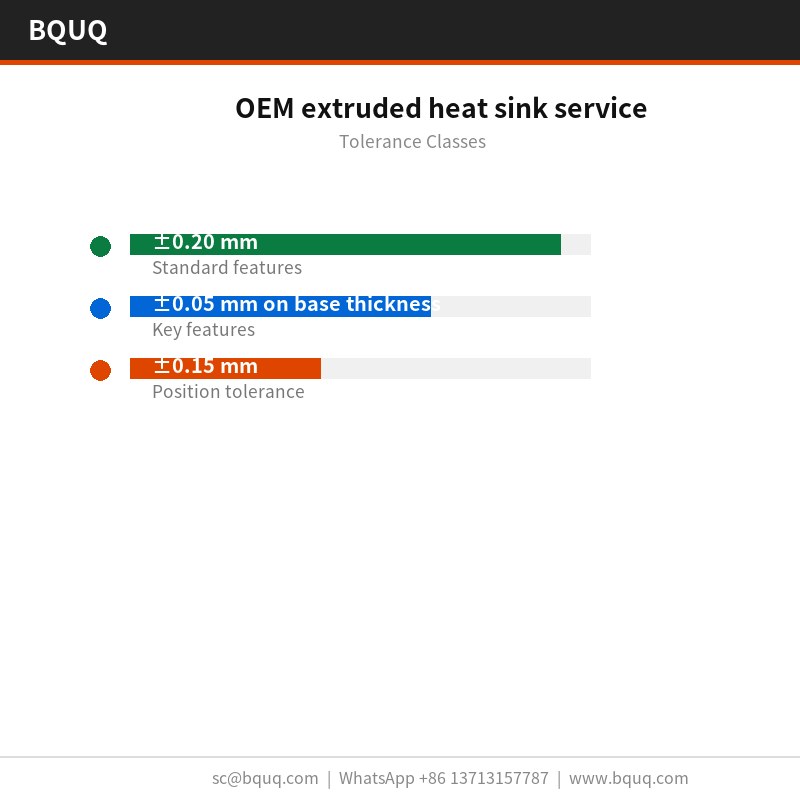
General dimensions run to ±0.20 mm, with critical features such as ±0.05 mm on base thickness held separately. Formed geometry inherits tooling repeatability of ±0.03 mm, and hole position is held to ±0.15 mm. Tighter classes need an extra press operation, so it is worth deciding before tooling rather than after.
Flatness is checked on a granite surface plate, 20 °C against a 0.05 mm over 100 mm limit, and fin pitch is verified optically at ±0.03 mm. Reports go out with each lot.
Each batch carries a CMM report from CMM plus 100% hydraulic press leak test. We record flatness, pitch, base thickness and hole position, and flag anything outside ±0.20 mm before it leaves the line.
Sampling is AQL 0.65 for critical dimensions and 1.5 for general, with CMM plus 100% hydraulic press leak test on every first article. Deviations beyond ±0.20 mm trigger a full-lot sort.
We inspect 1.0 mm fin tips for burr and crack after forming, because stamping can split a root without shifting any drawing dimension. Burr limit is set per part.
Where This Part Is Used
VFD and inverter programs are the reason this geometry exists. Where the enclosure cannot grow taller, fin density is the only lever, and 4.0 mm pitch with 1.0 mm stock is the practical ceiling for aluminium.
Where a OEM extruded heat sink service runs at VFD and inverter volumes, part-to-part consistency decides field returns. ±0.03 mm on a 120,000 pcs run keeps the thermal curve inside one band.
Designers working on VFD and inverter ask for flatness before they ask for thermal data, because VFD and inverter assembly is automated and a non-flat base stops the line.
VFD and inverter designs often run a 2.0 m/s forced-air path. 0.35 K/W at ΔT = 75 K, forced air 2.0 m/s means VFD and inverter can hold its target with fan power below the acoustic limit.
Every lot is inspected with CMM plus 100% hydraulic press leak test, and the report is included in the shipment. We check 0.05 mm over 100 mm, 4.0 mm, 3.0 mm and hole position against ±0.20 mm. Lot traceability from coil to carton is kept for 10 years.
Can you deliver without surface treatment?
Yes, we ship as-pressed for customers who do their own finishing. The risk is handling marks on 1.0 mm fins, so we pack those parts with interleaving sheets inside PE bag + honeycomb carton, 15 kg per carton.
Do you make the OEM extruded heat sink service in different sizes?
The family covers 80 x 60 x 35 mm, with unit weights from 15 g. Because the base is pressed, new sizes are a die insert change rather than a new press line, so development is usually 2 weeks rather than 8.
The key is avoiding a second metal at the wet contact area. We recommend black anodize Type II, 10-15 µm and, where the part touches an aluminium chassis, an isolating washer. Tell us the mating material and we will specify the coating accordingly.
What is the difference between your OEM extruded heat sink service and a skived fin OEM extruded heat sink service?
Skived fins are milled, so you get thin, tall fins and higher density in a given height, but the cost scales directly with fin area. Stamping gives the same result in one stroke at a much lower unit cost below 120,000 pcs. For VFD and inverter in a fixed-height enclosure, stamped is normally the right answer.
How We Manufacture and Ship
Source-direct from Dongguan: coil stock, forming, surface treatment and inspection happen in one building, so 0.05 mm over 100 mm flatness is verified before the part is packed.
Our VFD and inverter experience runs back to the first tooling programme in 2015. That history is why the standard black anodize Type II, 10-15 µm and ±0.20 mm are conservative rather than optimistic.
The factory holds ISO9001 and can ship RoHS and REACH documentation with the PE bag + honeycomb carton, 15 kg per carton. Third-party SGS inspection is arranged on request before the container is sealed.
Request a quote: sc@bquq.com | WhatsApp +86 13713157787 | Dongguan, China
±0.03 mm fin pitch; ±0.15 mm hole position; 0.05 mm flatness over 100 mm
Lead time
Not specified in excerpt
MOQ
Not specified in excerpt
Capacity
120,000 pcs monthly output; 18 s cycle on 160 T press
Selection / comparison
Option
Best for
Trade-off
Stamped 1.0 mm fin profile
Repeatable fin pitch within ±0.03 mm across 120,000 pcs
Requires 160 T press tooling; extrusion cannot hold this profile
Extruded heat sink
Continuous fin profiles with lower tooling complexity
Cannot achieve the 1.0 mm fin pitch tolerance of stamping
Machined alternative
Prototype or low-volume complex features
Black anodize can be cut through at fin roots; higher part cost scaling with complexity
Black anodize Type II, 10-15 µm
Corrosion protection after forming on VFD and inverter builds
Applied post-forming; not a substitute for dimensional control
Single 160 T stroke
Part cost stops scaling with complexity
Dedicated tooling runs ±0.03 mm; changeover is a tooling change
Process / inspection
Stage
Control
Record
Tooling
Tooling runs ±0.03 mm
Tooling dimensional report
Stamping
160 T stroke forms whole part in 18 s cycle
Cycle time and press log
Fin profile
Fin pitch stays within ±0.03 mm across 120,000 pcs run
Batch dimensional inspection
Hole position
±0.15 mm hole position carries across the batch
Hole position inspection record
Surface finish
Black anodize Type II, 10-15 µm applied after forming
Coating thickness record
Final inspection
Inspection before every shipment
Shipment inspection report
Frequently Asked Questions
What material is used in your OEM extruded heat sink service?
The standard material is copper-alloy CuZn37. It supports 1.0 mm fins and a 3.0 mm base flat to 0.05 mm over 100 mm, with a rated 0.35 K/W at ΔT = 60 K for VFD and inverter builds at 120,000 pcs monthly output.
What fin pitch tolerance can you hold on a 120,000 pcs run?
Stamping holds fin pitch within ±0.03 mm across a 120,000 pcs run. The 160 T die forms every fin in one stroke, so pitch stays consistent and hole position of ±0.15 mm carries across the batch.
Why use stamping instead of extrusion for 1.0 mm fins?
Stamping gives a repeatable 1.0 mm fin profile that extrusion cannot hold. The die forms every fin in one stroke, so pitch stays within ±0.03 mm across a 120,000 pcs run, and a single 160 T stroke forms the whole part.
What is the cycle time and press tonnage for this heat sink?
A single 160 T stroke forms the whole OEM extruded heat sink service, with an 18 s cycle feeding a 120,000 pcs line. Tooling runs ±0.03 mm, so every stroke is dimensionally identical across the batch.
What surface finish is standard and how is it applied?
Black anodize Type II, 10-15 µm is standard. It is applied after forming, so corrosion protection does not get cut through at the fin roots the way it does on machined alternatives. This supports VFD and inverter volume programs.
Can you support a thermal redesign without changing vendors?
Yes. One supplier now covers 1.0 mm to 1.0 mm fin gauges from the same 160 T press family, so a thermal redesign is a tooling change rather than a new vendor. Tooling runs ±0.03 mm and the 18 s cycle feeds a 120,000 pcs line.
What is the rated thermal performance of this heat sink?
The OEM extruded heat sink service is rated 0.35 K/W at ΔT = 60 K. It uses CuZn37 with 1.0 mm fins and a 3.0 mm base flat to 0.05 mm over 100 mm, supporting VFD and inverter builds at 120,000 pcs monthly output.
Key Specifications and Selection Guide
Spec comparison
Parameter
Value / Range
Material
CuZn37 copper alloy
Tolerance
Fin pitch ±0.03 mm; base flat 0.05 mm over 100 mm; hole position ±0.15 mm
Lead time
Not specified in article
MOQ
Not specified in article
Capacity
120,000 pcs monthly output; 160 T press; 18 s cycle
Selection / comparison
Option
Best for
Trade-off
Extruded heat sink
Simple profiles, lower tooling cost
Cannot hold 1.0 mm fin pitch as tightly as stamping
Stamped heat sink
Repeatable 1.0 mm fin profile, high volume
Requires stamping tooling; pitch ±0.03 mm
CuZn37 copper alloy
Thermal conductivity and stamping formability
Material cost higher than aluminum
Black anodize Type II, 10-15 µm
Standard surface finish, corrosion resistance
Adds process step; thickness range fixed
160 T press with 18 s cycle
120,000 pcs runs
Cycle time limits throughput per press
Frequently Asked Questions
What material is used in BQUQ OEM extruded heat sink service?
BQUQ uses CuZn37 copper alloy. This material supports 1.0 mm fins and a 3.0 mm base flat to 0.05 mm over 100 mm. The rated thermal performance is 0.35 K/W at ΔT = 60 K. Black anodize Type II, 10-15 µm is standard.
What is the fin pitch tolerance for stamped heat sinks?
Stamping holds fin pitch within ±0.03 mm across a 120,000 pcs run. The 160 T press with an 18 s cycle forms every fin in one stroke. This repeatability is tighter than extrusion can hold for a 1.0 mm fin profile.
What is the thermal resistance rating at ΔT = 60 K?
The rated thermal resistance is 0.35 K/W at ΔT = 60 K. This value applies to the CuZn37 copper alloy design with 1.0 mm fins and a 3.0 mm base. It supports VFD and inverter builds.
What surface finish is standard for OEM extruded heat sinks?
Black anodize Type II, 10-15 µm is standard. This finish is applied after stamping and before final inspection. It provides corrosion resistance and a consistent appearance for VFD and inverter applications.
What is the monthly production capacity for these heat sinks?
Capacity is 120,000 pcs monthly output. The line uses a 160 T press with an 18 s cycle. Tooling runs ±0.03 mm, and one supplier covers 1.0 mm to 1.0 mm fin gauges from the same press family.
What hole position tolerance can be specified?
Hole position tolerance is ±0.15 mm. Every stroke is dimensionally identical, so this tolerance carries across the 120,000 pcs run. The 160 T press and 18 s cycle support this repeatability.
How is base flatness controlled during production?
Base flatness is controlled to 0.05 mm over 100 mm. This is achieved through the stamping die and verified during inspection before every shipment. The 3.0 mm base supports this flatness specification.