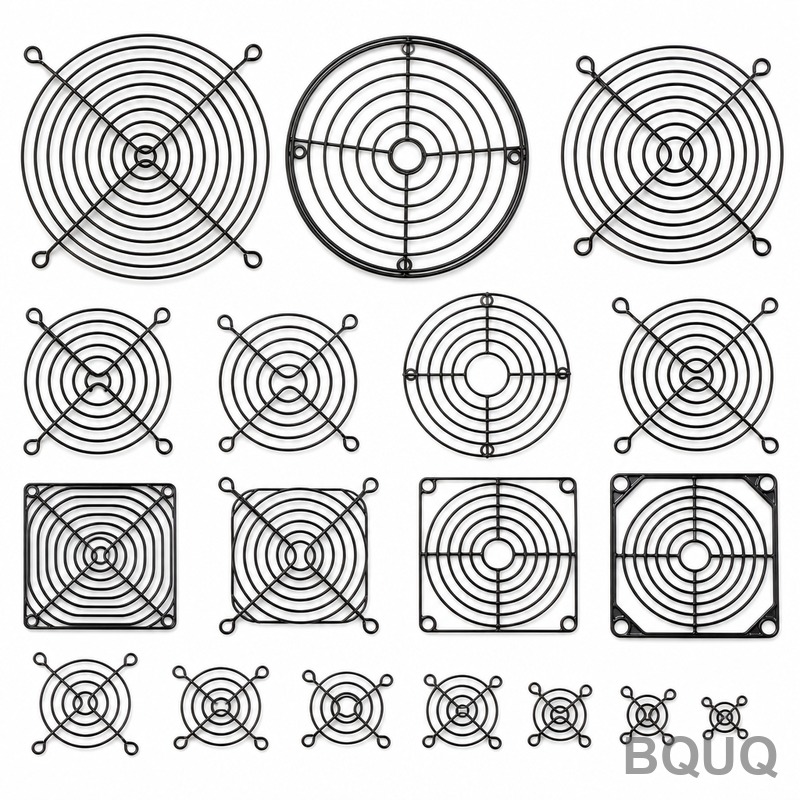
What This Collection Is and the Hard Numbers Behind It This is a complete line of stamped fan guards and wire mesh covers produced on 20-year-old CNC-stamping lines in our Donggua
BQUQ Stamped Fan Guards Wire Mesh Covers Collection | Precision Made in China
What This Collection Is and the Hard Numbers Behind It This is a complete line of stamped fan guards and wire mesh covers produced on 20-year-old CNC-stamping lines in our Dongguan factory. You get a
Get a Fast Quote for This Part
Send us your drawing / quantity / material — reply within 24h.
What This Collection Is and the Hard Numbers Behind It
This is a complete line of stamped fan guards and wire mesh covers produced on 20-year-old CNC-stamping lines in our Dongguan factory. You get a flatness of 0.08 mm, hole-to-hole tolerance of ±0.05 mm, and surface finish Ra 1.6 µm — without secondary machining. Lead time is 15 days for standard sizes, and we hold a surface hardness of 45 HRC on carbon steel versions.
Why Our Wire Mesh Covers Resist Deformation at High Airflow
Fan guards fail when the mesh bows under pressure or vibration. We counter that with a double-hit coining step in the die, which compresses the wire intersection points to a consistent 0.3 mm thickness. That means your cover holds its shape at 3,000 RPM fan speeds and up to 80°C ambient. The mesh opening is held to ±0.1 mm across the entire panel, so airflow stays predictable and finger-safety compliance (IP20) is never in question.
Materials and Heat Treatment We Use for Corrosion and Impact
We stock three base metals: Q195 carbon steel for cost-sensitive builds, SUS304 stainless for washdown environments, and galvanized SPCC for outdoor units. Carbon steel parts get a controlled austenitizing at 860°C followed by oil quench, then temper at 180°C — that gives you 45 HRC without making the wire brittle. Stainless versions skip heat treatment but get an electropolish pass to hold Ra 1.6 µm and pass a 72-hour salt spray test. If you need a specific wire diameter, we support 0.8 mm to 4.0 mm wire, with center-to-center spacing from 5 mm to 25 mm.
Die Life and Tooling Precision That Keeps Your Unit Cost Flat
Our progressive dies are built from D2 steel with a hardness of 60 HRC, and we run them at 120 strokes per minute. That die construction yields 500,000 hits before we even re-grind the cutting edges, which means your per-piece price does not creep up after the first 10,000 units. For custom covers, we charge a one-time tooling fee of $800 to $2,500, but we refund 50% of that after your first 50,000 parts. Standard sizes in the collection require zero tooling investment — you order, we stamp.
Inspection Before Every Shipment: CMM and Optical Comparators
Every batch goes through a three-tier check. First, in-process operators check every 50th piece with a go/no-go gauge for hole position. Second, a CMM (Coordinate Measuring Machine) samples 5 pieces per lot to verify overall flatness and diameter runout to 0.05 mm. Third, an optical comparator measures mesh opening angle at 20x magnification. We send you a PDF report with actual measured values, not just a pass/fail checkbox. If any part falls outside the tolerance, the entire lot is quarantined and re-run — no exceptions.
Packing and Anti-Rust Protection for Ocean Freight
Finished guards are stacked with interleaving kraft paper to prevent surface scratches during transit. For carbon steel parts, we apply VCI (Vapor Corrosion Inhibitor) film before sealing in export-grade cartons. This protects parts for up to six months in humid containers — standard for shipments to the US and EU. Stainless steel parts are packed in the same way but without VCI, so you never have to worry about chemical residue on the mesh surface.
Specification
Standard Value
Custom Range
Wire Diameter
1.5 mm
0.8 – 4.0 mm
Mesh Opening (Center-to-Center)
10 mm
5 – 25 mm
Overall Panel Size
100 x 100 mm
20 x 20 mm to 600 x 600 mm
Material Hardness
45 HRC (carbon steel)
40 – 55 HRC
Flatness Tolerance
0.08 mm
0.05 mm achievable
Hole Position Tolerance
±0.05 mm
±0.02 mm
Surface Finish (Ra)
1.6 µm
0.8 µm after electropolish
Runout (Fan Mounting Holes)
0.05 mm
0.03 mm
Lead Time (Standard Size)
15 days
7 days for rush order
Minimum Order Quantity (MOQ)
No MOQ
Single piece accepted
How We Handle Custom Shapes Without Killing Your Budget
Most fan guards are round or square, but we also stamp elliptical, triangular, and multi-hole mounting patterns. Send a 2D DXF or 3D STEP file, and our engineers will answer within one working day with a die feasibility comment. For simple round covers with a center hole, we use a standard die family that can be modified with a simple insert — that costs you only $150 to change the hole pattern. For complex shapes with tight radii, we run a simulation in AutoForm to check for springback before cutting steel. You get a tooling quote that is fixed, not estimated.
Ordering Process and Payment Terms for Global Buyers
We accept quotes via email or WhatsApp, and we issue a proforma invoice within 12 hours of agreement. Payment is 30% T/T deposit, 70% before shipment. For repeat orders, we can switch to net-30 terms after three paid shipments. We ship via DHL, FedEx, or sea freight — your choice. For small batches, we offer a flat $25 packing fee per order, but no hidden charges for tooling amortization on standard sizes.
Do You Require a Minimum Order Quantity?
No MOQ — we accept a single piece for prototyping, and the per-unit price drops linearly as your quantity increases.
Can You Match a Specific Wire Mesh Pattern From My Drawing?
Yes, we can replicate any pattern up to 600 x 600 mm, but we recommend you check our CNC cutting tool selection guide first to ensure your die material matches the wire hardness we use.
How Do You Verify Quality for a One-Off Prototype?
Even single-piece orders go through the same CMM inspection, and we email you the measured report alongside the shipment tracking number.
What Is the Fastest Lead Time for a Custom Stamped Guard?
If your design uses standard wire diameter and existing die inserts, we can ship in 7 days; for new tooling, plan for 20 days, and we always confirm the exact date before you pay.
Why Engineers Switch From Perforated Sheet to Our Stamped Mesh
Perforated sheet has a burr on the cut edge and limited opening ratios. Our stamped wire mesh uses a shearing action that leaves a clean edge on both faces, so there is no burr to scratch cables or fingers. The open area ratio reaches 65% with 1.5 mm wire at 10 mm pitch, versus 45% typical for perforated sheet of the same thickness. That means your fan moves more air with the same motor, saving energy and reducing noise. If you are comparing suppliers, ask for our CNC machining tolerances guide to see how we hold ±0.05 mm on a stamped part — not a machined one.
Final Cost Comparison and What You Actually Pay
For a 200 x 200 mm carbon steel guard, 1.5 mm wire, 10 mm pitch, your price is $0.85 per piece at 1,000 units. At 10,000 units, it drops to $0.62. Stainless steel SUS304 is 35% higher per piece but eliminates paint or plating costs downstream. Tooling for a standard round guard is $0 — we already have the dies. For a custom rectangular guard, tooling is $1,200 and refunded 50% after 50,000 pieces. Shipping to Los Angeles for 1,000 units is $180 via sea freight, or $95 via DHL if you need it in 5 days. There are no other fees — no setup charge, no sample charge, no die maintenance charge for the first year.
Request a Firm Quote Within 12 Hours
Send your drawing in DXF, DWG, STEP, or even a hand sketch with dimensions. Our engineers will reply with a firm price, tooling cost (if any), and exact delivery date — not a range. We operate on Dongguan time (GMT+8) and respond to every inquiry within 12 business hours. Email us at sc@bquq.com or reach us on WhatsApp at +86 13713157787 with your target quantity and material preference. If you are unsure about tolerances, include your application's operating temperature and fan RPM — we will recommend the right wire diameter and hardness.