Choosing the Best Material for a Custom Spring: A Precision Engineering Guide
The best material for a custom spring depends on the operating temperature, fatigue life requirements, and corrosion resistance, but for 90% of general industrial applications, Music Wire (ASTM A228) or Oil-Tempered Chrome Silicon (ASTM A401) offer the best strength-to-cost ratio. For high-temperature or corrosive environments exceeding 150°C, you must switch to stainless steel (17-7PH) or Inconel X750. This guide provides specific data and manufacturing constraints to help you select the correct alloy for your next production run.
## Defining Spring Performance Criteria Before selecting a material, you must define three mechanical parameters: maximum operating stress, cycle count (fatigue), and deflection rate. For a custom spring, the material's tensile modulus directly determines the spring rate (k). For example, a compression spring with a 10 mm wire diameter and 50 mm outer diameter will have a rate of 7.6 N/mm in Music Wire (E=206 GPa) versus 7.1 N/mm in 302 Stainless (E=193 GPa). Our BQUQ engineering team calculates stress using the Wahl factor to prevent premature fracture. We recommend specifying a maximum working stress of 45% of the material's tensile strength for static applications, and 30% for dynamic applications exceeding 100,000 cycles. If you do not have these numbers, our standard quoting process includes free spring calculation software output.
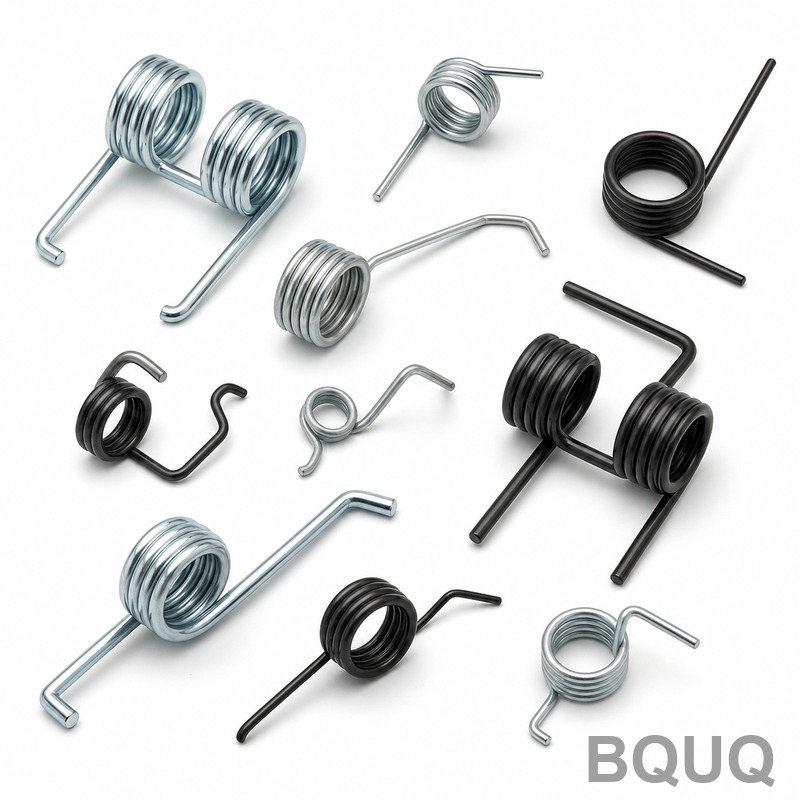
## Material Selection by Application The table below compares the four most common materials we stock in our Dongguan facility. We maintain a minimum inventory of 15 tons of wire across these grades for rapid prototyping.
| Material | Tensile Strength (MPa) | Max Temp (°C) | Relative Cost per kg | Corrosion Resistance | Best Application |
| Music Wire (A228) | 2300-2500 | 120 | 1.0x | Poor | High-stress static springs, general machinery |
| Oil-Tempered Chrome Silicon (A401) | 1900-2100 | 250 | 1.3x | Poor | Automotive suspension, shock absorbers |
| 302 Stainless Steel (A313) | 1700-1900 | 290 | 2.2x | Good | Medical devices, food processing, marine |
| 17-7PH Stainless (A313) | 2000-2200 | 340 | 3.5x | Excellent | Aerospace, high-fatigue corrosive environments |
| Inconel X750 (A637) | 1200-1400 | 650 | 8.0x | Excellent | Turbine engines, chemical processing, high heat |
For compression springs under 25 mm free length, Music Wire is the default due to its superior tensile strength, allowing a smaller wire diameter for the same load. This reduces material cost and weight. However, if your spring will be exposed to humidity or washdowns, the 302 stainless grade is mandatory to prevent surface pitting that initiates cracks.
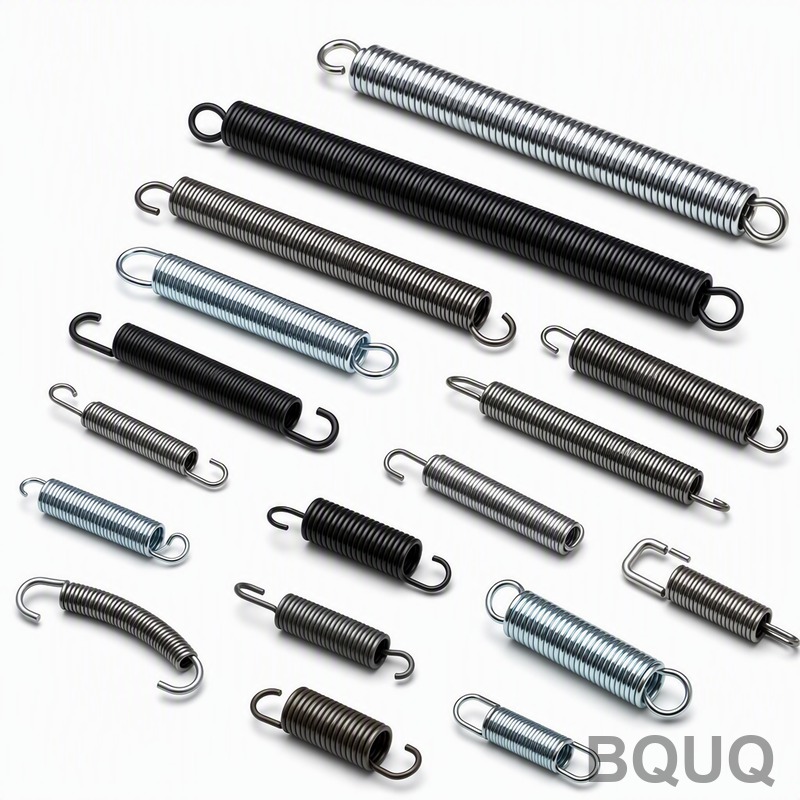
## Tolerances and Manufacturing Capabilities Precision tolerances vary significantly by material. Music Wire and Chrome Silicon can be ground flat to a tolerance of 0.05 mm on the ends, while Inconel requires slower grinding speeds to avoid work-hardening, resulting in a 0.10 mm tolerance. Our CNC coiling machines hold a wire diameter tolerance of ±0.01 mm for wire under 5.0 mm. For spring free length, we achieve ±0.5 mm for 10-50 mm lengths, tightening to ±0.2 mm for critical applications. The surface finish of the wire also matters: we use shot-peened Chrome Silicon for suspension springs to induce compressive residual stress, increasing fatigue life by 30-40%. For Music Wire, we recommend a zinc phosphate coating to prevent rust during storage and shipping.
## Cost Breakdown and Lead Times Material cost is only 20-25% of the total unit price for custom springs; the rest is tooling, heat treatment, and finishing. For a typical order of 5,000 pieces of a 1.5 mm wire compression spring, the price per unit is $0.08 for Music Wire, $0.11 for Chrome Silicon, and $0.19 for 302 Stainless. Tooling (a coiling mandrel and grinding fixture) is $150-$300, amortized over the order. Heat treatment is critical: Music Wire requires stress relief at 200°C for 30 minutes, while 17-7PH requires a precipitation hardening cycle at 480°C for 1 hour, which adds 3 days to lead time. Standard lead times from BQUQ are 10 working days for Music Wire and Chrome Silicon, 15 days for 302 Stainless, and 20 days for Inconel. For urgent orders, we can expedite Music Wire springs in 3 working days with a 20% surcharge.
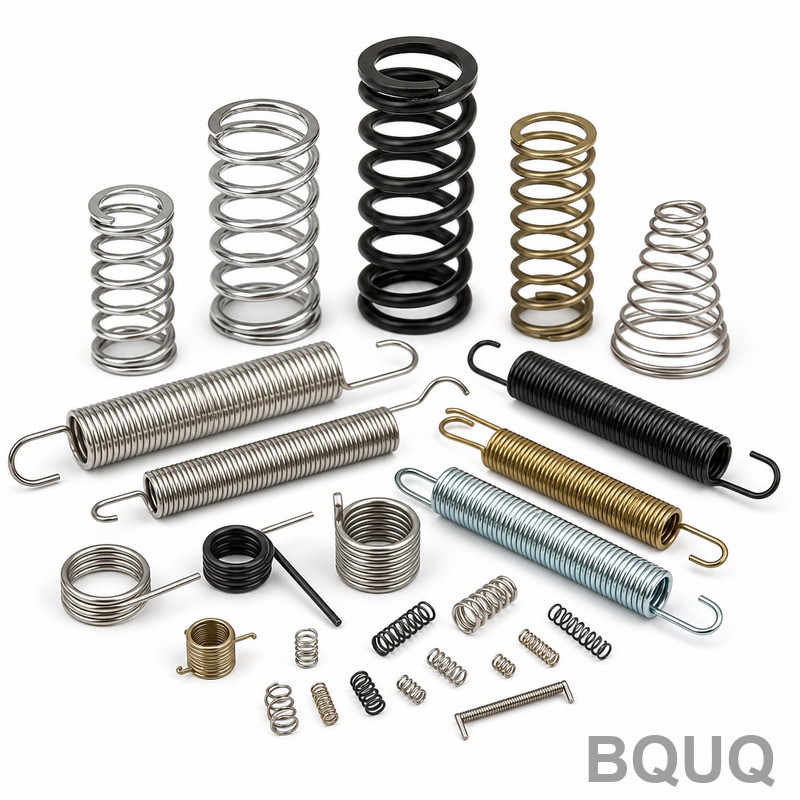
## Environmental Limits and Material Physics Temperature is the primary differentiator. At 100°C, Music Wire loses 10% of its tensile strength; at 150°C, it loses 25%, making it unsuitable for engine compartments. Chrome Silicon maintains full strength up to 150°C and 90% at 200°C, which is why it dominates automotive valve springs. Above 250°C, only 17-7PH and Inconel X750 are viable. However, Inconel has only 55% of the tensile strength of Music Wire, so you must increase wire diameter by 25% to achieve the same load, which increases the spring's solid height. For cryogenic applications down to -200°C, 302 Stainless is superior because it does not become brittle, unlike high-carbon steels. Always verify the working environment's chemical exposure; chlorine and sulfuric acid will corrode stainless grades, requiring a Hastelloy C-276 custom order.
## Practical Recommendations for Engineers For 80% of custom springs, we recommend Oil-Tempered Chrome Silicon (A401) as the best overall balance. It provides 85% of Music Wire's strength, but tolerates higher temperatures and has better ductility for coiling complex shapes. If you are designing a spring for a high-volume consumer product with a lifespan of 10,000 cycles, use Music Wire to save 20% in material cost. If you are designing for a safety-critical system (brakes, valves), specify 17-7PH and require 100% eddy current testing. We also recommend specifying a maximum allowable set (loss of free length) of 2% after 1 million cycles; our presetting process can achieve 1% reduction for Chrome Silicon. Always provide the operating temperature range and environmental media in your RFQ, as this changes our wire selection and heat treatment cycle.
## FAQ-Style Selection Tips What is the cheapest material for a prototype? Music Wire is the lowest cost and available in small quantities (5 kg minimum). For a one-off spring, we can laser-cut and grind it within 48 hours. When should I avoid Music Wire? Avoid it if the spring will contact a dissimilar metal in a humid environment, causing galvanic corrosion. What is the maximum wire diameter for custom springs? BQUQ coils wire from 0.2 mm to 20 mm, but above 12 mm, we recommend hot-coiling Chrome Silicon or 5160 steel for better formability. How do I specify a spring for extreme fatigue? Use a shot-peened 302 Stainless with a mirror-polished surface finish; this reduces crack initiation sites and improves fatigue life to 10 million cycles.
## Conclusion and Next Steps Selecting the best material for a custom spring is a trade-off between tensile strength, temperature resistance, corrosion resistance, and unit cost. For general machinery, Music Wire offers the highest strength per dollar, while Chrome Silicon provides the best thermal resilience for automotive use. For hostile environments, 17-7PH or Inconel X750 are the only safe choices. At BQUQ, we have 20 years of experience coiling precision springs with tolerances as tight as ±0.01 mm, and we offer free material consultation before you place an order. Send us your drawings and load requirements today; we will provide a complete quote with material recommendations, wire diameter calculations, and a 12-hour turnaround. Contact us at sc@bquq.com or on WhatsApp at +86 13713157787. Visit www.bquq.com to download our spring design checklist.