Compression Spring vs Torsion Spring vs Extension Spring: Key Differences
The direct answer is that compression springs resist axial compressive forces and shorten under load, extension springs resist tensile forces and lengthen under load, and torsion springs resist rotational or twisting forces around their axis. These three spring types are fundamentally different in their load direction, end configurations, and energy storage methods, which dictates their application in mechanical assemblies. For engineers, selecting the correct type is not about preference but about matching the spring's force-deflection curve to the exact kinematic requirements of the system.
Load Direction and Force Vector Analysis
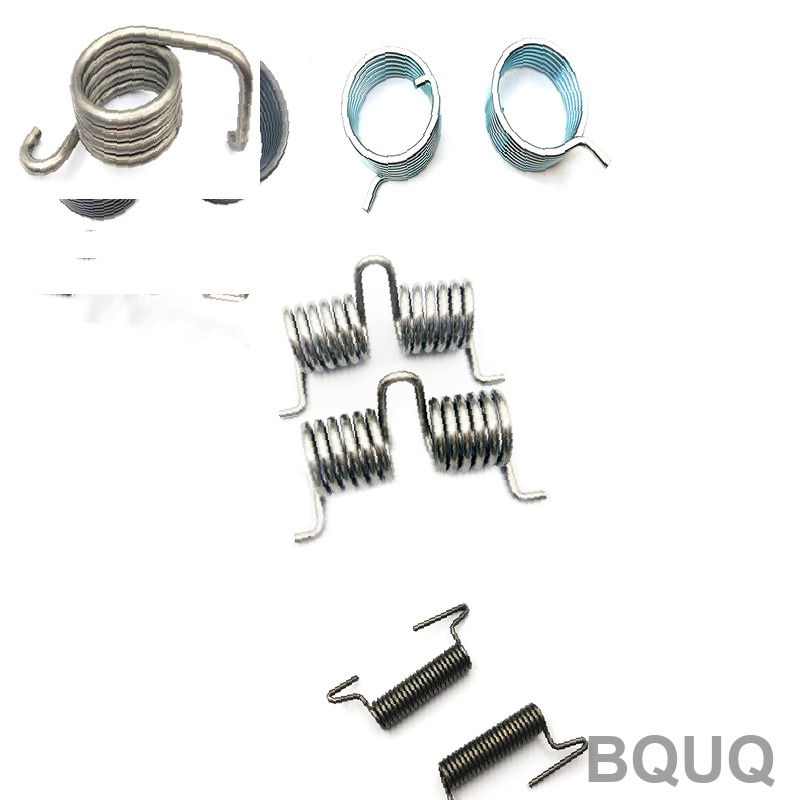
The primary differentiator lies in the direction of the applied force relative to the spring axis. A compression spring is designed to operate with a pushing force that reduces its overall length. Its coils are closely wound with a gap (pitch) to allow for deflection without coil-to-coil contact until solid height is reached. An extension spring operates with a pulling force that increases its length; its coils are typically wound tightly together (close-wound) with initial tension holding the coils in contact. A torsion spring, however, does not operate along the axis but rather around it. The force is applied as a moment (torque) to the legs, causing the body diameter to decrease as the spring winds up.
This fundamental difference dictates the stress distribution. Compression springs experience torsional stress on the wire cross-section due to the off-center load path. Extension springs also experience torsional stress but with an added axial tensile component. Torsion springs experience pure bending stress, which allows them to store a high amount of energy per unit volume but makes them susceptible to leg bending if not properly supported. For a 20-year veteran manufacturer, the most common failure we see is engineers applying a compression spring to a tensile application, which leads to buckling and premature fracture.
End Configurations and Mounting Interfaces
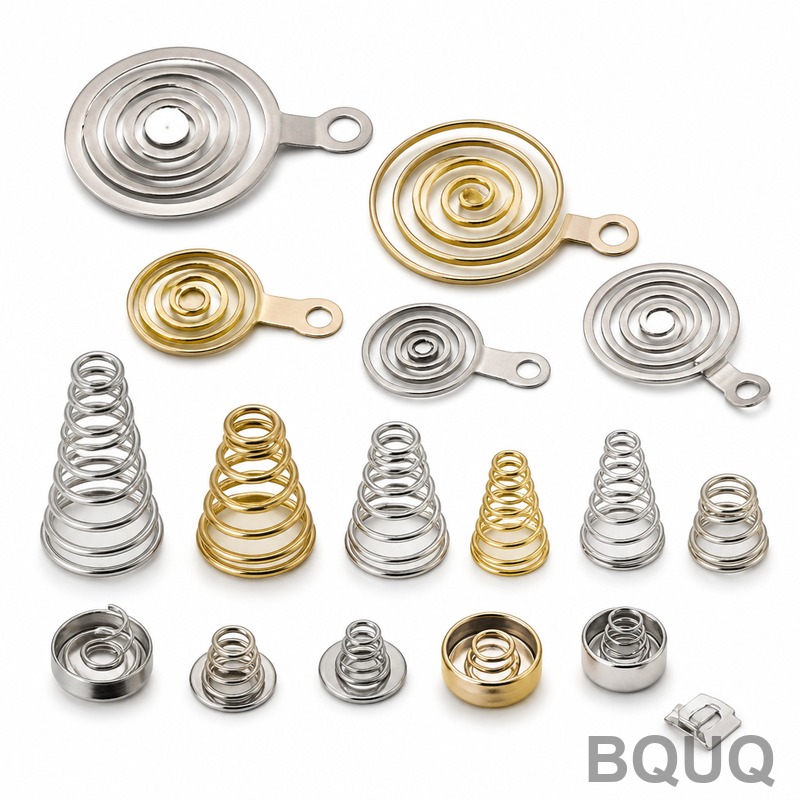
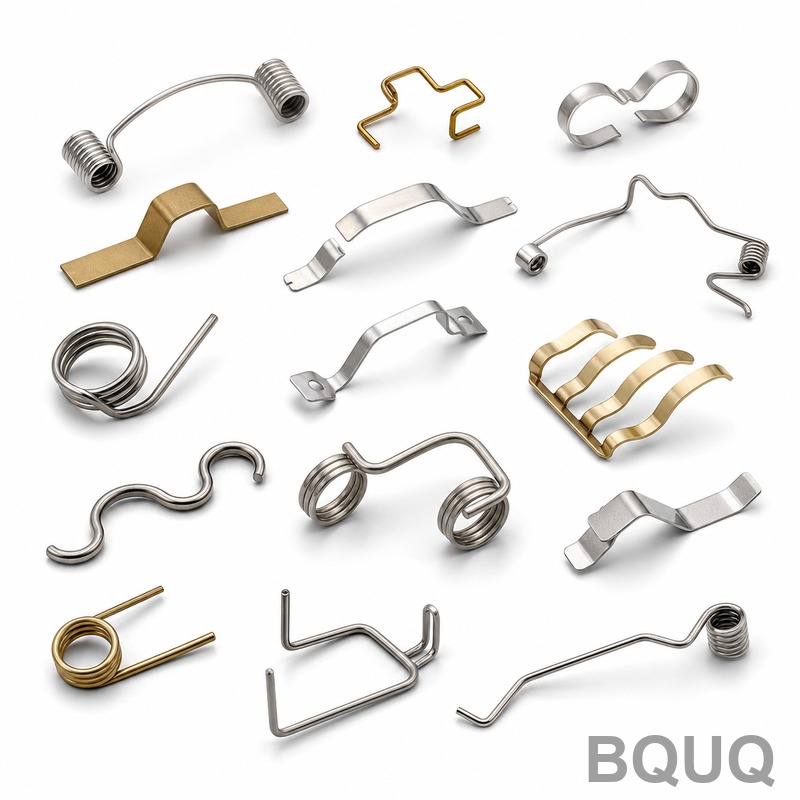
The physical ends of each spring type are engineered for specific mounting methods. Compression springs are available with four standard end types: closed, closed and ground, plain, and plain and ground. Closed and ground ends provide a flat seating surface perpendicular to the axis, critical for buckling prevention in long, slender springs. Extension springs rely on hooks or loops at each end—common types include full loops, side loops, and extended hooks. The hook radius is a stress concentration point; we recommend a hook radius of at least 1.5 times the wire diameter to reduce failure risk. Torsion springs have legs that extend radially; these can be straight, bent, or have special loops for attachment. The leg configuration determines how the torque is applied and must be specified with the free angle and the direction of wind (left or right).
The manufacturing tolerance for end positions is significantly different. For compression springs, we hold free length tolerance to ±1.0% for wire diameters under 5mm. For extension springs, the hook position tolerance is ±2 degrees to maintain consistent initial tension. For torsion springs, the angular tolerance on the legs is typically ±3 degrees, but the torque tolerance is tighter at ±5% of the specified value.
Material Selection and Thermal Performance
While all three types can be made from the same materials, the operational demands differ. Compression springs are often made from music wire (ASTM A228) for diameters under 6mm, offering high tensile strength (up to 2300 MPa). Extension springs, due to the stress at the hooks, often require alloy steel (ASTM A401 chrome-vanadium) to withstand fatigue. Torsion springs, operating in bending, are frequently made from oil-tempered chrome-silicon (ASTM A401) for high-temperature stability up to 250°C.
For stainless steel grades, 302 is standard for all types, but 17-7 PH is preferred for torsion springs requiring high yield strength in aerospace applications. The maximum operating temperature is a critical selection factor: music wire degrades above 120°C, while Inconel X-750 (for all types) can operate up to 650°C. In our Dongguan facility, we commonly plate compression springs with zinc (5-8 microns) for corrosion resistance, but this is rarely applied to torsion springs where the plating thickness can alter the leg angle and torque characteristics.
Manufacturing Processes and Tolerances
The production method differs significantly. Compression springs are typically cold-wound on a CNC coiler at speeds up to 100 parts per minute for small diameters. Extension springs require an additional process to set initial tension—either by twisting the wire during coiling or by a subsequent "scragging" operation (compressing to solid height). Torsion springs are the most complex to produce because the legs must be formed after coiling, often requiring a secondary CNC bending operation to achieve precise leg angles.
Tolerance standards follow DIN 2095 for cold-wound compression and extension springs, and DIN 2088 for torsion springs. For compression springs, the load tolerance at a specified deflection is ±5% for wire diameters 0.5-5mm. For extension springs, the initial tension tolerance is ±10% of the specified value. For torsion springs, the torque tolerance at a specified angle is ±7% for wire diameters up to 3mm. A critical difference is that compression springs have a defined solid height (the length when all coils touch), which must never be reached in operation to prevent stress relaxation. Extension springs have a maximum extension limit before hook yield. Torsion springs have a maximum deflection angle before coil clash.
Cost, Lead Time, and Application Comparison
The cost structure varies due to material usage and secondary operations. Compression springs are the cheapest to produce due to high-volume coiling. Extension springs are 15-20% more expensive due to the additional hook forming and initial tension setting. Torsion springs are the most expensive, often 30-40% higher than compression, due to the leg bending operations and tighter angular tolerances. Lead times in our factory follow a similar pattern: compression springs are 3-5 days for prototypes, extension springs 5-7 days, and torsion springs 7-10 days for custom tooling.
| Parameter | Compression Spring | Extension Spring | Torsion Spring |
| Load Type | Axial compressive force | Axial tensile force | Rotational torque |
| Wire Diameter Range | 0.1mm - 20mm | 0.2mm - 10mm | 0.3mm - 12mm |
| Typical Free Length Tolerance | ±1.0% | ±1.5% | ±2% (angle) |
| Load/Torque Tolerance | ±5% | ±5% (initial tension ±10%) | ±7% |
| Maximum Operating Temp (Music Wire) | 120°C | 120°C | 120°C |
| Fatigue Life (Typical) | 10^6 cycles | 10^5 cycles | 10^6 cycles |
| Relative Cost Index (1.0 base) | 1.0 | 1.2 | 1.4 |
| Typical Lead Time (Prototype) | 3-5 days | 5-7 days | 7-10 days |
| Common Application | Valve springs, shock absorbers | Garage door springs, trampolines | Mouse traps, clothespins, hinges |
Practical Selection Criteria for Engineers
First, define the force vector. If your load is pushing, choose a compression spring. If pulling, choose an extension spring. If twisting, choose a torsion spring. Second, check the space envelope. Compression springs require a minimum of 15% of free length as travel clearance to avoid buckling (slenderness ratio > 2.5 requires a guide rod or sleeve). Extension springs require end hooks that occupy axial space; ensure the hook loop inner diameter is at least 1.5x the wire diameter. Torsion springs require radial clearance because the body diameter shrinks as it deflects; calculate the expanded diameter at maximum deflection.
Third, consider the failure mode. Compression springs fail by buckling or set (loss of free length). Extension springs fail at the hook bend. Torsion springs fail by leg fracture at the bend point. For fatigue-critical applications exceeding 10^5 cycles, we recommend shot peening for compression springs and stress-relieving at 300°C for extension and torsion springs to improve fatigue life by up to 30%. Fourth, for high-temperature environments above 150°C, avoid music wire entirely and use 302 stainless steel or Inconel. Finally, do not mix initial tension requirements—an extension spring with 0 initial tension will have a dead zone where no force is applied, which is unsuitable for precision mechanisms.
FAQ-Style Engineering Tips
How do I measure initial tension in an extension spring? You must apply a force to just separate the coils; the load at separation is the initial tension. This is typically 5-15% of the maximum load. For a spring with a 10N max load, initial tension should be 0.5-1.5N.
Can I use a compression spring in reverse as an extension spring? No. The ends are not designed for tensile loads, and the open ends will cause stress concentration and rapid fatigue failure. The load direction reverses the stress state entirely.
What is the solid height for a compression spring? Solid height is calculated as the number of active coils plus 2 (for closed ends) multiplied by the wire diameter. For example, a spring with 10 active coils and 2mm wire has a solid height of (10+2) x 2mm = 24mm. Never operate beyond 80% of this value.
How do I specify the direction of wind for a torsion spring? Specify right-hand or left-hand wind. A right-hand spring winds clockwise when viewed from the top. For a torsion spring, the wind direction must oppose the load direction to prevent the coils from binding.
What is the price range for custom springs? For compression springs, expect $0.05-$2.00 per piece for quantities of 1000. For extension springs, $0.08-$3.00. For torsion springs, $0.15-$5.00. These prices are FOB Dongguan and include basic surface treatment.
Conclusion
The distinction between compression, torsion, and extension springs is not a trivial classification but a fundamental mechanical design decision. Compression springs handle axial push, extension springs handle axial pull, and torsion springs handle rotational torque. Each has unique end configurations, stress profiles, and cost structures. By matching the spring type to the load vector, respecting the tolerance limits, and considering the thermal and fatigue requirements, you ensure reliable operation. For critical applications, always prototype and test under real operating conditions.
For your next project, our engineering team in Dongguan provides rapid prototyping with full material certificates. We offer 12-hour quoting for custom spring designs. Send your 2D drawing or 3D model to sc@bquq.com or contact us on WhatsApp at +86 13713157787. Visit www.bquq.com for our full range of CNC machining and spring manufacturing capabilities.