Custom Metal Stamping MOQ: Minimum Order Quantities Explained for Engineers
For custom metal stamping parts, the Minimum Order Quantity (MOQ) typically ranges from 100 to 5,000 pieces for standard production runs, with prototype runs available as low as 10 to 50 pieces. However, this number is not fixed; it is a calculated value based on tooling amortization, material costs, and machine setup time. At BQUQ, we define MOQ as the quantity at which the unit price becomes economically viable for both the manufacturer and the buyer, usually falling between 500 and 2,000 parts for progressive die stamping, depending on material thickness and part complexity.
Defining MOQ in Precision Metal Stamping
MOQ is not a universal constant; it is a financial and operational threshold. In the context of metal stamping, the MOQ represents the smallest number of units a factory will produce in a single run without incurring a loss. For a factory like BQUQ operating in Dongguan, the calculation includes three primary cost buckets:
- Tooling and Die Costs: The fabrication of a progressive die for a complex heat sink or a stamped electrical contact can cost between $800 and $15,000. This cost is amortized into the unit price. - Setup and Changeover Time: A stamping press requires 2 to 4 hours to set up, verify tolerances, and run first-article inspection. At a shop rate of $60 to $100 per hour, this adds $120 to $400 to the total order cost. - Material Procurement: Metal coils (steel, aluminum, copper) are purchased in standard weights. For example, a 1.5mm thick stainless steel coil weighs approximately 4,500 kg. If your part only uses 200 kg, the factory must either purchase a partial coil (which incurs a surcharge) or stock the excess.
Therefore, a low MOQ (below 100) is only feasible if the customer accepts a significantly higher unit price to cover the fixed setup costs. A high MOQ (above 10,000) allows for full material coil utilization and minimal per-unit setup cost.
Standard MOQ Benchmarks by Stamping Type
Different stamping technologies have vastly different economic profiles. Progressive die stamping is ideal for high volumes due to high tooling cost but low per-part cost. Short-run stamping, using simpler hard tooling or CNC punching, is better for low volumes. Below are the realistic MOQ benchmarks we apply at BQUQ based on 20 years of production data.
| Stamping Type | Typical MOQ Range | Lead Time (First Article) | Tooling Cost Estimate | Tolerance Capability |
| Progressive Die Stamping | 1,000 to 10,000 pcs | 15 to 25 days | $3,000 to $15,000 | +/- 0.01 mm to 0.05 mm |
| Short-Run / Hard Tool Stamping | 100 to 2,500 pcs | 10 to 20 days | $800 to $3,500 | +/- 0.05 mm to 0.10 mm |
| Prototype / CNC Punching | 10 to 100 pcs | 3 to 7 days | $0 to $150 (programming) | +/- 0.10 mm to 0.20 mm |
| High-Speed Stamping (Heat Sink Fins) | 5,000 to 50,000 pcs | 20 to 30 days | $8,000 to $20,000 | +/- 0.02 mm to 0.03 mm |
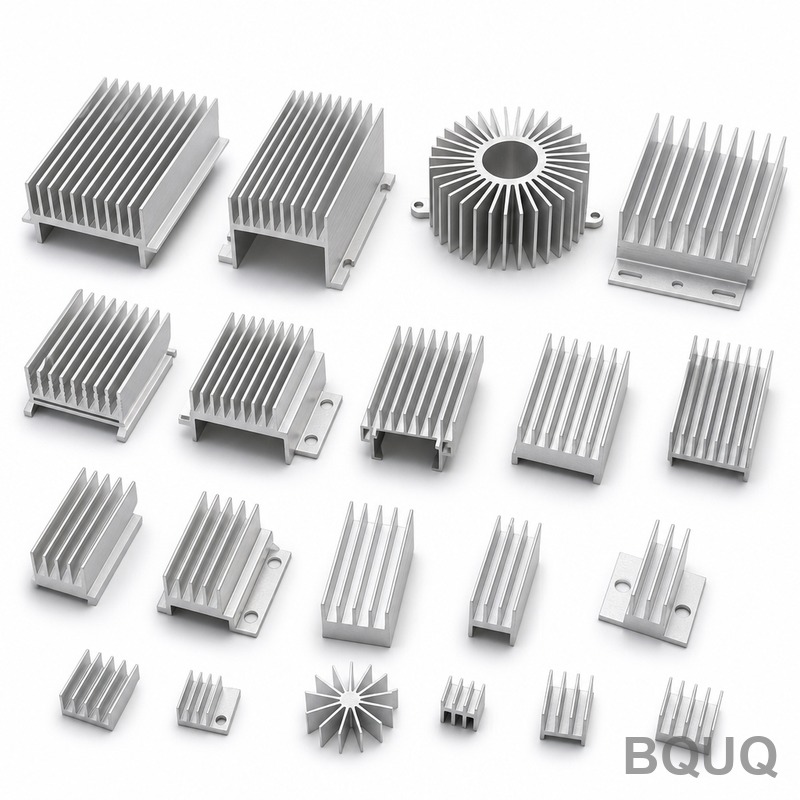
For high-speed stamping of aluminum heat sink fins (0.2mm to 0.4mm thickness), the MOQ is higher because the press speed exceeds 300 strokes per minute. A run of 5,000 parts may only take 16 minutes of press time, meaning the setup time dominates the cost. In this case, the MOQ ensures that the setup cost is diluted sufficiently to achieve a competitive price per part.
The Cost Formula Behind the MOQ Number
Understanding the math allows you to negotiate effectively. The total cost (TC) of your order is calculated as:
TC = Tooling Cost + (Setup Cost per Run) + (Material Cost per Unit x Quantity) + (Processing Cost per Unit x Quantity)
The MOQ is the quantity (Q) at which the price per unit (P) stabilizes to a target level. For example, consider a stamped bracket using 1.0mm thick SPCC steel.
- Tooling Cost: $2,500 - Setup Cost: $250 - Material Cost per Unit: $0.12 - Processing Cost per Unit (including labor, electricity, and overhead): $0.18
If you order 100 pieces: - Amortized tooling: $25.00 per unit - Setup: $2.50 per unit - Total Unit Price: $27.80 (very high)
If you order 1,000 pieces: - Amortized tooling: $2.50 per unit - Setup: $0.25 per unit - Total Unit Price: $3.05 (reasonable)
If you order 5,000 pieces: - Amortized tooling: $0.50 per unit - Setup: $0.05 per unit - Total Unit Price: $0.85 (optimal)
This calculation shows that the MOQ is not an arbitrary number but the point where the curve of price versus quantity flattens. For most custom parts, the "knee" of this curve is between 500 and 2,000 units. Ordering double the MOQ only reduces your unit price by 5 to 10 percent, while ordering half the MOQ can increase the unit price by 200 to 300 percent.
How Material and Tolerance Affect MOQ
Material selection has a direct impact on MOQ. For high-cost materials like beryllium copper or Inconel, the material cost per kilogram is high ($30 to $80 per kg), so the material cost dominates the unit price. In these cases, the MOQ can be lower because the tooling amortization is a smaller percentage of the total cost. Conversely, for low-cost materials like galvanized steel ($0.80 to $1.20 per kg), the tooling cost is more significant, pushing the MOQ higher.
Tolerances also dictate MOQ. If your drawing specifies a critical dimension of +/- 0.01 mm, the factory must use precision tooling with carbide inserts and perform in-process gauging. This slows the press speed from 200 SPM to 60 SPM and increases the rejection rate. At BQUQ, we typically require a 15 to 20 percent higher MOQ for parts with tolerances tighter than +/- 0.02 mm to account for the higher scrap rate and the need for a statistical process control (SPC) technician to monitor the run.
Strategies to Reduce MOQ Without Breaking the Bank
You can reduce your MOQ if you are flexible with your engineering requirements. The most effective strategies are:
1. Use a Modular Tooling Approach: Instead of a dedicated progressive die, we can use a multi-purpose die with interchangeable inserts. This reduces tooling cost by 40 percent, which directly lowers the MOQ threshold. For example, a single base die with changeable punching and forming inserts can produce three different bracket variations, allowing you to order 300 pieces of each variation instead of 1,000 of one.
2. Accept Secondary Operations: If you allow deburring, tapping, or countersinking to be performed manually after stamping, the main die is simpler, reducing tooling cost and MOQ. However, this increases the per-unit price by $0.05 to $0.15.
3. Split Your Order into Multiple Releases: Agree to a total annual volume of 3,000 pieces but ask for delivery in three batches of 1,000. The factory will charge a small restocking or storage fee, but you avoid paying the high unit price associated with a 100-piece prototype run.
4. Standardize Material Thickness: Using a standard material thickness (e.g., 1.0mm instead of 1.1mm) allows the factory to use off-the-shelf coils, eliminating material surcharges and reducing the effective MOQ by up to 25 percent.
Realistic Lead Times and Quoting Expectations
When you request a quote with a low quantity, expect a longer lead time for tooling fabrication. For a new progressive die, the toolroom requires 10 to 15 working days for design and machining, followed by 2 to 3 days for try-out. For a short-run hard tool, the lead time is 7 to 10 days.
For urgent requirements, BQUQ offers a rapid prototyping service using CNC punching and laser cutting, which requires no hard tooling. This allows us to deliver 10 to 50 pieces within 3 to 5 days, but the tolerance is limited to +/- 0.15 mm, and the unit cost is higher due to the slower process. This is suitable for fit-checking and assembly validation before committing to the production MOQ.
Frequently Asked Questions on MOQ for Metal Stamping
Q: Can I order just 50 pieces for a pilot run? A: Yes, we can accommodate this using soft tooling or CNC methods. However, the unit price will be 5 to 10 times higher than the production price. We recommend ordering 50 pieces for dimensional validation and then committing to the production MOQ of 1,000 pieces, with the prototype cost credited against the final order.
Q: What is the MOQ for a stamped heat sink? A: For aluminum heat sinks with a thickness of 0.3mm or less, the MOQ is typically 2,000 pieces due to the high-speed press setup. For thicker heat sinks (1.0mm) using a simple forming die, the MOQ can be as low as 500 pieces.
Q: Is there a price penalty for ordering below the MOQ? A: Yes. If the MOQ is 1,000 pieces and you order 300, the unit price will increase by approximately 40 to 60 percent because the setup and material handling costs remain constant. We will always provide you with a tiered price break at 300, 500, and 1,000 pieces so you can make an informed decision.
Q: How do I know if my part design is suitable for a low MOQ? A: Parts with simple 2D geometry, no tight tolerances on multiple features, and standard material thicknesses are best suited for low MOQs. Complex 3D forms with deep draws or tight flatness requirements (less than 0.05 mm) will require progressive tooling, which increases the MOQ.
Conclusion
The MOQ for custom metal stamping is a direct function of your part's complexity, material, tolerance, and the type of tooling required. At BQUQ, we do not enforce a rigid MOQ policy; instead, we calculate the break-even point for your specific drawing and provide transparent tiered pricing. Whether you need 100 pieces for a field trial or 100,000 for mass production, our engineering team will optimize the process to minimize your total acquisition cost while maintaining the required tolerances of +/- 0.01 mm.
To get an accurate MOQ and cost analysis for your metal stamping project, send us your 2D drawing and 3D model. We provide a detailed quotation within 12 hours, including a full breakdown of tooling costs, unit prices at various quantities, and lead time. Contact our engineering team at Email: sc@bquq.com, WhatsApp: +86 13713157787, or visit www.bquq.com for an immediate response.
Related Articles
- Springback Compensation in Metal Stamping: Design & Simulation Guide
- Multi-Physics Coupled Failure Mechanisms and Systematic Prevention Strategies in Stamping Processes
- High-speed precision stamping and in-die microforming technology: from electronic connections to micromotor cores
Frequently Asked Questions
What is the typical MOQ for custom metal stamping parts?
The typical MOQ ranges from 100 to 5,000 pieces for standard production runs, with prototype runs as low as 10 to 50 pieces. For progressive die stamping, MOQ usually falls between 500 and 2,000 parts, depending on material thickness and part complexity.
Why does the MOQ vary so much between different stamping types?
MOQ varies because it depends on tooling costs, setup time, and material procurement. Progressive die stamping has higher tooling costs ($3,000 to $15,000) but lower per-part costs, requiring 1,000 to 10,000 pieces. Short-run stamping uses cheaper tooling ($800 to $3,500) and allows 100 to 2,500 pieces, while prototype CNC punching has minimal tooling costs and accepts 10 to 100 pieces.
Can I order a low quantity below 100 pieces for metal stamping?
Yes, but only if you accept a significantly higher unit price. A low MOQ below 100 is feasible only when the customer covers the fixed setup costs, which include 2 to 4 hours of press setup at $60 to $100 per hour, plus material surcharges for partial coil purchases.
What are the MOQ and tolerance benchmarks for high-speed stamping of heat sink fins?
For high-speed stamping of aluminum heat sink fins (0.2mm to 0.4mm thickness), the MOQ ranges from 5,000 to 50,000 pieces, with lead time of 20 to 30 days and tooling costs between $8,000 and $20,000. Tolerance capability is +/- 0.02 mm to 0.03 mm, and press speed exceeds 300 strokes per minute.