Custom Spring Ordering: The 7 Critical Specifications You Must Provide
Ordering custom springs without complete specifications is the fastest way to receive non-functional parts, incur scrapped batches, and face production delays. To order custom springs correctly, you must provide seven critical specifications: wire diameter, outer diameter, free length, number of active coils, material grade, spring rate, and end type. Missing any one of these parameters forces the manufacturer to make assumptions, which in a precision machining environment like BQUU's Dongguan facility, leads to a 100% rejection rate in worst-case tolerance stack-ups.
Material Selection and Mechanical Limits
The material grade is the foundation of spring performance, dictating maximum operating temperature, corrosion resistance, and fatigue life. For general-purpose compression springs under 80°C, music wire (ASTM A228) offers the best tensile strength at 2,300-2,500 MPa for 1.0 mm wire, but it fails above 120°C. For elevated temperatures up to 250°C, choose chrome silicon (ASTM A401) or Inconel X-750 for 600°C+ environments. Stainless steel 302 (ASTM A313) provides corrosion resistance with a 25% lower tensile strength than music wire, while 17-7 PH offers higher strength after precipitation hardening.
At BQUU, we routinely see engineers specify "stainless steel" without a grade. This is a critical error. Type 304 and 316 have different modulus of elasticity (193 GPa vs. 200 GPa), which changes the spring rate by 3.6%. For a spring with a 5 N/mm rate, that is a 0.18 N/mm deviation, often exceeding the ±5% tolerance limit. Always specify the exact ASTM grade and the required tensile strength range.
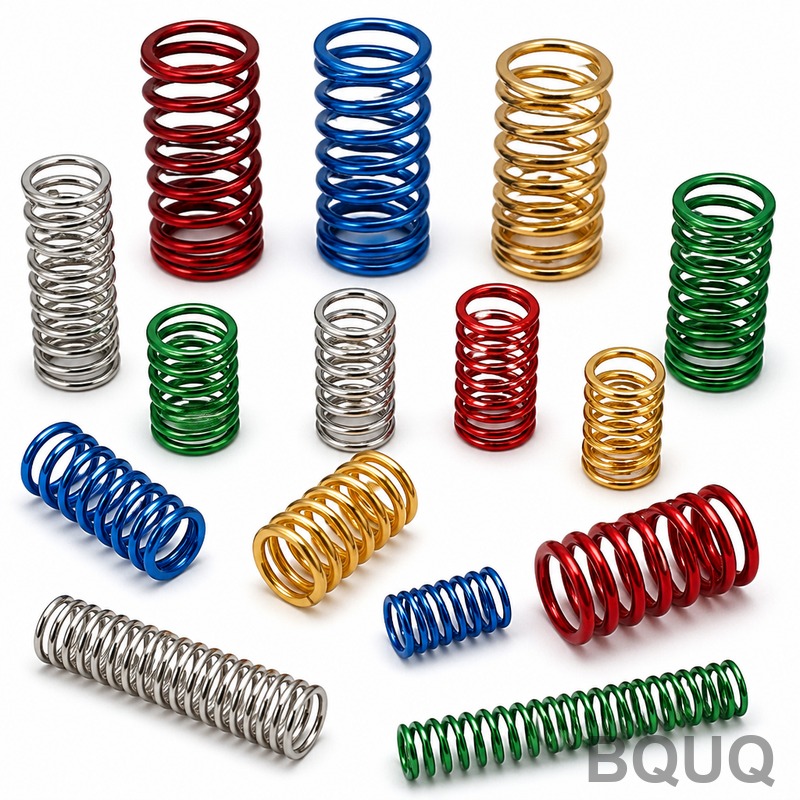
Dimensional Tolerances and Measurement Standards
Precision springs require defined tolerances on five key dimensions: wire diameter (d), outer diameter (OD), free length (L0), solid height, and total coils. According to DIN 2095 for cold-coiled compression springs, standard tolerance grades are Grade 1 (±1% of L0 or ±0.1 mm, whichever is greater) and Grade 2 (±2% of L0 or ±0.2 mm). For critical applications, BQUU can hold Grade 1 tolerances on wire diameter of ±0.005 mm for wire under 3.0 mm, achieved via CNC coiling with laser measurement feedback.
The table below shows typical achievable tolerances at BQUU for medium-volume production runs (1,000-10,000 pieces):
| Parameter | Wire Diameter 0.5-3.0 mm | Wire Diameter 3.1-8.0 mm | Wire Diameter 8.1-12.0 mm |
| Wire diameter tolerance (Grade 1) | ±0.005 mm | ±0.010 mm | ±0.015 mm |
| Outer diameter tolerance | ±0.10 mm | ±0.15 mm | ±0.25 mm |
| Free length tolerance (L0 up to 50 mm) | ±0.15 mm | ±0.25 mm | ±0.40 mm |
| Free length tolerance (L0 over 50 mm) | ±0.30 mm | ±0.50 mm | ±0.80 mm |
| Spring rate tolerance | ±3% | ±3% | ±5% |
| Total coils tolerance | ±0.25 coil | ±0.25 coil | ±0.50 coil |
Spring Rate and Load Deflection Data
The spring rate (k) in N/mm is the most functional specification, but it is insufficient alone. You must also provide the required load at a specific deflection (e.g., 50 N at 10 mm compression) or the working deflection range. The theoretical rate is calculated as k = (G × d^4) / (8 × Dm^3 × Na), where G is shear modulus, d is wire diameter, Dm is mean diameter, and Na is active coils. For a 2.0 mm music wire spring with 30 mm OD and 6 active coils, the rate computes to 2.65 N/mm. However, actual rate varies by ±3% due to material batch variations in G (79.3 GPa ± 1.5 GPa).
Provide both the required rate and a load tolerance. If you only give a free length and solid height, we cannot calculate the rate without knowing the number of active coils. In the absence of coil count, BQUU's engineering team will reverse-calculate from your stated load-deflection point, but this adds 4-6 hours to the quoting process. Include a force-deflection curve or at least two data points: load at 50% deflection and load at 80% deflection. This allows us to validate linearity and detect premature coil binding.
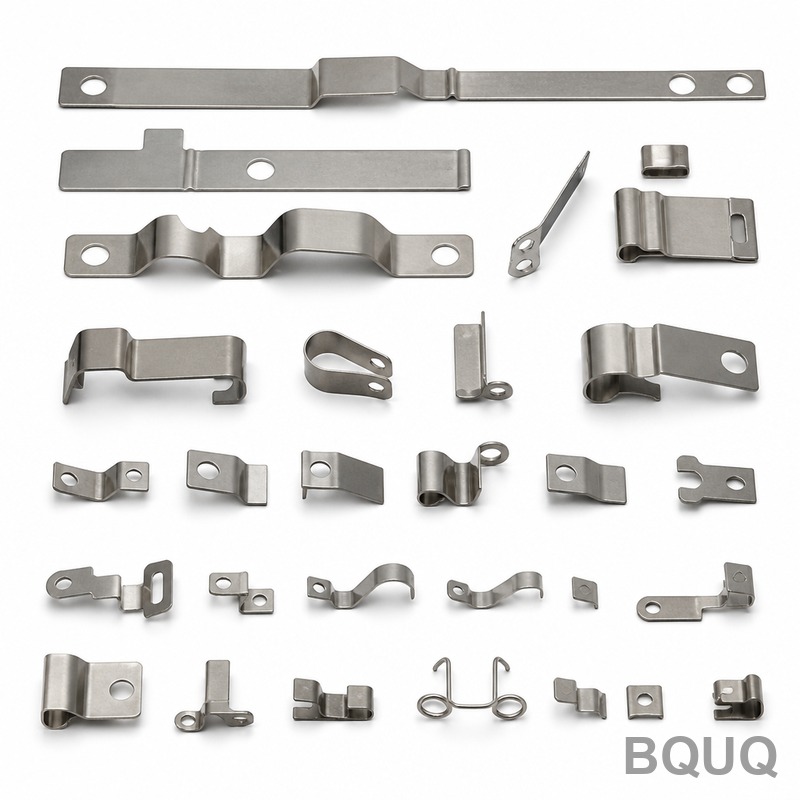
End Configurations and Coil Count Details
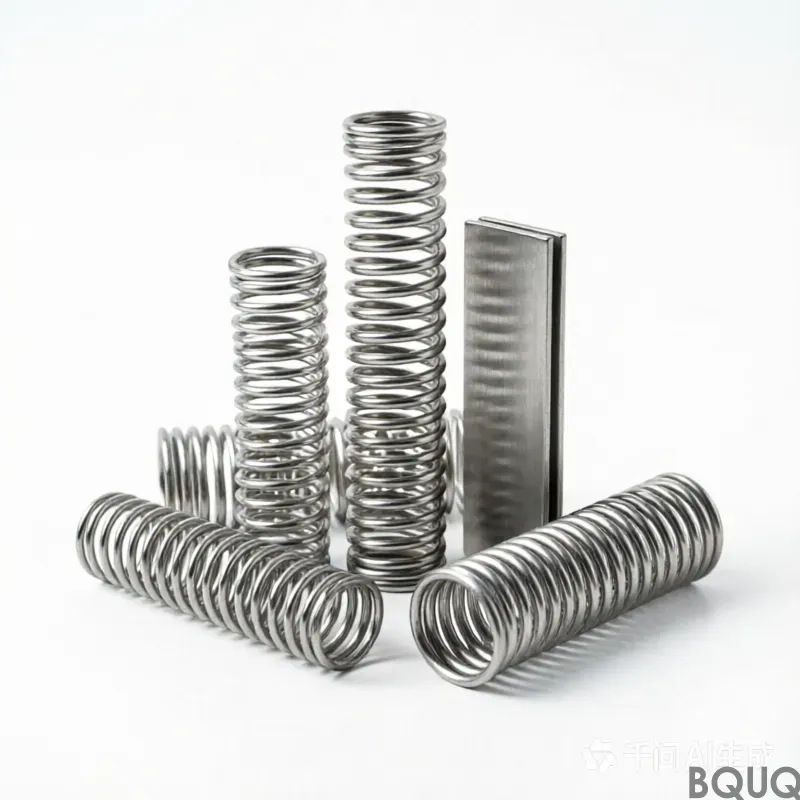
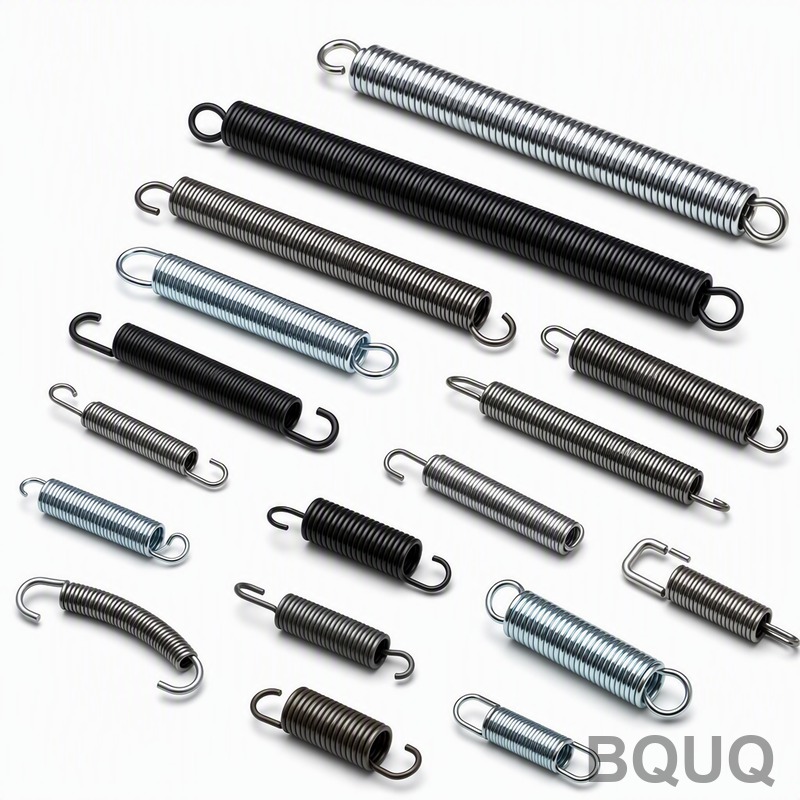
End type determines the effective number of coils and the solid height. For compression springs, standard ends are closed and ground, closed not ground, open, and closed with plain ends. Closed and ground ends provide a flat seating surface, reducing buckling risk and allowing precise load application. Grinding removes 0.5-1.0 mm from each end, which changes free length and solid height. For extension springs, specify initial tension (0.5-10 N typical) and end loop style (German loop, crossover loop, or side loop). Torsion springs require the leg length, leg angle, and winding direction (left or right hand).
For a closed and ground compression spring, the total coils equals active coils plus 2. The solid height is approximately total coils × wire diameter. If you specify 8 total coils with 2.0 mm wire, the theoretical solid height is 16 mm. But grinding removes material, so actual solid height is 14.5-15.5 mm. Always specify the maximum allowable solid height, not just the theoretical value. This prevents coil binding and stress overload when the spring is fully compressed.
Surface Treatment and Fatigue Life Requirements
Surface condition directly impacts fatigue performance. A ground surface with micro-cracks from grinding can reduce fatigue life by 50% compared to a shot-peened surface. For dynamic applications exceeding 10 million cycles, specify shot peening (intensity 0.15-0.30 A) and preset or scragging. At BQUU, we offer shot peening with Almen strip verification, achieving a 30-40% improvement in fatigue strength for chrome silicon springs. For corrosion resistance, specify zinc plating (5-8 μm, salt spray 72 hours), zinc-nickel (8-12 μm, salt spray 240 hours), or epoxy powder coating (20-40 μm).
For static applications under 1,000 cycles, no surface treatment is required beyond standard oiling. But for automotive valve springs operating at 6,000 RPM, fatigue life of 100 million cycles demands shot peening plus a compressive residual stress of 400-600 MPa on the surface. Provide the required cycle life and the maximum operating stress (as a percentage of tensile strength). If you exceed 45% of tensile strength for music wire, the spring will fail prematurely regardless of surface treatment.
Cost Drivers and Lead Time Variables
The price of a custom spring scales non-linearly with tolerance grade, material, and quantity. A Grade 2 tolerance spring costs 30-40% less than Grade 1 due to reduced inspection time and lower scrap rates. Material cost varies significantly: music wire is $2.5/kg, stainless 302 is $6.8/kg, and Inconel X-750 is $45/kg. For a 10 g spring, the material cost difference is $0.04 for music wire versus $0.45 for Inconel, but the machining time difference is negligible. Tooling setup is the major cost driver: a standard CNC coiler setup costs $150-250, while a custom mandrel for OD over 80 mm costs $400-600.
Lead times at BQUU are 3-5 working days for prototypes up to 50 pieces, 7-10 days for production runs of 1,000-5,000 pieces, and 15-20 days for orders over 50,000 pieces with full PPAP documentation. Surface treatment adds 2-3 days, and shot peening adds 1-2 days. For urgent breakdowns, we offer 24-hour express service with a 30% surcharge, available for springs with wire diameter under 5.0 mm and standard materials.
Practical Recommendations for Order Placement
Provide a 2D drawing with GD&T callouts and a 3D STEP file if available. If you only have a sample spring, BQUU can reverse-engineer it via optical measurement, but you must specify the material if the sample is unmarked. Always include the application environment: temperature range, chemical exposure, and vibration frequency. This allows our engineers to validate the material selection against your stated requirements. For new designs, request a prototype batch of 10-20 pieces before committing to mass production. Prototype testing on your side verifies the spring rate and solid height against your actual assembly, reducing the risk of a 10,000-piece reject.
Specify the measurement condition: free length should be measured with the spring resting on a flat surface, not hanging. Spring rate should be measured between 20% and 80% of the total deflection to avoid the non-linear seating region. If you require statistical process control (SPC) data, request CpK values of 1.33 or higher; BQUU provides full inspection reports with CMM measurements and force-deflection curves for every batch.
FAQ-Style Tips: Q: What if I only know the spring's wire diameter and outer diameter? A: Provide at least free length and total coils. Without active coils, we cannot calculate rate. At minimum, send a sample or a photo with a ruler for scale, and we will estimate the remaining parameters with a 48-hour engineering review.
Q: Can I order springs with mixed tolerances, e.g., Grade 1 on OD but Grade 2 on length? A: Yes, BQUU allows per-dimension tolerance assignment. This reduces cost by 15-20% compared to full Grade 1. However, the spring rate tolerance will still be governed by the looser dimension.
Q: What is the minimum order quantity for custom springs? A: No minimum for standard wire diameters (0.3-12.0 mm). A 10-piece prototype order costs $50-80 including setup, while a 100-piece order averages $0.30-0.60 per piece for basic music wire springs.
Conclusion
Providing complete spring specifications is not a formality, it is a technical necessity that directly determines the success of your component. The seven critical parameters—wire diameter, outer diameter, free length, active coils, material grade, spring rate, and end type—form the minimum dataset for any custom spring order. Additional data on surface treatment, fatigue life, and tolerance grades further reduces risk and accelerates production. At BQUU, our 20 years of CNC machining and spring manufacturing experience in Dongguan ensures that every specification is translated into a precise, repeatable manufacturing process.
For your next custom spring project, send your drawings, samples, or rough parameters to our engineering team. We provide a 12-hour quotation with full technical feedback, including alternative material suggestions and tolerance optimization to reduce your cost. Contact us at Email: sc@bquq.com, WhatsApp: +86 13713157787, or visit www.bquq.com. Our team is ready to review your requirements and deliver springs that meet your exact functional and budgetary targets.