Custom vs Catalog Springs: When to Specify Custom for Your Application
When deciding between custom and catalog springs, the answer is not binary but based on load accuracy, fatigue life, environmental factors, and total cost of ownership. Specify a custom spring when your application demands tolerances tighter than ±5% of load, operates outside standard temperature ranges, or requires a spring index below 4 or above 16. For general-purpose compression, extension, or torsion applications with standard loads, a catalog spring will save 30-60% in unit cost and reduce lead time from 3 weeks to 2 days.
Load Tolerance and Functional Requirements
The first technical gate is load tolerance. Catalog springs typically offer a load tolerance of ±10% at a specified working height, per ISO 10243 and DIN 2095 standards. Custom springs can achieve ±3% to ±5% consistently, and down to ±2% with additional grinding and testing.
For example, a valve return spring in a hydraulic system requiring a force of 50 N at 25 mm compressed height. A catalog spring may deliver 45-55 N, which could cause valve chatter or incomplete sealing. A custom spring with ±2% tolerance delivers 49-51 N, ensuring stable operation. If your design calculates a safety factor below 1.2 for spring force, you need custom.
| Spring Type | Load Tolerance | Fatigue Life (cycles) | Max Temperature | Lead Time | Relative Unit Cost |
| Custom Compression | ±2% to ±5% | 10,000,000+ | 300°C (Inconel) | 2-4 weeks | 3.5x catalog |
| Catalog Compression | ±10% | 1,000,000 | 120°C (music wire) | 1-3 days | 1.0x baseline |
| Custom Torsion | ±3% | 5,000,000 | 250°C (stainless 302) | 3-5 weeks | 4.0x catalog |
| Catalog Torsion | ±12% | 500,000 | 90°C (hard drawn) | 2-5 days | 1.2x baseline |
| Custom Die Spring | ±5% (load at 30% deflection) | 5,000,000 | 200°C (chrome silicon) | 3 weeks | 2.8x catalog |
| Catalog Die Spring | ±10% | 1,000,000 | 160°C (chrome vanadium) | 3-7 days | 1.5x baseline |
Fatigue Life and Dynamic Loading
Catalog springs are designed for static or low-cycle applications. A standard music wire compression spring (ASTM A228) has an infinite fatigue life only up to 20,000 cycles at 50% of maximum stress. Beyond that, you risk premature fracture. For dynamic applications exceeding 100,000 cycles, you must specify custom springs with shot peening, preset (scragging), and higher-grade materials.
Consider a spring in an automotive clutch system cycling at 2 Hz for 8 hours per day. That is 57,600 cycles per day. A catalog spring would fail within 3 weeks. A custom spring made from chrome silicon (ASTM A401) with shot peening can achieve 10 million cycles. The cost difference is roughly $0.80 vs $2.50 per piece, but the replacement labor and downtime cost exceed $50 per failure. Custom is the only rational choice.
For high-speed stamping dies running at 300 SPM (strokes per minute), die springs must survive 5 million cycles. Catalog die springs (medium pressure) typically survive 1 million cycles. Custom die springs with rectangular wire and full shot peening reach 10 million cycles. Always specify custom when your cycle count exceeds 1 million or when operating stress exceeds 60% of tensile strength.
Dimensional Constraints and Spring Index
The spring index (D/d, mean coil diameter divided by wire diameter) determines manufacturability. Catalog springs are limited to a spring index between 4 and 16. If your design space forces a spring index of 3 (very stiff, small diameter) or 18 (very flexible, large diameter), no catalog product will fit.
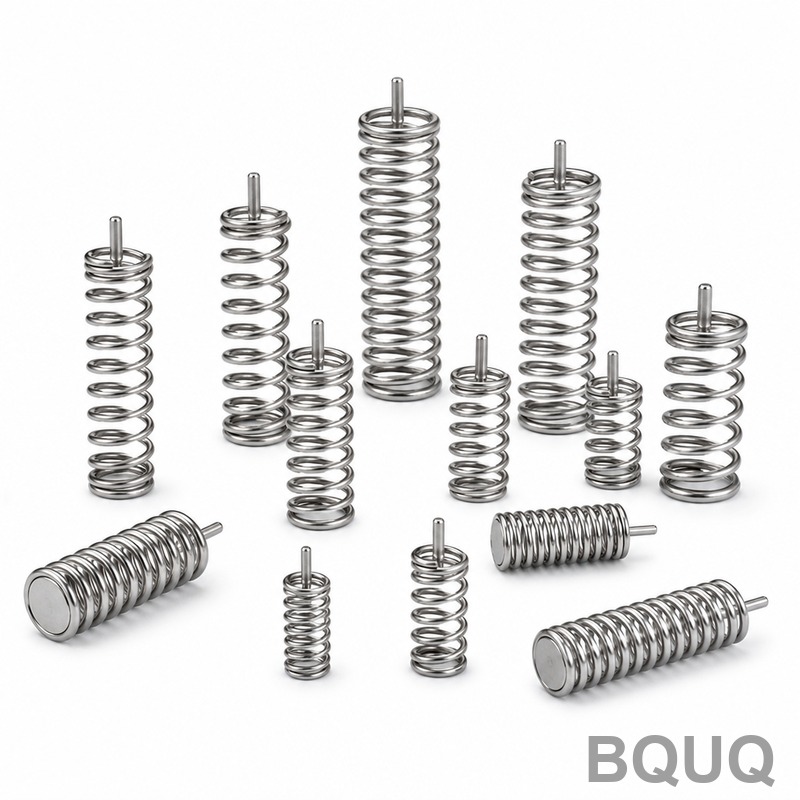
For example, a medical device requiring a spring with 3 mm outer diameter and 0.6 mm wire gives a spring index of 4.0. This is borderline. But if the outer diameter is 2.5 mm with 0.6 mm wire, the index is 3.2, which requires custom tooling and careful coiling control. Similarly, a spring with 30 mm outer diameter and 1.0 mm wire gives an index of 29, prone to buckling and requiring custom mandrels.
Custom springs also allow for closed and ground ends, which catalog springs may not offer. Ground ends improve load accuracy by providing flat seating surfaces, reducing stress concentration by up to 30%. If your spring must stand perpendicular within 1 degree, you need custom grinding. Catalog springs often have a perpendicularity tolerance of 3-5 degrees.
Environmental Resistance and Temperature Limits
Material selection is the most critical factor for extreme environments. Catalog springs are predominantly music wire (ASTM A228) or hard drawn wire (ASTM A227). These materials lose their elastic properties above 120°C and corrode rapidly in acidic or marine environments.
Custom springs allow specification of: - Stainless steel 302 (ASTM A313): corrosion resistant, usable to 250°C - Inconel X-750: oxidation resistant, usable to 600°C - Elgiloy: non-magnetic, high fatigue, usable to 400°C - Beryllium copper: non-sparking, conductive, usable to 200°C
For a spring operating in an engine bay at 150°C, a catalog music wire spring will lose 20% of its load within 100 hours due to stress relaxation. A custom stainless 302 spring with a stress-relieving heat treatment at 400°C will maintain 95% of load after 1,000 hours. The custom spring costs $1.80 vs $0.40 for catalog, but the catalog spring requires replacement every 3 months, making custom 4x cheaper over a 12-month period.
Corrosion is another trigger. If your spring will be exposed to salt spray (ASTM B117) for more than 24 hours, catalog music wire will show red rust. Custom springs with passivated 302 stainless or zinc-nickel plating (12-15 microns) withstand 96+ hours. For food processing or pharmaceutical applications with aggressive cleaning agents, specify custom springs in 316 stainless steel or Hastelloy.
Cost Breakdown and Total Cost of Ownership
The raw purchase price of a custom spring is always higher. A typical custom compression spring (2 mm wire, 20 mm OD, 40 mm free length) costs $0.80-$2.50 per piece at 5,000 piece volume. The same dimensions in a catalog spring costs $0.20-$0.50. However, the total cost of ownership includes installation, downtime, and failure risk.
| Cost Factor | Catalog Spring | Custom Spring |
| Unit price (5,000 pcs) | $0.35 | $1.20 |
| Tooling / setup (one-time) | $0 | $450 |
| Replacement frequency (cycles) | 500,000 | 10,000,000 |
| Cost per 10M cycles (excluding tooling) | $7.00 | $1.20 |
| Downtime cost per failure | $35 | $0 (no failure) |
| Total cost per 10M cycles | $42.00 | $1.20 + $450 tooling = $451.20 |
For low-volume production (under 1,000 pieces per year), catalog springs are always more economical. For high-volume or high-reliability applications, custom springs amortize tooling costs quickly. If your product will be manufactured for more than 2 years or exceed 50,000 units, the custom spring tooling cost is negligible per unit.
When to Use Catalog Springs as a Smart Default
Catalog springs are the correct engineering choice when all of these conditions are met: - Load tolerance of ±10% is acceptable - Operating cycles below 1 million - Temperature between -20°C and 100°C - Spring index between 5 and 12 - No corrosive environment - No certification or traceability requirements (e.g., automotive PPAP, medical ISO 13485)
For prototyping and early-stage development, always start with a catalog spring. Buy 10 different springs at $5 total, test them in your assembly, and measure actual performance. This gives you empirical data to write a precise custom specification. Only after validating the concept should you invest in custom tooling.
Practical Recommendations and Specification Tips
When you decide to go custom, provide your spring manufacturer with these data points: 1. Free length and solid height (mm) 2. Outer diameter, inner diameter, or mean diameter (mm) 3. Wire diameter (mm) 4. Load at one or two working heights (N or kgf) 5. Maximum deflection and maximum stress (MPa) 6. Operating temperature range (°C) 7. Required fatigue life (cycles) 8. End configuration (closed, ground, plain) 9. Surface treatment (zinc plating, shot peening, black oxide) 10. Acceptance test method (load test at specified height, rate test)
For example, a proper custom spec: "Compression spring, 2.0 mm music wire, 18.0 mm OD, 45.0 mm free length, 12.0 mm solid height, 100 N at 30.0 mm compressed height ±3%, 50 N at 35.0 mm ±3%, shot peened, preset, 10 million cycles, operating temperature -20°C to 90°C."
FAQ-Style Tips for Spring Selection
Q: Can I use a catalog spring but grind the ends myself? A: Yes, but you lose the factory stress relief. Grinding locally removes the shot-peened layer and creates micro-cracks. Always order custom if you need ground ends.
Q: How much does a custom spring die cost? A: For wire diameters under 4 mm, tooling costs $300-$600. For wire over 6 mm, tooling can reach $1,500. This is a one-time cost amortized over your order quantity.
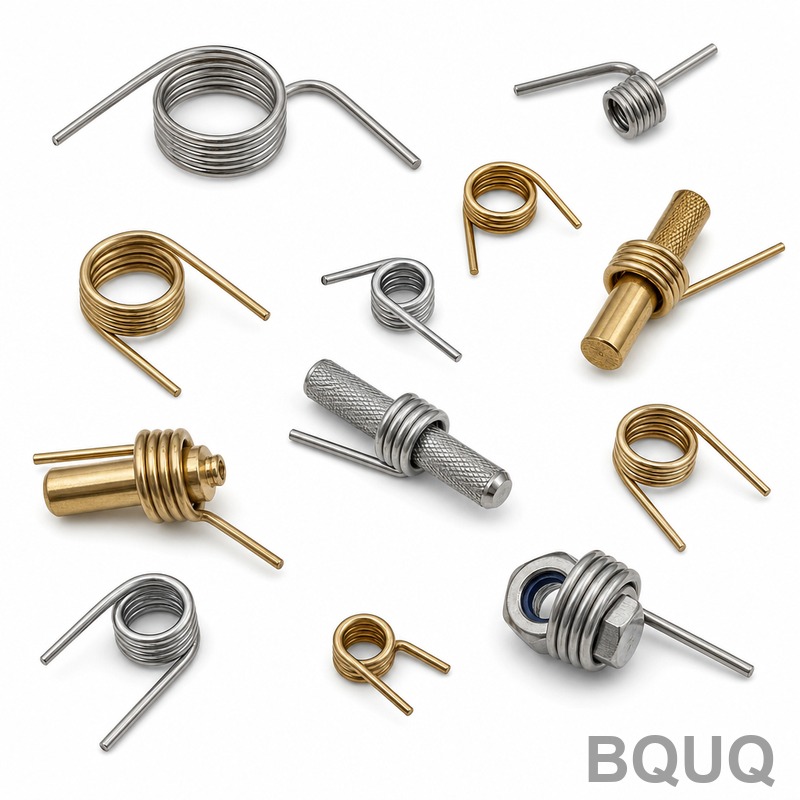
Q: What is the minimum order quantity for custom springs? A: At BQUQ, we accept custom spring orders from 500 pieces. For prototype, we can produce 20-50 pieces at a higher per-unit price (2-3x production price).
Q: How fast can I get a custom spring quote? A: A complete quotation with drawings and pricing takes 4-8 hours. Production lead time is 2-3 weeks for standard materials, 4-5 weeks for Inconel or Elgiloy.
Q: What tolerance can I expect on spring rate? A: Spring rate tolerance is typically ±5% for custom, ±15% for catalog. If you need ±2% on rate, you must specify 100% load testing and sorting.
Q: Do custom springs need certification? A: For automotive, medical, and aerospace, yes. We provide material certificates (EN 10204 3.1), dimensional reports, and load test data. This adds 3-5 days to lead time.
Conclusion
The decision between custom and catalog springs comes down to engineering economics. Use catalog springs for prototypes, low-cycle static applications, and where ±10% load is acceptable. Specify custom springs when your design requires tight tolerances, high fatigue life, extreme temperatures, or non-standard dimensions. The 3x premium in unit price is justified when it eliminates failures, reduces downtime, and ensures product reliability.
At BQUQ, our 20 years in CNC machining, metal stamping, and spring manufacturing means we produce custom springs with tolerances as tight as ±2% on load and surface finishes to Ra 0.8. We offer free design review and recommend the most cost-effective material and manufacturing process. Send us your drawing or sample, and we will provide a detailed quotation with full dimensional and load testing data.
For a custom spring quote within 12 hours, contact our engineering team at sc@bquq.com or WhatsApp +86 13713157787. Visit www.bquq.com to download our spring design checklist and tolerance guidelines.
Related Articles
- Smart Spring Inventory Management Strategies for OEMs
- Size control and online intelligent detection technology of precision spring
- From "standard parts" to "functional parts": 2026 hardware spring industry technology trends and functional innovation engineering direction
Frequently Asked Questions
When should I choose a custom spring over a catalog spring?
Choose a custom spring when your application demands load tolerances tighter than ±5%, operates outside standard temperature ranges, or requires a spring index below 4 or above 16. For general-purpose applications with standard loads, catalog springs save 30-60% in unit cost and reduce lead time from 3 weeks to 2 days.
What load tolerance can I expect from custom versus catalog springs?
Catalog springs typically offer a load tolerance of ±10% at a specified working height, per ISO 10243 and DIN 2095 standards. Custom springs can achieve ±3% to ±5% consistently, and down to ±2% with additional grinding and testing. For example, a valve return spring requiring 50 N at 25 mm compressed height, a custom spring with ±2% tolerance delivers 49-51 N, ensuring stable operation.
How does fatigue life differ between custom and catalog springs for dynamic applications?
Catalog springs are designed for static or low-cycle applications, with a standard music wire compression spring having infinite fatigue life only up to 20,000 cycles at 50% of maximum stress. For dynamic applications exceeding 100,000 cycles, custom springs with shot peening and preset are required. A custom chrome silicon spring can achieve 10 million cycles, while a catalog spring would fail within 3 weeks in a 57,600 cycles-per-day application.
What are the cost and lead time differences between custom and catalog die springs?
Custom die springs cost about 2.8x catalog baseline, with a lead time of 3 weeks, while catalog die springs cost 1.5x baseline with a 3-7 day lead time. Custom die springs with rectangular wire and full shot peening reach 10 million cycles, versus 1 million cycles for catalog die springs. For high-speed stamping dies at 300 SPM, custom is the only rational choice when cycle counts exceed 1 million.