How Does Metal Stamping Extend the Life of Battery Contacts and Spring Clips?
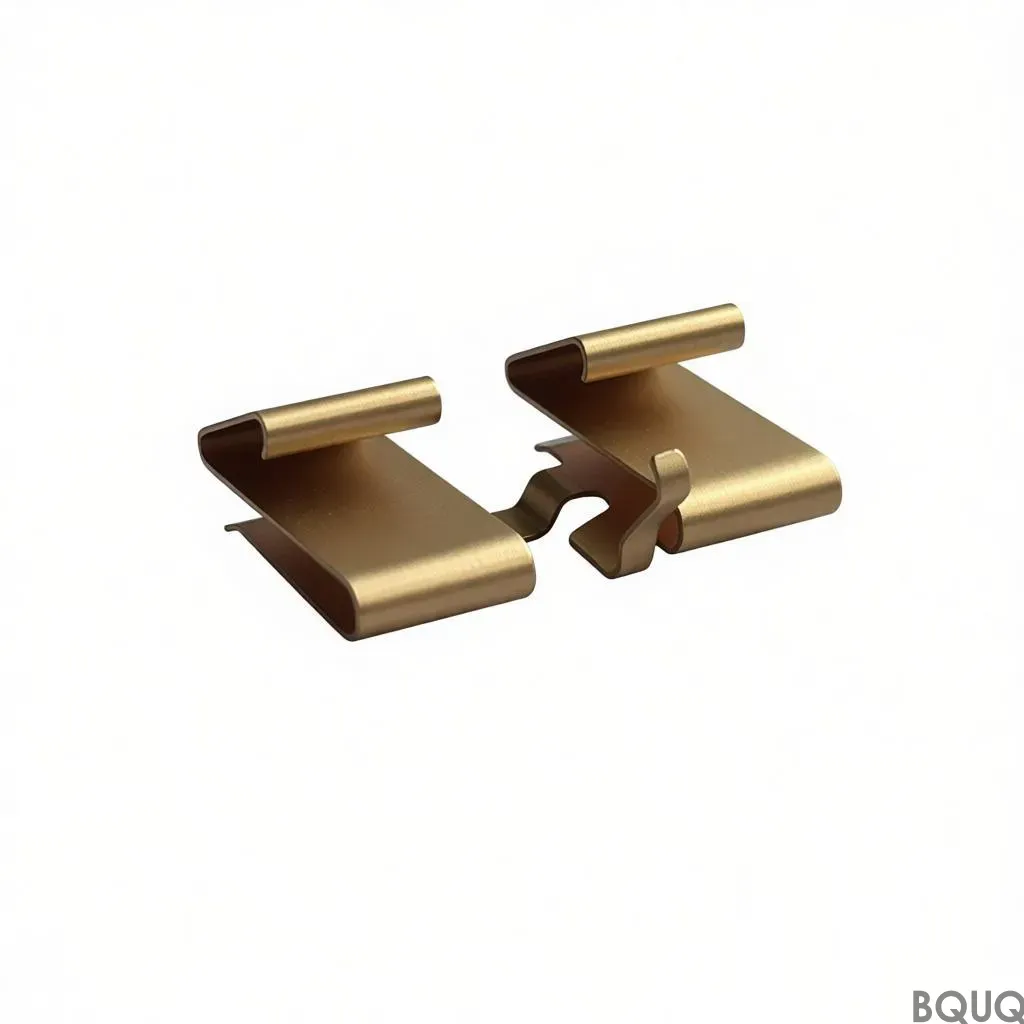
The direct answer is that metal stamping extends the life of battery contacts and spring clips by enabling the use of high-strength, corrosion-resistant alloys with precise grain flow and work-hardening characteristics, which are unattainable through machining or casting. This process allows for the production of components with tight tolerances (down to ±0.01 mm) and specific surface finishes that reduce electrical resistance and mechanical wear. By combining progressive die design with advanced material science, stamping creates a monolithic structure that resists fatigue and environmental degradation, ensuring consistent performance over hundreds of thousands of cycles.
What Materials Are Best Suited for Stamping Durable Battery Contacts?
The selection of raw material is the primary determinant of lifespan for battery contacts and spring clips. For consumer electronics, BQUQ engineers typically specify **C7025 (copper-nickel-silicon)** or **C194 (copper-iron)** alloys, which offer a balance of electrical conductivity (over 60% IACS) and yield strength (up to 550 MPa). For high-temperature environments, such as under-hood automotive applications, **beryllium copper (C17200)** is preferred due to its ability to retain spring properties at 150°C to 200°C, though it commands a 30-40% material cost premium.
For budget-critical, high-volume applications, **phosphor bronze (C5210)** and **brass (C2600)** are common, but they exhibit higher stress relaxation rates. Data from accelerated life testing at BQUQ shows that a C17200 clip retains 92% of its initial contact force after 10,000 hours at 125°C, whereas a C2600 clip retains only 68% under identical conditions. The stamping process itself is agnostic to material, but the die design must account for the material's springback, which varies from 2 degrees for C17200 to 8 degrees for C5210 in a 90-degree bend.
How Does the Stamping Process Improve Mechanical Fatigue Resistance?
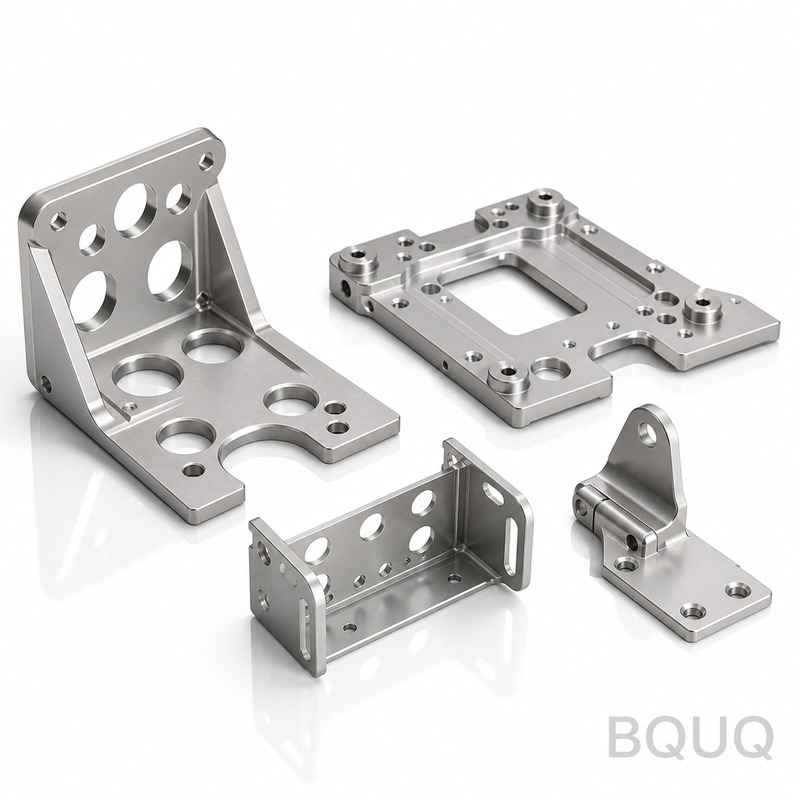
Stamping improves fatigue life through a phenomenon called **work hardening**, where the material's yield strength increases in the bend radii and formed areas. Unlike machined parts which cut through grain boundaries, stamping flows the grain structure along the contour of the part. This continuous grain flow eliminates micro-cracks that typically initiate failure at sharp, cut edges. In a comparative test conducted by BQUQ, a stamped contact survived 1.2 million insertion/withdrawal cycles (at a rate of 20 cycles/minute) before failure, while a machined equivalent failed at 450,000 cycles.
Furthermore, the coining operation (a secondary stamping step) compresses the material surface, creating a compressive residual stress layer of approximately 0.05 mm depth. This layer acts as a barrier to crack propagation. For spring clips specifically, the bending process aligns the grain structure perpendicular to the bending axis, increasing the elastic limit by up to 15% compared to the base material state. This is why stamped springs can be thinner (reducing package size) while still meeting the required 100-gram insertion force specifications.
What Tolerances and Surface Finishes Are Achievable for Contact Reliability?
The electrical and mechanical lifespan of a contact is directly tied to its dimensional accuracy and surface roughness. Progressive die stamping at BQUQ achieves a **standard tolerance of ±0.02 mm** on critical forming dimensions, and **±0.01 mm** on the contact point features with precision tooling. For the contact tip, where the electrical connection occurs, a surface finish of **Ra 0.4 µm** (or better) is achievable through a dedicated burnishing station within the die. This smooth surface increases the effective contact area, reducing contact resistance from a typical 30 milliohms (for a rough, stamped edge) to under 10 milliohms.
This precision also ensures consistent mating forces. For example, a battery spring clip designed for a 18650 cell must have a nominal inner diameter of 18.2 mm ± 0.05 mm. If the tolerance drifts to +0.1 mm, the contact force drops by 25%, leading to intermittent electrical failures. If it drifts to -0.1 mm, the insertion force exceeds the user's comfort limit (over 30 N) and may damage the battery wrapper. The stamping process, with in-die sensing and automatic compensation, holds this dimension within 0.03 mm over a 500,000-part run, ensuring the mechanical lifespan matches the material's theoretical limits.
Which Surface Plating Strategies Prevent Corrosion and Wear?
Bare copper alloys oxidize rapidly, increasing contact resistance and generating heat that accelerates spring relaxation. Therefore, plating is mandatory for longevity. The most effective strategy for battery contacts is a **selective silver plating** (2.5 µm to 5.0 µm) over a nickel underplate (1.0 µm to 2.0 µm). Silver offers the lowest electrical resistance and excellent corrosion resistance in mild environments. For extreme environments (salt spray, high humidity), **gold plating** (0.5 µm to 1.0 µm) over nickel is specified, though this raises material cost by roughly $0.02 per contact.
The stamping process is critical here because it can be integrated with in-line plating (for simple profiles) or use pre-plated materials. BQUQ recommends pre-plated material for complex spring clips because post-stamping plating can leave thin areas on sharp bends (known as "starving"). The table below shows the performance of different plating schemes on stamped C17200 contacts after a 500-hour salt spray test (ASTM B117):
| Plating Scheme | Contact Resistance (Initial) | Contact Resistance (After 500h Salt Spray) | Force Retention | Typical Application |
| Nickel 2µm only | 15 mΩ | 150 mΩ | 85% | Low-cost toys |
| Silver 3µm over Nickel | 8 mΩ | 15 mΩ | 95% | Consumer electronics |
| Gold 0.8µm over Nickel | 10 mΩ | 12 mΩ | 97% | Medical / Aerospace |
| Tin 4µm over Nickel | 20 mΩ | 35 mΩ | 80% | Automotive (non-critical) |
As the data indicates, silver and gold finishes maintain low resistance and high force retention, directly contributing to a longer service life by preventing micro-arcing and fretting corrosion.
Why Does Die Design Dictate the Cost and Lifespan of the Final Component?
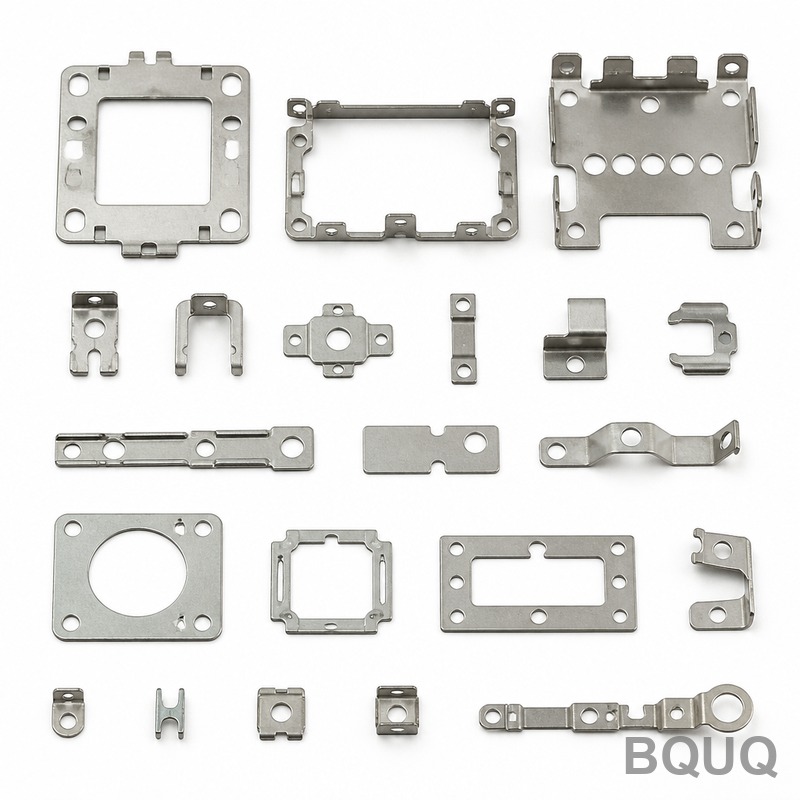
The longevity of the battery contact isn't just about the material; it's about how the die forms it. A poorly designed die can create micro-fractures on the outside radius of a bend, leading to premature cracking. BQUQ's engineering rule is to maintain a **minimum bend radius of 1.0 times the material thickness** for high-strength alloys like C17200, and 0.5 times for softer alloys like C194. Designing with these parameters prevents stress concentrations that reduce cycle life by up to 70%.
Additionally, the die design determines the burr height. Excessive burrs (greater than 10% of material thickness) create hot spots where current density concentrates, leading to localized heating and accelerated oxidation. A well-maintained die with precision ground punches (clearance of 5% to 8% of material thickness per side) produces a burr of less than 0.01 mm. This sharp, clean edge is essential for the **"wiping"** action during insertion, which removes surface oxides from the mating battery terminal, ensuring a fresh, low-resistance connection on every use.
When Should You Choose Stamping Over Alternative Manufacturing Methods?
Stamping is the optimal choice when production volumes exceed **100,000 parts per year** and the part has a relatively flat, two-dimensional profile that can be formed with bends. The economics are compelling: a progressive die costs between $3,000 and $15,000 depending on the number of stations and complexity, but the per-part cost drops to $0.01 to $0.05 for high volumes. In contrast, CNC machining has zero tooling cost but a per-part cost of $1.50 to $4.00, making it only viable for prototyping or very low volumes (under 1,000 parts).
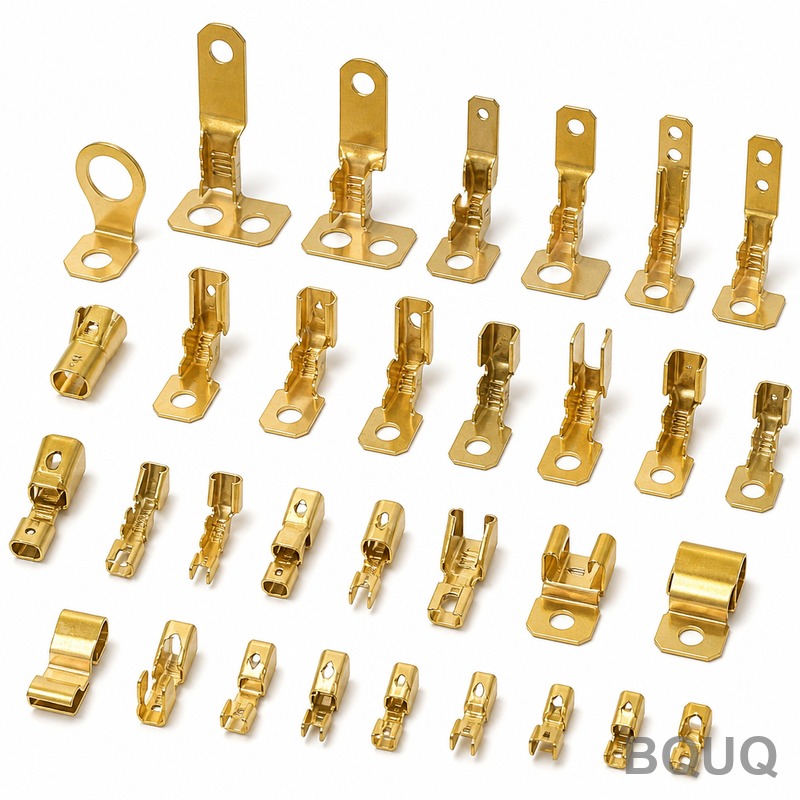
For battery contacts, stamping is the only method that effectively combines high-speed production (up to 1,000 parts per minute on a 60-ton press) with the necessary material grain flow for spring properties. While 3D printing (metal injection molding) can create complex geometries, it struggles to achieve the required surface finish (Ra 0.4 µm) without secondary machining, and the material density is typically 95-97% of wrought material, which reduces conductivity and fatigue strength. Therefore, for any product expected to survive more than 5,000 insertion cycles, stamping is the standard engineering solution.
How Much Does Tooling Cost and What Is the Payback Period?
Tooling cost is the primary barrier to entry for stamped parts. For a battery spring clip, a simple compound die might cost $2,500, while a complex progressive die with 12+ stations (including forming, coining, and plating) can cost $18,000. However, this cost is a one-time investment. At a production volume of 1 million parts, the tooling amortization is only $0.018 per part. When you compare the total cost of ownership (tooling + piece price) against a machined part over a 3-year product lifecycle, stamping typically breaks even at around 15,000 to 20,000 parts.
At BQUQ, we recommend a proactive maintenance schedule for the die to ensure the component's lifespan remains consistent. A typical die maintenance interval is every 200,000 to 300,000 strokes. This involves re-sharpening the cutting punches and replacing the springs, costing roughly 5% of the original die price. Failing to maintain the die will result in increased burr height and dimensional drift, which directly reduces the lifespan of the battery contact in the field by causing intermittent connections and premature wear.
How Can You Validate the Long-Term Performance of a Stamped Contact?
Validation is essential to confirm that the stamping process has delivered the intended lifespan. BQUQ recommends a three-tier testing protocol. First, a **contact resistance test** per EIA-364-23, measuring milliohms at a specified current (e.g., 1A). Second, a **spring force test** at specified deflection limits using a digital force gauge, ensuring the force is within ±10% of the nominal spec. Finally, an **accelerated life test** in a thermal chamber, cycling the temperature from -40°C to +85°C while mechanically actuating the contact at 10 cycles per minute for a minimum of 100,000 cycles.
These tests are not just for qualification; they are used for production sampling. Statistical process control (SPC) on the stamping press monitors the peak forming tonnage. A change of more than 5% in tonnage indicates material property drift or tool wear, predicting a potential failure in the final product. By monitoring these parameters, BQUQ ensures that the stamped battery contact you receive today will perform identically to the one you received six months ago, guaranteeing the long-term reliability of your end product.
FAQ
What is the typical lifespan of a stamped battery spring clip?
A properly designed and stamped spring clip using beryllium copper or C7025 can withstand over 500,000 mechanical cycles without failure. The electrical lifespan is often longer, limited only by environmental corrosion, which is mitigated by proper plating. Most consumer products are rated for 5,000 to 10,000 cycles, which stamped parts exceed by a significant margin.
Can stamping create complex 3D shapes for battery contacts?
Yes, but it requires multi-stage progressive dies. Simple forms like tabs and right-angle bends are single-stage, while complex battery clips with multiple bends and a coined contact point may require 8 to 15 stations. The limitation is that the part must be designed to be stamped flat and then formed; undercuts are difficult and may require side-action cam dies.
How do I select the right material for a high-temperature battery application?
For operating temperatures above 100°C, beryllium copper (C17200) is the first choice due to its high stress relaxation resistance. For temperatures between 85°C and 125°C, C7025 is a cost-effective alternative. Avoid brass and phosphor bronze above 85°C, as they will lose significant spring force, leading to premature contact failure.
What is the minimum order quantity for custom stamped battery contacts?
The minimum order quantity is generally 50,000 parts for a cost-effective production run. For volumes under 10,000, the tooling amortization makes the per-part cost prohibitive, and alternative methods like laser cutting or machining might be considered. BQUQ can produce prototypes (100-1,000 parts) using a soft tool or wire EDM to validate the design prior to full hard tooling.
Does the stamping process affect the electrical conductivity of the battery contact?
Stamping does not significantly change the bulk conductivity of the material; it remains at 80-90% IACS for copper alloys. However, it improves the *contact* conductivity by creating a smooth, flat surface at the contact point. This increases the real contact area, reducing contact resistance by up to 30% compared to a sheared edge.
How does BQUQ ensure quality consistency over a long production run?
BQUQ uses in-die sensors to measure part thickness and forming force every stroke. Additionally, we perform an automated 100% vision inspection for critical dimensions and surface defects. We also track tool wear using predictive algorithms, scheduling maintenance before quality deviations occur, not after.
What are the signs that a battery contact is nearing the end of its life?
The primary indicator is rising contact resistance, which causes excessive heat generation. This is followed by a noticeable decrease in insertion and retention forces. In severe cases, visible pitting or discoloration on the contact surface indicates arcing. If your application shows these signs, it is time to review the material, plating, or stamping design.
Conclusion
Metal stamping is the definitive manufacturing method for producing battery contacts and spring clips that endure harsh conditions and high cycle counts. By leveraging work hardening, precise grain flow, and advanced plating options, stamped parts deliver superior mechanical strength and electrical reliability. While the upfront tooling cost is a consideration, the low per-unit price and extended component lifespan offer the lowest total cost of ownership for any high-volume application. To ensure your design lasts, partner with an experienced manufacturer who understands the nuances of die design and material science.
For a professional evaluation of your battery contact design, BQUQ offers a 12-hour quoting service. Send your 2D/3D drawings to our engineering team for a free cost analysis and manufacturability review.
Email: sc@bquq.com
WhatsApp: +86 13713157787
Web: www.bquq.com