How Many Cycles Will My Spring Last? Fatigue Life Explained
The fatigue life of a spring is not a single number but a calculated prediction based on material, stress level, surface condition, and operating environment. For most standard compression springs made from oil-tempered chrome silicon wire, you can expect between 10,000 and 1,000,000 cycles before failure, with 100,000 cycles being a common baseline for general industrial use. To maximize lifespan, engineers must design for a maximum operating stress below 45% of the material's tensile strength for infinite life, or use shot peening to increase fatigue resistance by up to 30%.
What Is Spring Fatigue Life and How Is It Measured?
Spring fatigue life refers to the number of load-unload cycles a spring can withstand before it fractures or loses its required force. It is measured using a fatigue testing machine that cycles the spring between a preload and a maximum load at a specific frequency, typically 5 to 50 Hz, while monitoring for cracks or load loss. The result is expressed as a Weibull distribution, with B10 life (the point where 10% of springs fail) being the most common industrial benchmark. At BQUQ, we test to B10 life at 10 million cycles for automotive-grade springs, which equates to a 99.9% survival rate for the remaining population.
How Does Material Selection Affect Spring Cycle Life?
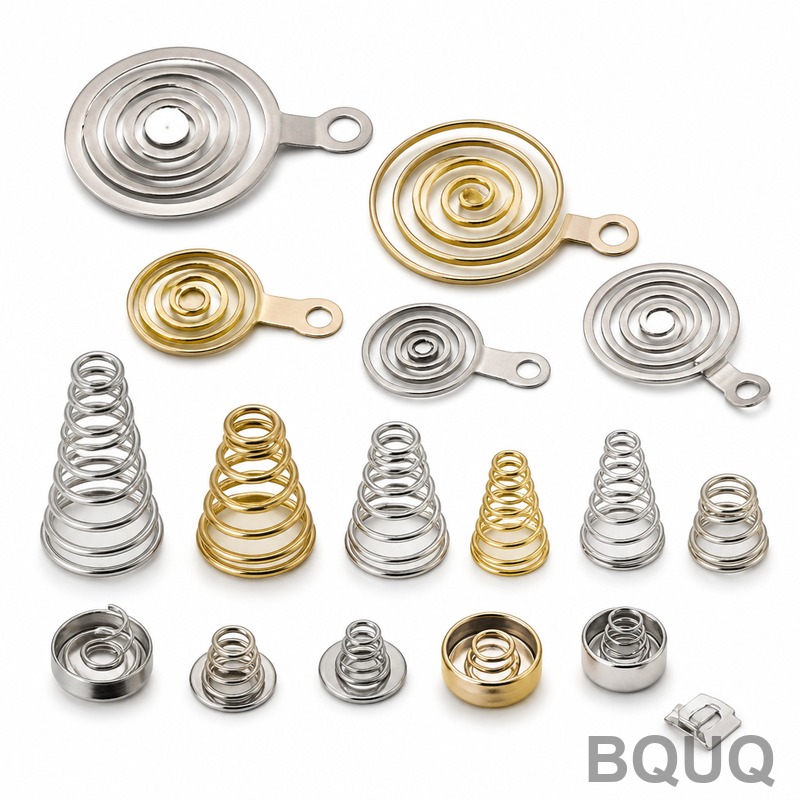
Material choice is the single largest factor in determining fatigue life. Music wire (ASTM A228) has a tensile strength of 2300 to 2700 MPa but suffers from poor performance above 120 degrees Celsius, limiting its fatigue life to roughly 100,000 cycles in high-temperature environments. Chrome silicon (ASTM A401) offers a tensile strength of 1900 to 2100 MPa and maintains its properties up to 250 degrees Celsius, achieving over 1,000,000 cycles in most applications. Stainless steel 302 provides corrosion resistance but has a lower fatigue limit, typically 500,000 cycles, due to its lower hardness and susceptibility to surface work-hardening.
| Material Type | Tensile Strength (MPa) | Max Operating Temp (°C) | Typical Fatigue Life (cycles) | Cost Index |
| Music Wire ASTM A228 | 2300 - 2700 | 120 | 100,000 | 1.0 |
| Chrome Silicon ASTM A401 | 1900 - 2100 | 250 | 1,000,000+ | 1.6 |
| Oil-Tempered Chrome Vanadium | 1800 - 2000 | 220 | 800,000 | 1.8 |
| Stainless Steel 302 | 1200 - 1500 | 300 | 500,000 | 2.2 |
| Beryllium Copper | 1100 - 1300 | 200 | 200,000 | 3.5 |
How Much Stress Can a Spring Handle Before Fatigue Failure?
The allowable stress for infinite fatigue life is typically 45% of the material's ultimate tensile strength for compression springs and 35% for torsion springs. For a chrome silicon spring with 2000 MPa tensile strength, this means a maximum corrected stress of 900 MPa for compression and 700 MPa for torsion. Operating above these limits does not cause immediate failure but reduces the cycle count logarithmically; a 10% increase in stress above the fatigue limit can reduce life by 50%. For example, a spring designed at 50% of tensile strength will last 100,000 cycles, while the same spring at 60% will fail at only 20,000 cycles.
Why Does Surface Finish and Shot Peening Extend Spring Life?
Fatigue cracks almost always initiate at the spring surface, where stress is highest and micro-defects act as stress concentrators. A ground surface with a roughness of Ra 0.8 micrometers will have a fatigue life that is 2 to 3 times longer than a hot-rolled surface with Ra 3.2 micrometers. Shot peening, which bombards the surface with 0.6 mm steel shot at 60 to 80 m/s, induces a compressive residual stress of 600 to 800 MPa. This compressive layer prevents crack propagation, increasing fatigue life by 20% to 30% for unpeened springs. At BQUQ, we shot peen all springs designed for more than 500,000 cycles, and we verify residual stress using X-ray diffraction.
How Do Operating Temperature and Environment Influence Cycle Count?
High temperatures reduce material strength and accelerate creep, directly shortening fatigue life. A chrome silicon spring operating at 200 degrees Celsius will have 70% of its room-temperature fatigue life, while a music wire spring at 120 degrees Celsius loses 50% of its life. Corrosive environments, such as salt spray or acidic fumes, create pitting on the surface; a pit of only 0.1 mm depth can reduce fatigue life by 80%. For corrosive applications, we recommend zinc-nickel plating with a thickness of 8 to 12 micrometers, which adds a sacrificial layer that protects the base material without affecting the spring rate.
Which Spring Design Parameters Most Influence Fatigue Life?
The spring index (mean coil diameter divided by wire diameter) and the Wahl factor are critical design parameters. A spring index below 4 creates high stress concentration on the inner surface, reducing fatigue life by 40% compared to an index of 8. The Wahl factor, which accounts for curvature stress, should be kept below 1.3 for fatigue-critical applications. Additionally, the number of active coils affects the natural frequency; if the operating frequency exceeds 20% of the natural frequency, the spring will surge, causing coil impact and premature failure. For a spring with a natural frequency of 200 Hz, you must limit the cycling rate to 40 Hz or add a damping mechanism.
How Can You Predict Spring Life Before Production?
Finite element analysis (FEA) with a Goodman diagram is the standard method for predicting fatigue life at the design stage. You plot the alternating stress against the mean stress, and the Goodman line connects the fatigue limit (at zero mean stress) to the tensile strength (at zero alternating stress). Any point below this line indicates infinite life, while points above it show a finite life using the modified Goodman equation: 1/N = (Sa/Se) + (Sm/Sut), where N is cycles to failure, Sa is alternating stress, Se is fatigue limit, Sm is mean stress, and Sut is ultimate tensile strength. For example, a spring with Sa of 300 MPa, Se of 500 MPa, Sm of 400 MPa, and Sut of 2000 MPa gives a life of approximately 2.5 million cycles. We run this analysis on every custom spring design and provide the predicted B10 life in our engineering report.
FAQ
What Is the Difference Between Low Cycle and High Cycle Fatigue?
Low cycle fatigue occurs below 10,000 cycles with stress levels above the yield strength, causing plastic deformation each cycle. High cycle fatigue occurs above 10,000 cycles with elastic deformation, and failure is driven by crack initiation at surface defects. Most industrial springs operate in the high cycle regime, where surface quality and residual stress dominate life.
Can I Extend the Fatigue Life of an Existing Spring?
Yes, shot peening is the most effective retroactive method, increasing life by 20% to 30%. Reducing the operating stress by 10% through adjusting preload or adding a shim can also double the fatigue life. However, re-peening is only effective if the spring has not already developed micro-cracks.
What Is the Typical Lead Time for a Fatigue-Tested Spring?
At BQUQ, a standard compression spring with fatigue testing to 100,000 cycles has a lead time of 5 to 7 working days. Springs requiring shot peening and 10 million cycle testing take 10 to 14 working days. Prototype springs without full fatigue validation can ship in 48 hours.
How Much Does Fatigue Testing Cost per Spring?
Fatigue testing to 100,000 cycles costs approximately 200 to 400 RMB per spring, depending on the load and frequency. Testing to 1 million cycles costs 800 to 1500 RMB per spring, and 10 million cycle testing is typically only done on production samples due to the time required, costing 3000 to 5000 RMB per sample.
Which Spring Material Is Best for High Temperature and Fatigue Life?
Chrome silicon (ASTM A401) is the best balance of cost and performance, offering 1,000,000 cycles at up to 250 degrees Celsius. For temperatures above 250 degrees Celsius, you should use Inconel X-750, which maintains 80% of its room-temperature fatigue life at 500 degrees Celsius, though it costs 5 times more than chrome silicon.
When Should I Use a Spring with Infinite Life Design?
You should design for infinite life (10 million cycles or more) when the spring operates continuously in safety-critical systems such as automotive valves, circuit breakers, or aerospace actuators. The cost increase is typically 15% to 25% due to shot peening and tighter tolerances, but it eliminates the risk of catastrophic failure. For consumer products with a lifespan under 5 years, a finite life design of 100,000 cycles is usually sufficient.
How Does Spring End Coiling Affect Fatigue Life?
Closed and ground ends are mandatory for fatigue-critical compression springs because they provide a flat bearing surface and reduce stress concentration at the end coil. A properly ground end with a flatness of 0.05 mm can improve fatigue life by 15% compared to closed-only ends. Torsion springs should have a minimum leg bend radius of 1.5 times the wire diameter to prevent cracking at the hook.
In conclusion, spring fatigue life is a predictable engineering parameter that depends on material, stress, surface treatment, and environment. For most applications, specifying chrome silicon with shot peening and a maximum stress of 45% of tensile strength will deliver over 1,000,000 cycles reliably. If you need a fatigue life prediction for your specific spring design, BQUQ provides free engineering analysis and a detailed B10 life report with every prototype. Send us your drawings or specifications, and we will return a quotation with fatigue calculations within 12 hours. Contact our engineering team at sc@bquq.com or WhatsApp +86 13713157787, or visit www.bquq.com for more information on our CNC machining, metal stamping, and spring manufacturing capabilities.