How to Order Custom Springs: Exact Specifications You Must Provide
Ordering custom springs without complete specifications is the fastest way to receive parts that fail in the field or do not fit your assembly. To order custom springs correctly, you must provide at minimum: wire diameter, outer diameter, free length, number of active coils, material grade, and end type. Missing any of these six parameters will result in a spring that cannot be manufactured or will not meet your load requirements.
Critical Dimensions and Tolerances
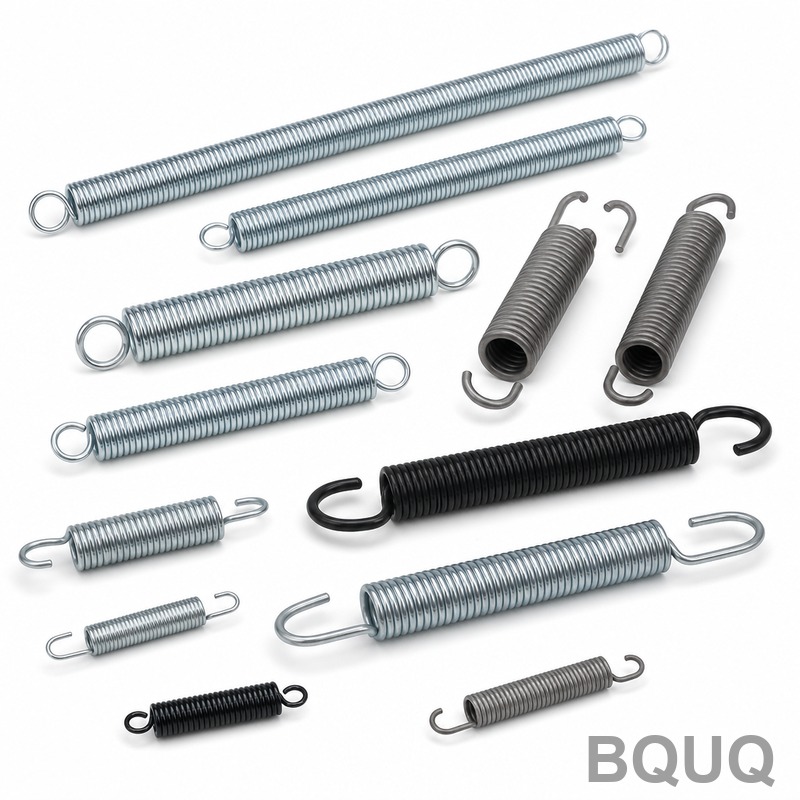
The first set of specifications defines the physical geometry of the spring. These dimensions must be given with tolerance bands, not just nominal values. For compression springs, provide wire diameter (d), outside diameter (OD), and free length (L0). For extension springs, add inside hook radius and initial tension if applicable. For torsion springs, specify leg length and wind direction.
Standard manufacturing tolerances from BQUQ's CNC coiling machines are ±0.05 mm for wire diameter up to 3.0 mm, and ±0.10 mm for wire diameter from 3.0 mm to 8.0 mm. Outer diameter tolerance is typically ±0.15 mm for springs under 25 mm OD, and ±0.25 mm for larger diameters. Free length tolerance depends on the number of coils and index ratio, but a practical starting point is ±1.0% of free length or ±0.5 mm, whichever is larger. If you require tighter tolerances, note that precision grinding and secondary operations can achieve ±0.02 mm on wire diameter but will increase unit cost by 15-25%.
Load and Rate Requirements
Spring rate (k, in N/mm) and required load at a specific deflection are the most critical performance data. Provide the working load at a defined compressed height, not just a spring rate. For example, specify "load must be 45 N ± 5% when compressed to 20 mm from a free length of 35 mm." This gives the manufacturer a clear target for both rate and stress.
Maximum deflection or solid height is equally important. If the spring is compressed to solid, the stress at solid height must be below the material's torsional yield strength. For music wire (ASTM A228), the maximum allowable stress at solid is approximately 45-50% of tensile strength. For chrome silicon (ASTM A401), this can reach 55-60% of tensile strength. Always state the maximum operating temperature and whether the spring will experience cyclic loading. For fatigue applications over 10 million cycles, design stress should not exceed 30% of tensile strength. BQUQ uses finite element analysis to verify these values before cutting wire.
Material Selection and Surface Treatment
Material grade determines temperature range, corrosion resistance, and cost. Do not assume standard spring steel will work for every application. Provide the operating environment: humidity, chemical exposure, and temperature extremes.
| Material Grade | Max Temp (C) | Tensile Strength (MPa) | Relative Cost | Best Use Case |
| Music Wire ASTM A228 | 120 | 2000-2200 | 1.0x | General industrial, low cost |
| Oil-Tempered ASTM A229 | 150 | 1600-1900 | 0.9x | Automotive, static loads |
| Chrome Silicon ASTM A401 | 220 | 1900-2100 | 1.4x | High stress, shock loading |
| Stainless 302/304 | 250 | 1400-1800 | 2.2x | Corrosive environments |
| Inconel X-750 | 600 | 1000-1200 | 8.5x | High temp, aerospace |
| Phosphor Bronze | 90 | 700-900 | 3.0x | Electrical conductivity |
Surface treatment options include zinc plating (5-8 micron, salt spray 72 hours), electroless nickel (10-15 micron, salt spray 200 hours), and black oxide (minimal corrosion protection). For stainless steel springs, specify passivation per ASTM A967. Shot peening is recommended for springs under cyclic load above 100,000 cycles; this process increases fatigue life by 20-40% but adds 0.05-0.15 USD per piece depending on size.
End Configuration and Coil Count
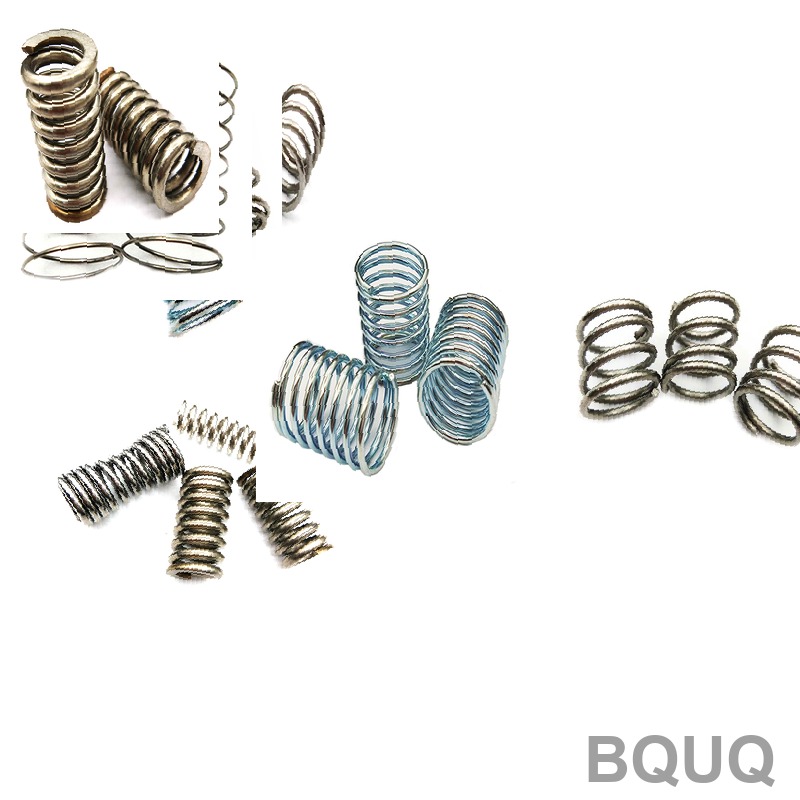
End type affects spring performance and cost. For compression springs, specify one of four end options: closed and ground, closed and not ground, open ends, or plain ends. Closed and ground ends are mandatory for springs that must stand square on a flat surface. Grinding adds 0.02-0.05 USD per end for small springs and improves load uniformity by eliminating end coil deflection.
Number of active coils determines spring rate. Provide either active coils or total coils. The formula for spring rate is k = (G x d^4) / (8 x D^3 x Na), where G is shear modulus (79.3 GPa for carbon steel), d is wire diameter, D is mean diameter, and Na is active coils. If you provide a target rate, BQUQ can calculate the required active coils. Total coils equals active coils plus dead coils from the ends. For closed and ground ends, total coils = active coils + 2. For plain ends, total coils = active coils.
Dimensional Drawings and Acceptance Criteria
Provide a 2D drawing or 3D STEP file with critical dimensions labeled. If you do not have a drawing, BQUQ can reverse-engineer from a physical sample, but this adds 2-3 days to the quoting process. On the drawing, indicate the direction of helix (right-hand is standard), and specify which dimensions are inspection critical. Include a note on acceptable surface defects: for example, "no cracks, no overlapping coils, surface roughness Ra 1.6 max."
Define acceptance criteria for load testing. Industry standard is to test 100% of springs for free length and load at a specified height if the annual volume is under 50,000 pieces. For higher volumes, statistical process control with AQL 1.0 sampling is common. BQUQ uses automated load testers with accuracy of ±0.5 N for springs rated under 100 N, and ±1.0 N for higher rated springs. Specify whether you require a material certification (EN 10204 3.1) and a dimensional inspection report (PPAP Level 2 or 3) for your first article.
Lead Time and Cost Drivers
Understanding what drives price and delivery helps you make trade-offs. Lead time for standard custom compression springs from BQUQ is 7-10 working days for quantities under 5,000 pieces. For 5,000-50,000 pieces, lead time extends to 12-15 working days. Tooling cost is zero for springs under 6 mm wire diameter because CNC coilers are fully programmable. For wire over 6 mm, a coiling mandrel costs 80-150 USD, and for wire over 12 mm, hot-coiling tooling costs 300-600 USD.
Quantity pricing for a typical compression spring (2.0 mm wire, 20 mm OD, 50 mm free length, music wire, closed and ground ends) is as follows: 100 pieces at 0.85 USD each, 1,000 pieces at 0.42 USD each, 10,000 pieces at 0.28 USD each, and 100,000 pieces at 0.19 USD each. Tighter tolerances (half the standard values) add 10-20% to unit cost. Stainless steel adds 80-120% over music wire for the same geometry. Shot peening adds 0.03-0.10 USD per piece depending on size.
FAQ-Style Tips for Faster Quoting
What if I only have a physical sample? Send the sample to BQUQ by courier. We measure all dimensions, test the load curve, and identify the material via spectroscopy. The reverse-engineering report is free if you place an order.
What if I do not know the spring rate but have a working assembly? Provide the compressed height and the load you need at that height. We will design the wire diameter and coil count to hit your target.
What is the minimum order quantity? For standard wire sizes, MOQ is 50 pieces. For non-standard wire sizes requiring a wire drawing operation, MOQ increases to 2,000 pieces.
Can you provide springs with a non-linear rate? Yes, variable pitch springs or conical springs are possible. Provide the load at two different heights to define the rate curve.
Should I specify surface finish tolerance? Yes, state "no burrs, no tool marks deeper than 0.05 mm" if the spring contacts a sealing surface. Otherwise, standard commercial finish is acceptable.
Conclusion
Providing complete spring specifications is a straightforward process if you cover the six core parameters: wire diameter, outer diameter, free length, active coils, material, and end type. Add load at deflection, operating temperature, and surface treatment to avoid field failure. Tolerances, material grade, and surface finish directly impact cost and lead time, so specify them based on function, not habit. BQUQ has manufactured custom springs for 20 years across automotive, medical, and consumer electronics sectors. We can quote your spring from a list of dimensions, a drawing, or a physical sample. Send your inquiry today and receive a detailed quotation within 12 hours. Contact us at Email: sc@bquq.com, WhatsApp: +86 13713157787, or visit www.bquq.com for design guidelines and downloadable spring specification forms.