How to Order Custom Springs: The 7 Critical Specifications You Must Provide
Ordering custom springs without a complete specification sheet is the single fastest way to generate scrap metal, missed deadlines, and inflated costs. To receive an accurate quote and a functional part, you must provide seven critical data points: wire diameter, outer diameter, free length, total coils, material grade, end type, and load requirements. This article details each specification with real-world tolerances, price implications, and engineering rationale based on 20 years of precision manufacturing at BQUQ.
Wire Diameter and Outer Diameter: The Geometric Foundation
The wire diameter (d) is the thickness of the spring wire, and the outer diameter (OD) is the maximum outside measurement of the coil. These two values define the spring's stress profile and its physical fit within an assembly. CNC spring machines at BQUQ hold wire diameter tolerances of ±0.01 mm for wire under 3.0 mm, and ±0.02 mm for wire between 3.0 mm and 8.0 mm. For compression springs, you must also specify whether the OD is measured unloaded or at solid height, as the coil can expand slightly under compression.
If you omit the wire diameter but provide the OD and inner diameter (ID), we can calculate it, but this introduces a compounding tolerance error. The ID tolerance is directly linked to the OD tolerance; a 0.01 mm error in wire diameter creates a 0.02 mm error in the ID. For precision applications such as medical devices or automotive fuel injectors, provide the exact wire gauge in millimeters, not just a SWG or AWG number, as conversion charts vary by region. Always specify whether the OD is free or compressed, and state the maximum allowable OD under full deflection.
Free Length, Solid Height, and Total Coils: Defining the Spring's Travel
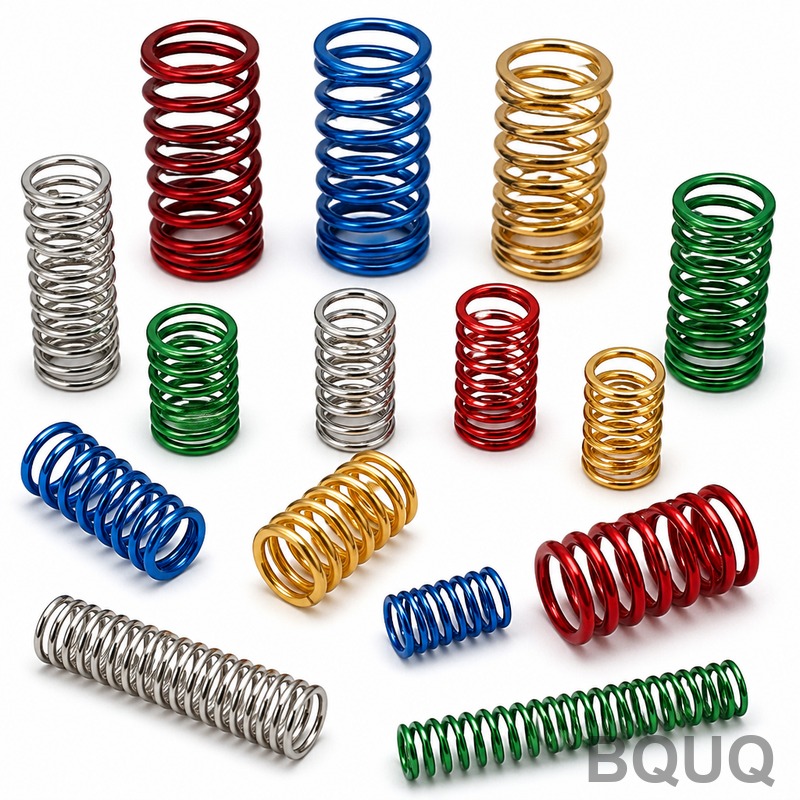
Free length (L) is the overall length of the spring with no load applied. Solid height is the length when all coils are touching, which is calculated as (total coils x wire diameter). The difference between free length and solid height is the maximum possible travel, but operating at solid height causes premature fatigue failure. For carbon steel springs, do not design for travel beyond 85% of the free length minus solid height. Total coils (Nt) includes the end coils; active coils (Na) are those that actually deflect. A spring with 8 total coils and closed and ground ends has approximately 6 active coils.
Providing only the free length without the total coils forces the manufacturer to guess at the pitch, which directly alters the spring rate. For example, a spring with a free length of 50 mm and 6 active coils will have a rate of 10 N/mm, but the same length with 8 active coils will have a rate of approximately 5.6 N/mm. This is a 44% difference in performance. Specify total coils, and if you require a specific pitch, state it in millimeters. For extension springs, provide the length from hook to hook, not the body length alone.
Material Grade and Surface Treatment: Performance Under Stress and Temperature
The material grade determines the maximum operating temperature, corrosion resistance, and tensile strength. Music wire (ASTM A228) is the most common for general use, with a tensile strength of 2300-2450 MPa for 1.0 mm wire, but it degrades above 120°C. Stainless steel 302 (A313) offers better corrosion resistance and operates up to 260°C, but its tensile strength is lower at 1900-2100 MPa. For high-temperature environments above 300°C, use Inconel X-750, which maintains 70% of its room-temperature strength at 540°C, but costs 8-10 times more than music wire.
Surface treatment is equally critical. Plain finish is acceptable for indoor applications, but for any moisture exposure, specify zinc plating (5-8 microns) or electroless nickel plating (10-15 microns). For springs under cyclic loading, specify shot peening, which induces compressive residual stress on the surface and increases fatigue life by up to 30%. At BQUQ, we recommend shot peening for any spring expected to exceed 1 million cycles. If you do not specify a material, we will default to music wire, which may fail prematurely in your application.
End Types and Hook Configurations: Geometry That Affects Load Distribution
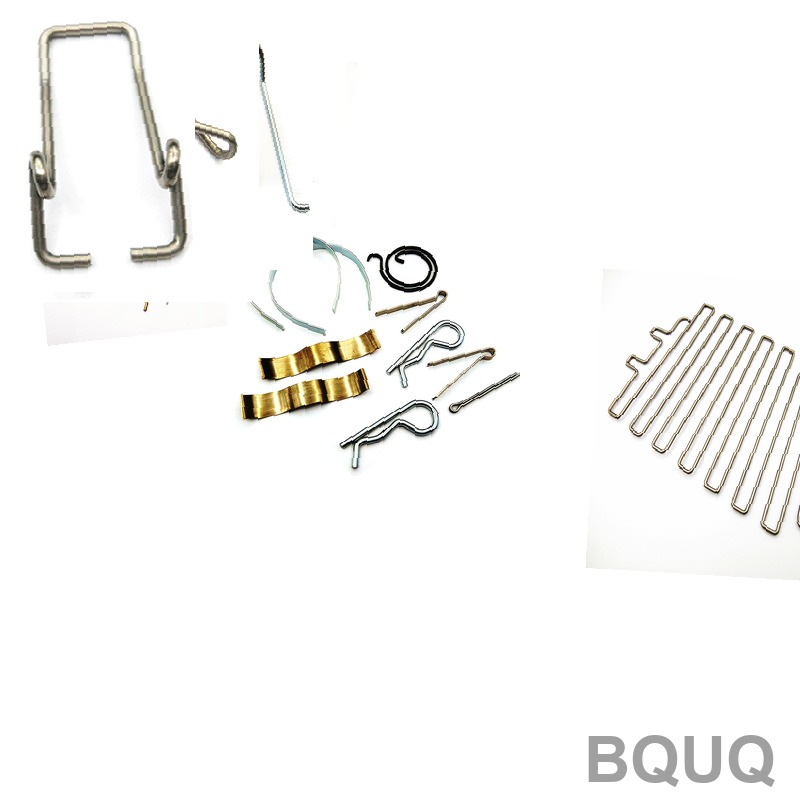
The end type directly affects how the spring sits in your assembly and how load is transferred. The four standard compression spring end types are closed and ground, closed not ground, open, and plain ground. Closed and ground ends provide a flat seating surface, ensuring the load is applied axially. This is mandatory for precision applications; the flatness tolerance on the ground surface is 0.05 mm. Closed not ground ends are cheaper but can cause buckling if the spring is long relative to its diameter. Open ends are only for low-stress applications where the spring is guided by a rod or tube.
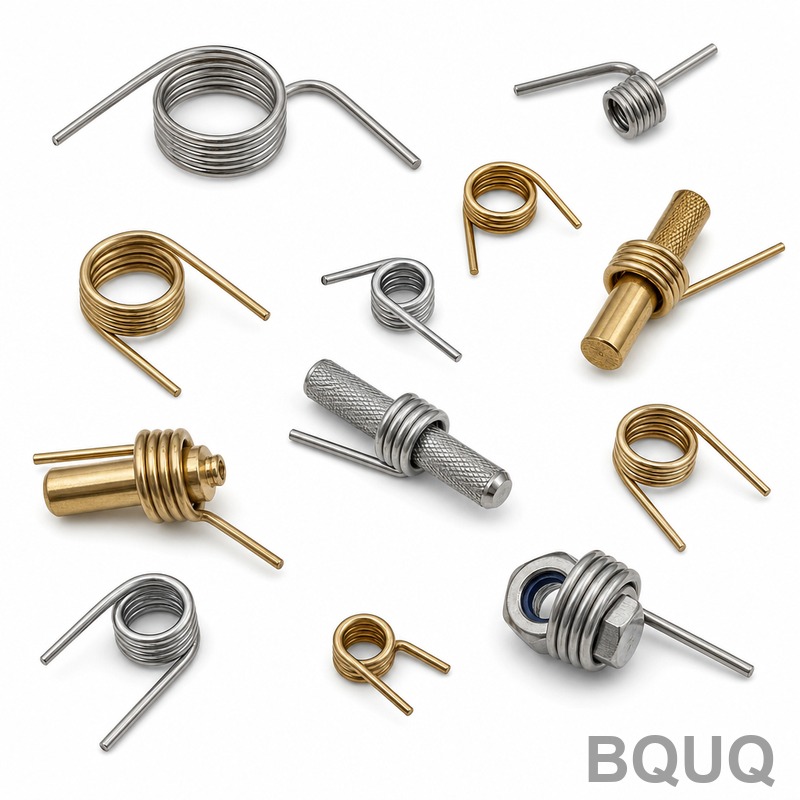
For extension springs, you must specify the hook style: full loop, side loop, or extended hook. The hook is the first point of failure under load; the stress concentration factor at the hook bend is 1.5 to 2.0 times the body stress. If you require a specific hook orientation relative to the coil, provide a drawing or specify the angle in degrees. A standard full loop adds 1.5 times the wire diameter to the overall length. Failure to specify the end type will result in a spring that does not sit flat, causing eccentric loading and premature breakage.
Load Requirements and Spring Rate: The Non-Negotiable Performance Data
You must provide either the spring rate (k) in N/mm or a specific load at a specific height (e.g., 50 N at 30 mm compressed length). The spring rate is calculated as (wire modulus of rigidity x wire diameter^4) / (8 x active coils x mean coil diameter^3). A change in wire diameter of 0.05 mm alters the rate by approximately 20% due to the fourth-power relationship. Therefore, specifying a load tolerance is critical. Standard load tolerance is ±10% for general springs, but BQUQ can hold ±5% for precision springs with an additional cost of 15-20%.
Include the maximum deflection and the operating frequency if the spring is cyclic. High cyclic rates require a lower stress level; the allowable shear stress should not exceed 45% of the ultimate tensile strength for infinite life. If you only provide the free length and the solid height, we can calculate the maximum rate, but we cannot determine your operating point. Provide the load at working height, the load at preload height, and the rate. This allows us to verify the spring will not take a set (permanent deformation) during use.
Data Table: Standard Tolerances and Cost Multipliers for Custom Springs
| Specification | Standard Tolerance | Precision Tolerance | Cost Multiplier (Precision) | Typical Lead Time (Days) |
| Wire Diameter (d < 3mm) | ±0.01 mm | ±0.005 mm | 1.5x | 5-7 |
| Wire Diameter (d 3-8mm) | ±0.02 mm | ±0.01 mm | 1.3x | 7-10 |
| Free Length | ±0.5 mm | ±0.1 mm | 1.2x | 5-7 |
| Outer Diameter | ±0.2 mm | ±0.05 mm | 1.4x | 5-7 |
| Spring Rate (k) | ±10% | ±5% | 1.2x | 7-10 |
| Load at Height | ±10% | ±5% | 1.5x | 7-10 |
| Surface Treatment (Zinc) | 5-8 microns | 8-12 microns | 1.1x | 3-5 |
| Shot Peening | N/A | Full coverage | 1.3x | 5-7 |
FAQ-Style Tips for Fast and Accurate Quoting
What happens if I only provide a drawing without dimensions? We will reverse-engineer the part by measuring the wire diameter, OD, free length, and coil count. This adds 2-3 days to the quoting process and incurs a measurement fee of approximately 50 USD, which is waived if you proceed with the order.
Can I order a spring with a custom hook orientation without a drawing? Yes, but you must provide the hook angle relative to the coil end. For example, "180 degrees opposite" or "90 degrees clockwise." Vague descriptions like "standard hook" will default to a full loop, which may not fit your assembly.
Is there a minimum order quantity for custom springs? For wire diameters under 2.0 mm, the minimum is 500 pieces. For larger diameters, the minimum is 100 pieces. Prototype orders of 10-20 pieces are available at 3-4 times the unit price of production quantities, with a 7-day lead time.
How does temperature affect my material choice? If your operating temperature exceeds 150°C, music wire will lose its hardness and take a permanent set. Switch to 302 stainless steel or 17-7PH. For temperatures above 350°C, use Inconel X-750. Always state the maximum ambient temperature, not the average.
Conclusion: Complete Data Equals Zero Rework
Supplying the seven critical specifications—wire diameter, OD, free length, total coils, material, end type, and load data—eliminates ambiguity from the manufacturing process. At BQUQ, we have seen that incomplete specifications cause a 35% rate of first-article rejection, whereas complete data sheets achieve a 98% first-pass yield. The cost of providing precision tolerances is typically 20-30% higher than standard, but it is far less than the cost of a failed prototype or a production stoppage. When in doubt, provide a range for your load requirement and let our engineers optimize the design.
For a detailed review of your spring application, send your specifications or a rough sketch to our engineering team. We will validate your design for stress, fatigue, and manufacturability before quoting. Our average quote turnaround is 12 hours, with prototype shipping available in 5 days. Contact us at Email: sc@bquq.com, WhatsApp: +86 13713157787, or visit www.bquq.com to start your project.