How to Reduce Metal Stamping Costs: 10 Practical Tips for Buyers
Direct Answer: How to Reduce Metal Stamping Costs
Metal stamping costs are reduced by 15% to 40% through four primary levers: simplifying part geometry, selecting the correct material grade, optimizing tooling design for high-volume production, and consolidating secondary operations. For a typical 2mm thick steel bracket, the material cost constitutes 45% of the total piece price, tooling amortization 20%, and labor/overhead 35%. By applying the ten engineering principles below, buyers can achieve a target cost per part of $0.08 to $0.15 for medium-complexity components at 50,000 annual volumes, versus $0.20 to $0.30 for non-optimized designs.
Material Selection: The Largest Cost Driver
Material accounts for 40% to 55% of total stamping cost. The difference between using DC01 cold-rolled steel versus SUS304 stainless steel is significant. At current market rates, DC01 costs approximately $780 per metric ton, while SUS304 costs $2,850 per metric ton. For a part weighing 0.15 kg, this material delta alone equals $0.31 per part. For a 100,000-piece annual order, that is a $31,000 difference.
Practical material substitutions that preserve function: - Replace SUS301 (temper 3/4H) with SK5 high-carbon steel for spring clips, reducing cost by 35% while maintaining tensile strength above 1,500 MPa after heat treatment. - Use galvanized SECC instead of post-plating for corrosion resistance up to 72 hours in neutral salt spray, saving $0.02 per part on zinc plating costs. - Specify SPCC with a tight thickness tolerance of +/- 0.03mm instead of stainless for non-corrosive enclosure brackets, cutting material cost by 62%.
Tolerances: Loosen What You Do Not Need
Precision costs money. A hole position tolerance of +/- 0.05mm requires a progressive die with precision-ground bushings and a high-end press with dynamic balancing. The same feature at +/- 0.15mm can be produced on a standard die set. The cost difference is $0.04 to $0.08 per part due to reduced die maintenance, less press downtime, and higher stamping speed.
| At BQUQ, we define three standard tolerance classes for stamping: | |||
| Tolerance Class | Typical Feature | Achievable Tolerance | Cost Index |
| Standard | Hole-to-edge, bend-to-hole | +/- 0.20mm | 1.00 |
| Precision | Critical mounting holes | +/- 0.05mm | 1.25 |
| Ultra-Precision | Datum features for assembly | +/- 0.02mm | 1.55 |
Use the Standard class for 80% of your features. Only assign Precision to features that interface with mating components. Every feature upgraded from Standard to Precision increases die cost by 8% to 12% and adds 15% to 20% to inspection time.
Part Geometry: Simplify Features to Reduce Operations
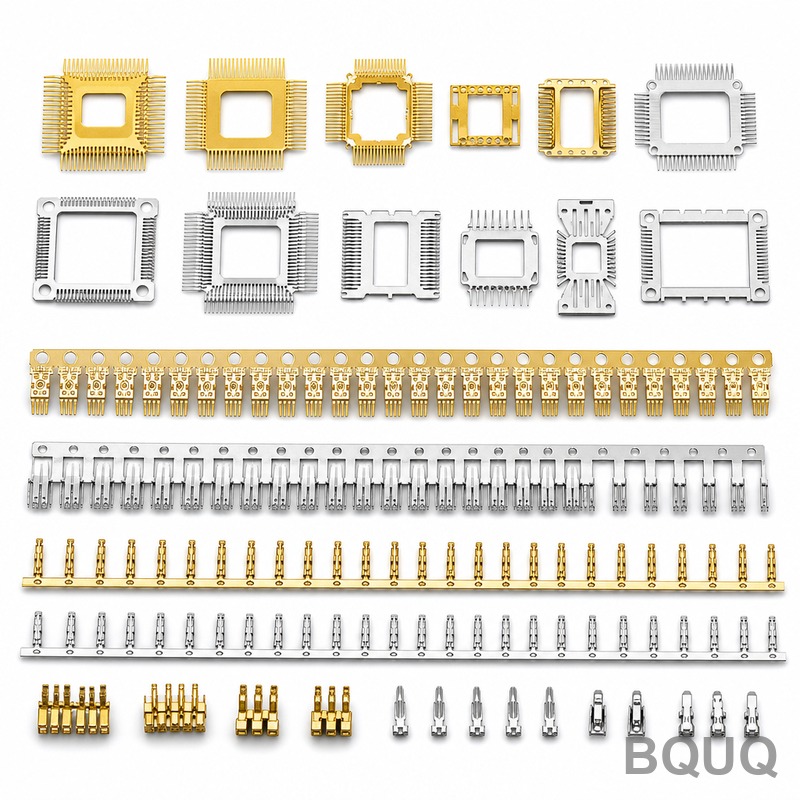
Each additional bend, form, or pierced hole adds a station to the progressive die. A simple flat blank requires 3 stations. The same part with four bends and two extruded holes requires 10 to 12 stations. Die cost scales linearly with station count: $4,500 per station for a medium-size die (300mm width). Reducing from 12 stations to 7 stations saves $22,500 in tooling and reduces piece price by $0.03 per part.
Specific geometry rules to lower cost: - Maintain a minimum bend radius of 1x material thickness. Radii tighter than 0.5x thickness require coining operations and increase die wear by 30%. - Keep hole diameter greater than 1.2x material thickness. Holes below 1.0x thickness require punching with smaller punches that break frequently, increasing downtime. - Limit bend count to five per part. Each additional bend requires a separate station and increases the risk of springback variation, necessitating secondary correction. - Design for a single direction of form. Up-and-down forming requires cam actions, adding $3,000 to $6,000 per cam station.
Tooling Strategy: Long-Term vs. Short-Term Cost
Tooling cost for a progressive die ranges from $8,000 for a simple flat part to $85,000 for a complex 12-station die with cam actions and in-die tapping. Buyers must decide between a single hard die versus a softer tool steel die. D2 tool steel dies last 1 million strokes; a carbide-inserted die lasts 5 million strokes but costs 2.3 times more.
| Die Type | Tool Steel Grade | Total Die Cost | Life (Strokes) | Cost per Stroke |
| Prototype Die | P20 | $6,500 | 50,000 | $0.130 |
| Production Die | D2 | $18,000 | 1,000,000 | $0.018 |
| High-Volume Die | Carbide Inserts | $42,000 | 5,000,000 | $0.008 |
For annual volumes below 30,000 pieces, use a prototype die and replace it after 2 years. For volumes above 200,000 pieces per year, invest in a carbide die. The crossover point is at approximately 150,000 total strokes where carbide becomes more economical.
Secondary Operations: Eliminate Before You Automate
Secondary operations (tapping, welding, heat treatment, plating) often cost more than the stamping itself. A tapped hole adds $0.05 to $0.09 per part if done as a secondary operation. With in-die tapping (using a tapping unit synchronized to the press), the cost drops to $0.02 per part. However, in-die tapping requires a dedicated station and adds $7,000 to die cost. The breakeven point is 100,000 parts per year.
Heat treatment is another cost multiplier. Spring steel parts requiring oil quenching and tempering at 400 degrees Celsius cost $0.12 per kg extra. If you can switch to a pre-tempered material (e.g., C75S with 500 MPa yield strength), you save $0.10 per kg and eliminate the risk of distortion.
For surface finishing, choose vibratory deburring over manual deburring. A vibratory bowl processes 300 parts per hour at $0.01 per part. Manual deburring costs $0.06 per part and introduces human variation.
Order Quantity and Scheduling
Stamping economics favor larger lot sizes. The setup cost for a stamping line is $180 per run (including die change, press adjustment, and first-article inspection). For a part with a piece price of $0.12, ordering 5,000 pieces per run adds 3.6% setup overhead. Ordering 50,000 pieces per run reduces that to 0.36%.
Annual volume should also dictate the number of cavities in the die. A single-cavity die producing 10 parts per minute yields 4,800 parts per 8-hour shift. A double-cavity die (costing 1.8x a single cavity) yields 9,600 parts per shift. The double cavity pays for itself when annual demand exceeds 250,000 parts.
FAQ-Style Tips: Quick Answers for Buyers
Q: What is the minimum quantity for cost-effective stamping? A: For a simple bracket, 10,000 pieces per year is the minimum to justify hard tooling. Below that, consider laser cutting or sheet metal fabrication, which have zero tooling cost but a 4x higher piece price.
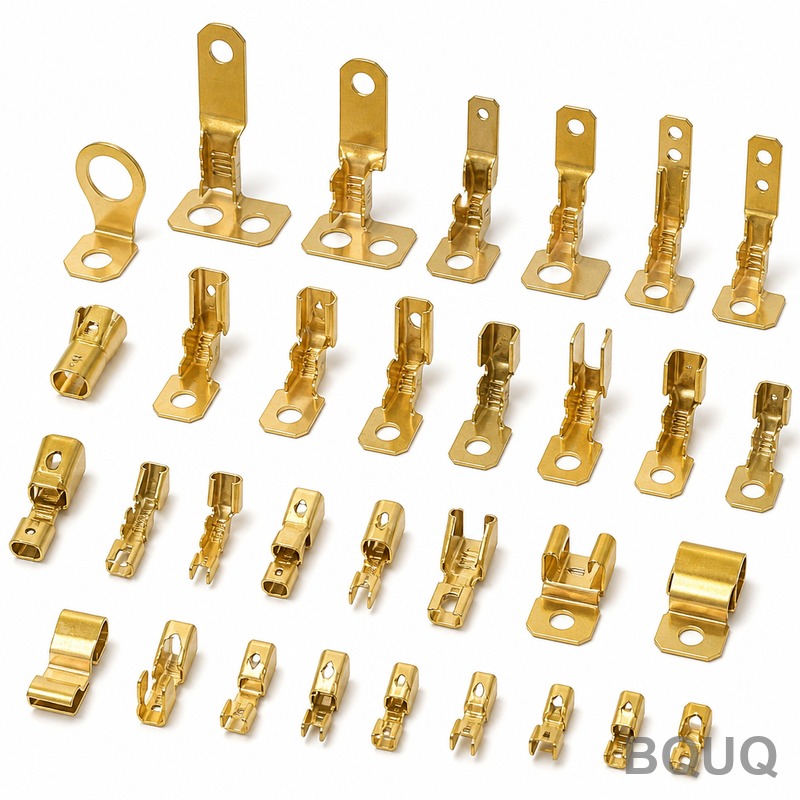
Q: How much does a stamping die cost for a simple part? A: A 4-station progressive die for a flat part with two holes costs $8,000 to $12,000. Lead time is 3 to 4 weeks.
Q: Can I reduce cost by using thinner material? A: Yes, if structural analysis allows. Reducing thickness from 2.0mm to 1.5mm cuts material cost by 25%. However, ensure the part stiffness is adequate for your load case. Bending strength scales with the cube of thickness.
Q: What tolerance can I get without extra cost? A: Use +/- 0.20mm for all hole positions and outer dimensions. Bend angle tolerance is +/- 1 degree. These are standard for any ISO 9001 certified stamping supplier.
Q: Should I supply my own material? A: Rarely. Stamping suppliers have better purchasing power for steel coils. Buying through us at BQUQ gives you a 5% to 8% material cost advantage due to consolidated purchasing volume.
Conclusion: Your Next Step to Lower Stamping Costs
The ten tips above are not theoretical. They are the daily practice at BQUQ, a Dongguan factory with 20 years of CNC machining, metal stamping, spring manufacturing, and heat sink production experience. Our engineering team reviews every drawing for cost reduction opportunities before quoting. We typically find 10% to 20% savings that the customer did not initially see.
To put these principles into action, send us your 2D drawing or 3D model. We will return a detailed quotation with a cost breakdown by material, tooling, and piece price, along with suggestions for geometry simplification and material substitution. Our standard response time is 12 hours. Contact us at sc@bquq.com or WhatsApp +86 13713157787. Visit www.bquq.com to see our facility and case studies. Let us manufacture your parts at the lowest total cost, not just the lowest quoted price.
Related Articles
- Metal Parts Finishing Guide After Stamping | Complete
- Multi-Physics Coupled Failure Mechanisms and Systematic Prevention Strategies in Stamping Processes
- High-speed precision stamping and in-die microforming technology: from electronic connections to micromotor cores
Frequently Asked Questions
What are the main ways to reduce metal stamping costs?
Metal stamping costs can be reduced by 15% to 40% through four primary levers: simplifying part geometry, selecting the correct material grade, optimizing tooling design for high-volume production, and consolidating secondary operations. For example, material costs account for 40% to 55% of total stamping cost, so material selection is the largest cost driver.
How much can I save by choosing a different material for my stamped parts?
Material substitution can yield significant savings. For instance, replacing SUS301 with SK5 high-carbon steel for spring clips reduces cost by 35% while maintaining tensile strength above 1,500 MPa after heat treatment. Using SPCC instead of stainless for non-corrosive brackets cuts material cost by 62%. The delta between DC01 and SUS304 can equal $0.31 per part.
How do tolerances affect the cost of metal stamping?
Tighter tolerances increase costs. A hole position tolerance of +/- 0.05mm costs $0.04 to $0.08 more per part than +/- 0.15mm due to die maintenance and press downtime. We define three tolerance classes: Standard (+/- 0.20mm, cost index 1.00), Precision (+/- 0.05mm, 1.25), and Ultra-Precision (+/- 0.02mm, 1.55). Upgrading from Standard to Precision adds 8% to 12% to die cost.
How does part geometry impact tooling costs?
Each additional bend, form, or pierced hole adds a station to the progressive die. A simple flat blank requires 3 stations, while a part with four bends and two extruded holes requires 10 to 12 stations. Die cost scales linearly at $4,500 per station for a medium-size die (300mm width). Reducing from 12 to 7 stations saves $22,500 in tooling.