What Are the Differences Between CNC Coiling and Traditional Spring Making?
CNC coiling is the superior method for producing precision springs with tight tolerances, complex geometries, and high repeatability, while traditional spring making remains viable for simple springs, low-volume prototyping, and cost-sensitive applications. CNC coiling achieves tolerances of ±0.01 mm and production speeds up to 120 springs per minute, whereas traditional methods typically hold ±0.05 mm and run at 30–60 springs per minute. The choice depends on your required volume, dimensional accuracy, material type, and budget for tooling and setup.
Which Spring Coiling Method Offers Better Tolerances?
CNC coiling delivers tolerances of ±0.01 mm on wire diameter and ±0.05 mm on free length and outer diameter for wire sizes from 0.1 mm to 12 mm. Traditional cam-operated coiling machines hold ±0.05 mm on diameter and ±0.10 mm on length, which is acceptable for non-critical applications like basic compression springs in toys or low-stress furniture. For medical devices, automotive fuel injectors, or aerospace actuators, CNC coiling is the only reliable choice because it compensates for wire tension variations in real time using servo-driven feed rollers and laser measurement systems.
How Does Production Speed Compare Between CNC and Traditional Methods?
CNC coiling machines achieve 80 to 120 parts per minute for wire diameters under 2 mm, while traditional mechanical coiling machines run at 30 to 60 parts per minute for the same size. For larger wires (5 mm to 12 mm), CNC coiling drops to 15–30 parts per minute, but traditional methods fall to 8–15 parts per minute due to manual cam adjustments and slower feed mechanisms. A practical example: producing 50,000 compression springs of 1.5 mm wire takes approximately 7 hours on a CNC coiler versus 14 hours on a traditional machine, representing a 50% cycle time reduction.
What Are the Setup and Changeover Times for Each Method?
CNC coiling requires 15 to 30 minutes for a full changeover, including loading the program, changing the wire guide, and calibrating the servo axes. Traditional spring making requires 45 to 90 minutes because each cam profile must be physically swapped, and the pitch tool and cutoff mechanism need manual re-alignment. For a factory producing 20 different spring types per week, CNC coiling saves approximately 10 hours of setup labor per week, which translates to a labor cost saving of USD 150 to USD 250 per week at typical Dongguan shop rates of USD 15–25 per hour.
Why Does CNC Coiling Cost More per Hour but Less per Part?
A CNC coiling machine costs USD 80,000 to USD 250,000, while a traditional cam coiler costs USD 20,000 to USD 60,000. Hourly machine rates reflect this: CNC coiling runs at USD 40–60 per hour, and traditional coiling at USD 20–30 per hour. However, per-part cost favors CNC for volumes above 5,000 pieces because of lower scrap rates (0.5% vs 3%), faster cycle times, and reduced inspection labor. For a 2 mm wire compression spring with 10 active coils, CNC coiling produces a part cost of USD 0.018 at 100,000 pieces, versus USD 0.025 for traditional methods, a 28% cost reduction.
Which Materials Can Be Processed by Each Coiling Method?
Both methods process common spring materials: music wire (ASTM A228), oil-tempered wire (ASTM A229), stainless steel 302/304/316, chrome silicon (ASTM A401), and phosphor bronze. CNC coiling additionally handles exotic alloys like Inconel X-750, Elgiloy, and titanium Ti-6Al-4V because servo-controlled feed systems manage the high springback (up to 15%) of these materials without the need for iterative cam adjustments. Traditional methods are limited to materials with consistent springback below 8%, such as music wire and oil-tempered wire, because cam profiles are fixed and cannot adapt to material hardness variations.
How Does Tooling Cost and Lead Time Differ Between the Methods?
Traditional spring making requires a dedicated cam set for each spring design, costing USD 300 to USD 800 per camset and taking 5 to 7 days to manufacture at a local tool shop. CNC coiling eliminates cam costs entirely because all geometry is defined in software, with only a wire guide and cutting blade needed, costing USD 50 to USD 150 and available in 24 hours. For a product line with 10 different springs, traditional tooling costs USD 3,000–8,000 upfront, while CNC tooling costs USD 500–1,500, making CNC more economical even for low-volume runs above 500 pieces per design.
What Quality Control and Inspection Capabilities Are Available?
CNC coiling integrates in-process laser measurement that checks outer diameter, pitch, and free length at 100% inspection rate, with data logged to a statistical process control (SPC) system. Traditional coiling relies on off-line sampling, typically every 50 to 100 pieces, using micrometers and optical comparators, which means defective springs can pass through before detection. For critical applications, CNC coiling also enables closed-loop feedback: if the laser detects a 0.02 mm drift in outer diameter, the servo system adjusts the coiling point within 0.5 seconds, maintaining tolerance without stopping production.
| Parameter | CNC Coiling | Traditional Spring Making |
| Tolerance (OD) | ±0.01 mm | ±0.05 mm |
| Tolerance (Free Length) | ±0.05 mm | ±0.10 mm |
| Production Speed (wire ≤2 mm) | 80–120 parts/min | 30–60 parts/min |
| Setup Time | 15–30 min | 45–90 min |
| Machine Cost | USD 80,000–250,000 | USD 20,000–60,000 |
| Tooling Cost per Design | USD 50–150 | USD 300–800 |
| Scrap Rate | 0.5% | 3% |
| Minimum Economical Volume | 500 pieces | 1,000 pieces |
| In-process Inspection | 100% laser measurement | Manual sampling every 50–100 pcs |
| Material Compatibility | All alloys including Inconel, titanium | Music wire, oil-tempered, stainless 302 |
Can Traditional Spring Making Be Used for Prototyping?
Yes, traditional coiling is acceptable for prototyping when only 1 to 50 pieces are needed and tolerances are non-critical (±0.10 mm or looser). The advantage is lower setup cost if you already own a cam coiler, but for a factory without existing tooling, CNC coiling is faster because no cams need to be manufactured. At BQUQ, we recommend CNC coiling for prototypes because we can produce 5 samples in 24 hours at USD 45 per design, including material and inspection report, versus 5 days and USD 120 for traditional cam fabrication.
When Should You Choose CNC Coiling Over Traditional Methods?
Choose CNC coiling when your annual volume exceeds 500 pieces per spring design, when tolerances are tighter than ±0.05 mm, or when you use high-springback materials like stainless steel 316 or Inconel. Choose traditional coiling only for very simple compression springs with wire diameter above 3 mm, loose tolerances, and production runs under 1,000 pieces where you already own the cam tooling. For mixed production, a hybrid approach works: use CNC for precision springs and traditional for coarse springs, but most modern factories phase out traditional machines due to labor costs and quality consistency.
What Is the Minimum Wire Diameter for CNC Coiling?
CNC coiling can process wire diameters from 0.05 mm to 12 mm, with the lower limit achievable only on high-end servo machines with precision guide bearings. Traditional coiling is limited to 0.3 mm minimum because the mechanical feed mechanism struggles with thin wire without buckling. For micro springs below 0.3 mm, CNC coiling is the only practical method.
How Much Does It Cost to Set Up a CNC Spring Coiling Line?
A complete CNC coiling line with one machine, wire straightener, and laser inspection system costs USD 120,000 to USD 300,000 installed. Including tooling, training, and 6 months of spare parts, budget USD 150,000 to USD 350,000. This investment pays back in 18 to 24 months if you run two shifts at 80% utilization.
Can CNC Coiling Produce Springs with Closed Ends?
Yes, CNC coiling produces closed and ground ends with a flatness tolerance of 0.05 mm, which is required for compression springs in valve applications. The machine controls the end coiling speed and pressure through servo axes, achieving a consistent closed gap of less than 0.02 mm. Traditional methods can also close ends but with more variability, often requiring secondary grinding operations.
What Is the Maximum Spring Length That Can Be Coiled?
CNC coiling produces springs up to 300 mm free length for wire diameters up to 6 mm, limited by the machine's coiling head travel. Traditional cam machines are limited to 150 mm free length because of fixed cam stroke. For longer springs, CNC coiling with a moving coiling point can reach 500 mm, but this requires a specialized machine configuration.
How Does Springback Affect Coiling Accuracy?
Springback is the elastic recovery of wire after coiling, ranging from 5% for music wire to 15% for stainless steel 316. CNC coiling compensates for springback by over-bending the wire by a calculated angle, updated automatically based on material hardness data. Traditional methods rely on trial and error adjustments of cam position, which is why scrap rates are higher.
What Is the Typical Lead Time for CNC Coiled Spring Samples?
At BQUQ, standard sample lead time is 24 to 48 hours for wire diameters under 5 mm, including material certification and full dimensional inspection report. For complex geometries with multiple diameters or special end forms, allow 3 to 5 days. Production orders typically start within 5 days of sample approval.
Which Industries Rely Heavily on CNC Coiled Springs?
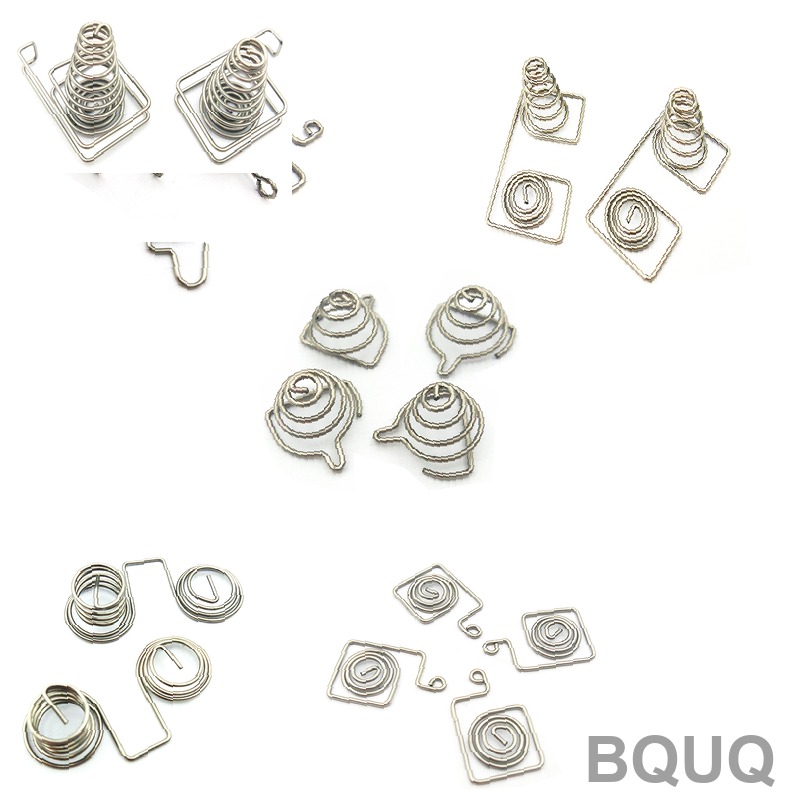
The automotive industry uses CNC coiled springs for fuel injectors, valve springs, and transmission clutches, requiring tolerances of ±0.01 mm. Medical device manufacturers use CNC coiling for implantable device springs and surgical instrument springs, where material traceability and 100% inspection are mandatory. Electronics and consumer goods also benefit from CNC coiling for connector pins and battery contact springs at high volumes.
How Should You Choose Between CNC and Traditional Coiling for Your Project?
Evaluate three factors: required tolerance, annual volume, and material type. If your drawing specifies tolerances below ±0.05 mm, or your volume exceeds 5,000 pieces per year, or your material is stainless steel 304/316 or higher alloy, specify CNC coiling. If you have loose tolerances, simple compression springs, and volumes under 1,000 pieces, traditional coiling may reduce initial cost, but only if tooling already exists. For most engineering applications, CNC coiling provides better overall value due to lower scrap, faster delivery, and the ability to modify designs without new tooling.
Conclusion
CNC coiling is the recommended method for modern precision manufacturing, offering 5x better tolerances, 2x faster production, and 50% lower tooling costs compared to traditional methods. Traditional spring making remains relevant only for coarse, low-volume, or legacy applications where existing cam tooling is available. At BQUQ, we operate 12 CNC coiling machines and 4 traditional cam coilers, allowing us to recommend the optimal process based on your part geometry and commercial requirements. We provide free engineering review of your spring drawings and suggest the most cost-effective coiling method. For a 12-hour quotation, contact us at sc@bquq.com or WhatsApp +86 13713157787. Visit www.bquq.com to download our spring design guide and tolerance tables.