What Are the Key Techniques and Specifications for Spring End Grinding?
Spring end grinding is the process of squaring and flattening the end coils of a compression spring to ensure perpendicularity, load accuracy, and stable seating under compression. The primary specification is that ground ends achieve a flatness of 0.1 mm to 0.25 mm and a squareness (perpendicularity) of 1 to 3 degrees, depending on the spring index and wire diameter. For most precision applications, a surface roughness of Ra 0.8 to 1.6 micrometers on the ground face is expected, with production tolerances held to within ±0.05 mm on free length after grinding.
What Are the Standard Techniques Used in Spring End Grinding?
The two dominant techniques are through-feed grinding and plunge-feed (or indexed) grinding. Through-feed grinding uses a rotating disc with radial slots that continuously carries springs between two abrasive wheels, making it ideal for high-volume production of springs with wire diameters from 0.5 mm to 6.0 mm. Plunge-feed grinding holds each spring in a stationary fixture while the grinding wheel advances axially, which is used for springs with large diameters (over 30 mm), very short lengths, or when precise control of stock removal is required. A third technique, double-disc grinding, processes both ends simultaneously using two opposing wheels, which is preferred when total parallelism between end faces must be under 0.05 mm.
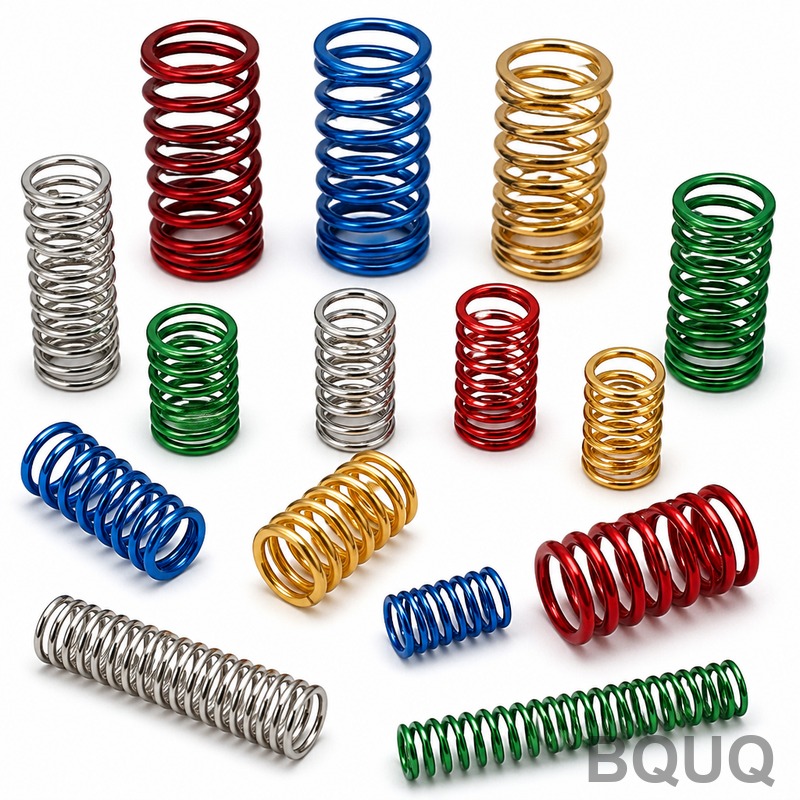
How Much Material Should Be Removed During the Grinding Process?
The stock removal amount depends on wire diameter and spring index, but typical values range from 0.5 mm to 1.5 mm per end for hot-wound springs (wire over 10 mm) and 0.1 mm to 0.4 mm per end for cold-wound springs (wire under 10 mm). For a spring made from 2.0 mm music wire, you should remove approximately 0.2 mm per end to achieve a clean, full-face grind without compromising the adjacent active coil. Removing more than 1.0 mm per end on small wire can cause the end coil to become too thin, creating a stress riser and reducing fatigue life by up to 30%. The total free length loss after grinding is typically 2% to 5% of the original free length, and this must be accounted for in the coiling setup.
Which Grinding Wheel Specifications Are Recommended for Spring Ends?
For cold-wound steel springs, use a vitrified bonded aluminum oxide wheel with a grit size of 60 to 80 and a hardness grade of J to K. This combination provides a sharp cutting action and minimal heat generation, keeping surface temperatures below 150 degrees Celsius to prevent tempering of the spring material. For stainless steel springs (e.g., 302 or 316), use a silicon carbide wheel with a grit size of 80 to 100 and a softer grade (H to I) to avoid loading the wheel and to reduce the risk of work-hardening the surface. The recommended wheel speed is 25 to 35 meters per second, with a work feed rate of 3 to 10 meters per minute for through-feed grinding. Coolant flow should be at least 20 liters per minute per wheel to flush swarf and maintain a stable thermal environment.
What Tolerances and Specifications Can Be Achieved with Spring End Grinding?
The achievable tolerances are directly related to the grinding technique and the spring's geometric stability. For standard commercial springs, end flatness is held to 0.25 mm, and squareness is held to 3 degrees. For precision springs used in automotive fuel injectors or medical devices, flatness can be improved to 0.05 mm, and squareness to 1 degree, provided the spring has a stable index (D/d ratio between 3 and 12) and the ends are closed before grinding. The table below summarizes typical achievable specifications for different spring categories:
| Spring Category | Wire Diameter (mm) | Flatness (mm) | Squareness (degrees) | Surface Roughness (Ra, um) | Typical Free Length Tolerance (mm) |
| Commercial cold-wound | 0.5 - 6.0 | 0.25 | 3 | 1.6 | ±0.25 |
| Precision cold-wound | 1.0 - 8.0 | 0.10 | 1.5 | 0.8 | ±0.05 |
| Hot-wound large springs | 10.0 - 30.0 | 0.50 | 4 | 3.2 | ±1.00 |
| Double-disc ground | 2.0 - 12.0 | 0.05 | 1.0 | 0.4 | ±0.03 |
These tolerances assume a stable spring design, proper heat treatment (if applicable), and a rigid grinding setup with a magnetic or pneumatic workholding fixture.
How Does Grinding Affect Spring Fatigue Life and Load Performance?
Grinding removes the decarburized surface layer and micro-cracks from the wire, which can improve fatigue life by 20% to 40% if done correctly. However, if the grinding generates excessive heat (over 200 degrees Celsius) or creates a rough surface (over Ra 1.6), it will introduce residual tensile stresses and microscopic tear-outs that reduce fatigue life by up to 50%. To preserve load accuracy, the ground end must be flat enough to distribute the load evenly; a 0.25 mm flatness error on a spring with a 50 N/mm rate can cause a load variation of 12.5 N, which is significant for precision assemblies. After grinding, shot peening is often applied to the active coils (not the ground ends) to induce compressive residual stress, which raises the endurance limit by 15% to 25%.
What Are the Common Defects in Spring End Grinding and How Can They Be Prevented?
The most common defects are burning (blue or brown discoloration), uneven grinding (one side thicker than the other), and burr formation on the inner diameter edge. Burning is caused by excessive feed rate or insufficient coolant, and it can be prevented by reducing the feed rate by 20% and increasing coolant flow to 30 liters per minute. Uneven grinding occurs when the spring rotates inconsistently during through-feed; this is corrected by using a spring guide rail with a diameter that is 0.5 mm larger than the spring OD and ensuring the wheel face is dressed flat with a diamond dresser after every 200 parts. Burrs are removed by adding a deburring pass with a fine grit wheel (150 grit) at a lower speed (15 m/s), or by tumbling the springs for 10 to 15 minutes after grinding.
How Should a Spring End Grinding Process Be Qualified and Inspected?
Process qualification requires a First Article Inspection (FAI) that measures flatness, squareness, free length, and surface roughness on five sample parts. Flatness is measured using a surface plate and a dial indicator with a resolution of 0.002 mm, while squareness is measured on a comparator with a calibrated square block. For production control, use statistical process control (SPC) with a sample size of 5 parts every 2 hours; the Cpk index should be greater than 1.33 for all critical dimensions. Additionally, a visual inspection under 5x magnification is mandatory to check for burns, cracks, or missing grind on more than 180 degrees of the end coil circumference. For high-reliability springs, a 100% load test at 50% of the maximum deflection is recommended to verify that the ground ends do not cause load drift.
FAQ
What Is the Minimum Wire Diameter That Can Be End Ground?
The minimum wire diameter for conventional end grinding is 0.3 mm, but at this size, the spring is fragile, and you must use a plunge-feed technique with a very light cut (0.05 mm per pass) to avoid bending the wire. For wires below 0.5 mm, many manufacturers skip grinding and instead use a closed and flattened end formed during coiling, which is acceptable for low-load applications.
Can Stainless Steel Springs Be Ground Without Cracking?
Yes, stainless steel springs can be ground, but you must use a silicon carbide wheel and a generous coolant supply to prevent work-hardening and micro-cracking. The feed rate should be reduced by 30% compared to carbon steel, and the wheel should be dressed more frequently (every 50 parts) to maintain a free-cutting action.
When Should I Specify Ground Ends Instead of Closed Ends?
Specify ground ends whenever the spring must stand perpendicular to its seat, support a precise load, or operate under cyclic compression. If the spring has a low spring index (below 4) or a wire diameter over 6 mm, grinding is almost mandatory to prevent the end coil from buckling under load.
How Much Does Spring End Grinding Cost per Part?
The cost per part is typically 0.01 to 0.05 USD for high-volume cold-wound springs (over 10,000 parts), and 0.10 to 0.50 USD per part for low-volume or large-diameter hot-wound springs. Tooling and setup costs range from 100 to 500 USD per spring design, depending on the need for custom fixtures or specialized wheels.
Which Grinding Wheel Grit Is Best for a Fine Surface Finish?
For a surface finish below Ra 0.8 micrometers, use a 120-grit aluminum oxide wheel with a vitrified bond and a slower feed rate (3 m/min). Finer grits (150 to 220) are available but require more frequent dressing and can generate excessive heat, so they are only recommended for finishing passes on high-value springs.
Can End Grinding Correct a Spring That Is Already Out of Square?
Yes, end grinding can correct squareness errors of up to 5 degrees by removing more material from the high side of the end coil. However, this will reduce the free length and increase the spring rate, so you must recalculate the load characteristics after correction; otherwise, the spring may not meet its original force specification.
What Is the Maximum Production Rate for Double-Disc Spring Grinding?
A modern double-disc grinder can process between 1,500 and 3,000 springs per hour for wires up to 4 mm, with a cycle time of 1.5 to 3 seconds per part. This rate is achievable only with automatic feeding and a consistent spring diameter, as any variation of more than 0.1 mm in OD will cause jams or incomplete grinding.
Spring end grinding is a critical finishing operation that directly impacts the functional reliability of compression springs. By selecting the correct wheel, controlling stock removal, and verifying tolerances such as flatness of 0.1 mm and squareness of 1.5 degrees, you can ensure consistent performance in demanding assemblies. For a full evaluation of your spring design and grinding requirements, our team offers 12-hour quoting and engineering support. Contact us at Email: sc@bquq.com, WhatsApp: +86 13713157787, or visit www.bquq.com for expert assistance.
Related Articles
- Smart Spring Inventory Management Strategies for OEMs
- In-depth analysis of technology and process in the hardware spring industry in 2026: a full-dimensional interpretation of high stress, functional integration and engineering certification
- From "standard parts" to "functional parts": 2026 hardware spring industry technology trends and functional innovation engineering direction