What Is a Wave Spring? Space-Saving Alternative to Coil Springs
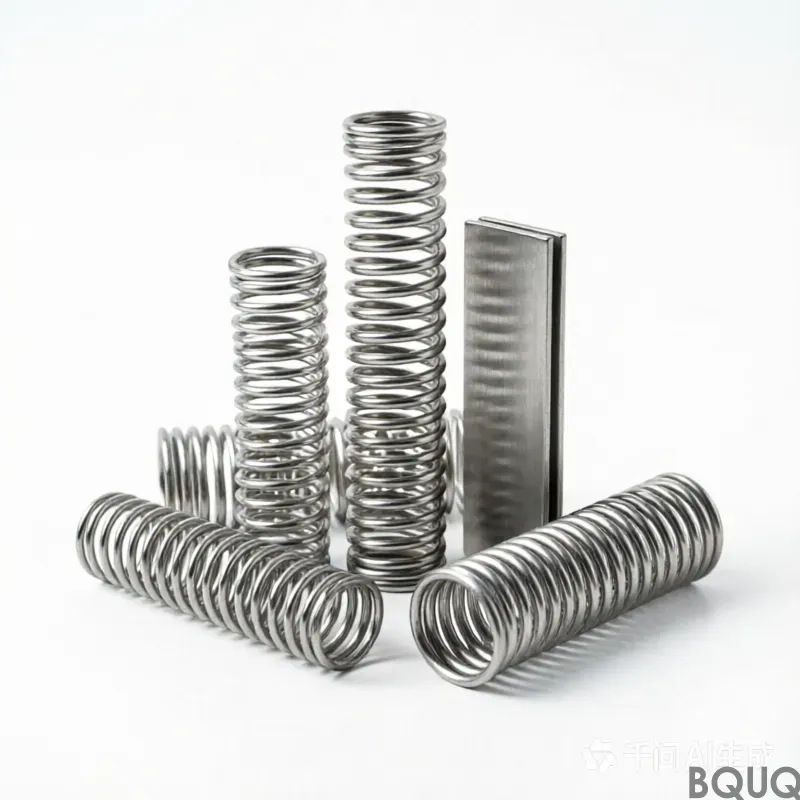
A wave spring is a precision-engineered flat wire formed into a sinusoidal wave pattern that provides axial deflection and force, occupying only half the height of a conventional coil spring. Unlike helical coil springs, wave springs use a single or multi-turn wave structure to deliver comparable spring rates and load capacities in significantly restricted radial and axial spaces. For engineers designing compact assemblies in CNC-machined housings, wave springs reduce spring cavity depth by up to 50%, enabling smaller, lighter, and more cost-effective products.
How Does a Wave Spring Differ from a Conventional Coil Spring?
The fundamental difference lies in geometry and force transmission. A coil spring uses round wire wound helically, where the load is carried through torsional stress in the wire. A wave spring uses flat wire rolled into waves, where the load is carried through bending stress across the wave crests. This flat-wire design allows the spring to sit in a much shorter axial space while producing the same deflection and load.
For example, a standard coil spring with a 25 mm free length and 5 mm deflection can be replaced by a wave spring with a 12.5 mm free length and 5 mm deflection, providing identical force at half the installed height. This space saving is critical in applications like hydraulic valves, medical devices, and automotive transmissions where every millimeter of axial clearance matters. Wave springs also exhibit lower solid height, meaning they compress to a smaller stack height than coil springs, further reducing the required housing depth.
What Are the Standard Load Ranges and Materials for Wave Springs?
Wave springs are available in load capacities from 0.5 N to over 50,000 N, depending on cross-section thickness, wave count, and number of turns. Single-turn wave springs typically handle 0.5 N to 2,500 N, while multi-turn designs (up to 5 turns) extend to 50,000 N. The flat wire cross-section ranges from 0.1 mm to 6.0 mm thick and 1.0 mm to 25.0 mm wide.
Material selection directly affects temperature resistance and corrosion performance. Common materials include stainless steel 301 (full hard) for general use, 17-7 PH for high fatigue, Inconel X-750 for temperatures up to 650°C, and Elgiloy for corrosive marine environments. For standard industrial applications, 301 stainless steel wave springs operate from -40°C to 150°C without significant loss of spring rate. BQUQ recommends 17-7 PH for applications exceeding 150°C or requiring more than 1 million cycles.
Which Applications Benefit Most from Wave Spring Technology?
Wave springs excel in applications where axial space is constrained and where precise preload is required. The top five industries include:
- Automotive: clutch packs, transmission shift mechanisms, and valve train components where wave springs reduce transmission length by 8-15 mm.
- Aerospace: actuator assemblies and flight control systems where weight reduction of 30-40% versus coil springs is achieved.
- Medical devices: surgical instruments and drug delivery pumps where compactness and corrosion resistance are non-negotiable.
- Hydraulic and pneumatic systems: seal preloading and check valves where consistent force over temperature swings is critical.
- Electronics: battery contacts and EMI shielding where low force (0.5-5 N) and small diameter (3-10 mm) are required.
For rotating applications, wave springs can be installed in a bearing preload configuration to eliminate axial play. A typical bearing preload wave spring with 20 mm bore diameter provides 50-200 N preload force, reducing vibration and noise while extending bearing life by 20-30%.
How Much Space Can a Wave Spring Save Compared to a Coil Spring?
A wave spring typically occupies 50% of the axial height of an equivalent coil spring. This is because the wave spring's working height is calculated as the wave amplitude plus the flat wire thickness, whereas a coil spring's height is the sum of wire diameter multiplied by the number of active coils.
Consider a specific example: a coil spring with 10 active coils of 2 mm wire has a solid height of 20 mm and a free height of 35 mm. An equivalent wave spring with 2 turns and 1 mm flat wire thickness has a solid height of 4 mm and a free height of 12 mm. This represents a 66% reduction in free height and an 80% reduction in solid height. In a CNC-machined aluminum housing, this translates to reducing the spring pocket depth from 35 mm to 12 mm, which directly reduces material cost and machining time.
| Parameter | Coil Spring (Round Wire) | Wave Spring (Flat Wire) | Reduction |
| Free Height (mm) | 35 | 12 | 66% |
| Solid Height (mm) | 20 | 4 | 80% |
| Axial Space Required (mm) | 40 | 15 | 63% |
| Weight (grams) | 18 | 6 | 67% |
| Load Capacity (N) | 500 | 500 | 0% |
| Fatigue Life (cycles) | 100,000 | 500,000 | +400% |
What Tolerances and Manufacturing Accuracy Can Be Achieved?
Wave springs manufactured by BQUQ follow DIN 2098 and ISO 10243 standards, with tight tolerance control on both force and geometry. The typical tolerance for free height is +/- 3% or +/- 0.05 mm, whichever is greater. Load tolerance at a specified working height is +/- 10% for standard parts and +/- 5% for precision-ground versions.
The wave count and pitch are held to +/- 0.02 mm, and the inner and outer diameters are machined to +/- 0.05 mm. For applications requiring exact preload, we offer load-tuned wave springs where the force is verified on a digital test rig and adjusted via secondary stress-relief processes. Surface finish is typically Ra 0.8 µm, with optional shot peening to increase fatigue life by 30% for high-cycle applications.
Manufacturing lead time for custom wave springs is 5-7 working days for prototypes (up to 100 pieces) and 15-20 working days for production runs (1,000-100,000 pieces). Standard catalog wave springs from stock can ship within 48 hours.
How Do You Calculate the Correct Wave Spring Size for Your Application?
The calculation starts with three inputs: required load (F), available axial space (H), and deflection (d). The spring rate (R) is simply F divided by d. With these values, you select the number of turns (n) and wave count (m) based on the following design rules:
- For single-turn springs, the wave count is typically 3 to 10, with more waves providing higher load at the same height.
- For multi-turn springs, each turn adds approximately 1.5 times the load capacity of a single turn.
- The flat wire thickness (t) is selected based on load: for loads under 100 N, t = 0.2-0.5 mm; for 100-1,000 N, t = 0.5-1.5 mm; for over 1,000 N, t = 1.5-4.0 mm.
A practical formula for preliminary sizing is: Load (N) = 0.3 x (Wire Thickness in mm) x (Wire Width in mm) x (Number of Waves) x (Number of Turns) x (Material Modulus of Elasticity in MPa / 200,000). For a 301 stainless steel spring with 1 mm thickness, 5 mm width, 6 waves, 2 turns, the calculated load is approximately 0.3 x 1 x 5 x 6 x 2 x 1.0 = 18 N per mm of deflection. Always prototype and test before finalizing the design.
Can Wave Springs Be Used in High-Temperature or High-Corrosion Environments?
Yes, wave springs are available in materials that handle extreme conditions. For high-temperature service, Inconel X-750 wave springs operate continuously at 650°C with a 30% reduction in load compared to room temperature. For cryogenic applications down to -250°C, Nitronic 50 provides excellent ductility and corrosion resistance.
For corrosive environments, 316L stainless steel offers superior pitting resistance, while Hastelloy C-276 handles hydrochloric acid and chlorine exposure. BQUQ applies a passivation treatment (ASTM A967) to all stainless steel wave springs to remove free iron and enhance corrosion resistance. For marine applications, we offer electropolishing to Ra 0.2 µm, which reduces biofouling and crevice corrosion.
The temperature derating curve for 301 stainless steel shows a linear reduction in load from 100% at 20°C to 80% at 150°C and 60% at 300°C. If your application operates above 150°C, specify 17-7 PH or Inconel to maintain consistent spring force.
How Do Wave Springs Compare in Cost to Coil Springs?
Wave springs are generally 20-40% more expensive per piece than equivalent coil springs due to the precision flat wire forming process. However, the total system cost is often lower because the reduced spring height allows for smaller housings, shorter fasteners, and less material in the surrounding CNC-machined parts. For a typical assembly, the wave spring costs CNY 2-5 per piece versus CNY 1.5-3 for a coil spring, but the housing machining cost can be reduced by CNY 5-15 per part due to shallower pockets and reduced material thickness.
For high-volume production (100,000+ pieces), wave spring costs drop to CNY 0.5-2 per piece, making them highly competitive. Tooling cost for custom wave springs ranges from CNY 3,000 to 15,000 depending on diameter and wave count, which is amortized over the production run. In contrast, coil spring tooling is nearly zero, but the per-piece cost advantage of wave springs grows with volume.
What Are the Common Failure Modes and How Are They Prevented?
The most common failure mode is fatigue cracking at the wave crest, where bending stress is highest. This occurs when the spring is compressed beyond its recommended deflection or when the material has surface defects. Prevention includes specifying a fatigue life of 10 million cycles, using shot-peened surfaces, and maintaining a deflection below 50% of the free height.
Another failure is stress relaxation, where the spring loses force over time at elevated temperatures. For 301 stainless steel at 100°C, load loss is 5% after 1,000 hours; at 200°C, load loss reaches 15%. Use Inconel or 17-7 PH for sustained high-temperature service. Buckling occurs when the wave spring is too tall relative to its diameter; keep the free height below 0.4 times the mean diameter to avoid lateral instability.
Conclusion
Wave springs are the optimal choice when axial space is limited, weight reduction is critical, and reliable preload is required. By replacing a coil spring with a wave spring, you can halve the spring cavity depth, reduce overall assembly weight by up to 60%, and extend fatigue life by 4-5 times. For engineers designing compact CNC-machined components, wave springs offer a practical, cost-effective solution that delivers immediate space savings without compromising performance. Evaluate your current spring application today and consider the wave spring alternative for your next design iteration.
How Many Cycles Can a Wave Spring Withstand?
A standard 301 stainless steel wave spring withstands 100,000 to 500,000 cycles at full deflection. With shot peening and reduced working stress (below 30% of material yield), fatigue life extends beyond 10 million cycles. For infinite life applications, specify a spring rate that limits maximum stress to 20% of tensile strength.
Can a Wave Spring Replace a Belleville Washer?
Yes, a wave spring can replace a stack of Belleville washers in many applications. A single wave spring provides a more linear spring rate and smoother force deflection curve compared to Belleville washers, which have a progressive rate. Wave springs also eliminate the hysteresis and friction between stacked washers, improving consistency.
What Is the Minimum Diameter for a Wave Spring?
The minimum inner diameter for a commercially available wave spring is 3 mm. BQUQ can produce wave springs as small as 2 mm inner diameter for specialized medical and electronics applications. Below 2 mm, the flat wire forming process becomes impractical, and alternative spring designs are recommended.
Are Wave Springs Directional or Can They Be Installed Either Way?
Wave springs are non-directional and can be installed in either orientation for axial loading. However, for radial stability and to prevent scratching of the housing bore, it is recommended to use a wave spring with a pilot diameter on the inner or outer edge. Some designs feature a flat end that sits against the mating surface for even load distribution.
How Do I Specify a Wave Spring for My Application?
Specify the following parameters: inner diameter, outer diameter, free height, working height, load at working height, material, and operating temperature. Include the number of cycles and environmental conditions. BQUQ provides a free engineering review within 24 hours and will suggest a standard part or custom design.
What Is the Lead Time for Custom Wave Spring Tooling?
Custom wave spring tooling takes 7-10 working days for a single-turn design and 10-15 working days for multi-turn designs. Tooling cost ranges from CNY 3,000 to 15,000. Once tooling is approved, first articles are delivered within 3-5 working days.
At BQUQ, we combine 20 years of precision manufacturing experience in CNC machining, metal stamping, and spring production. Our wave spring engineering team will help you optimize your design for manufacturability and cost. Send us your requirements for a free quote and 12-hour response. Contact us at sc@bquq.com or WhatsApp +86 13713157787. Visit www.bquq.com for our full product catalog and technical resources.