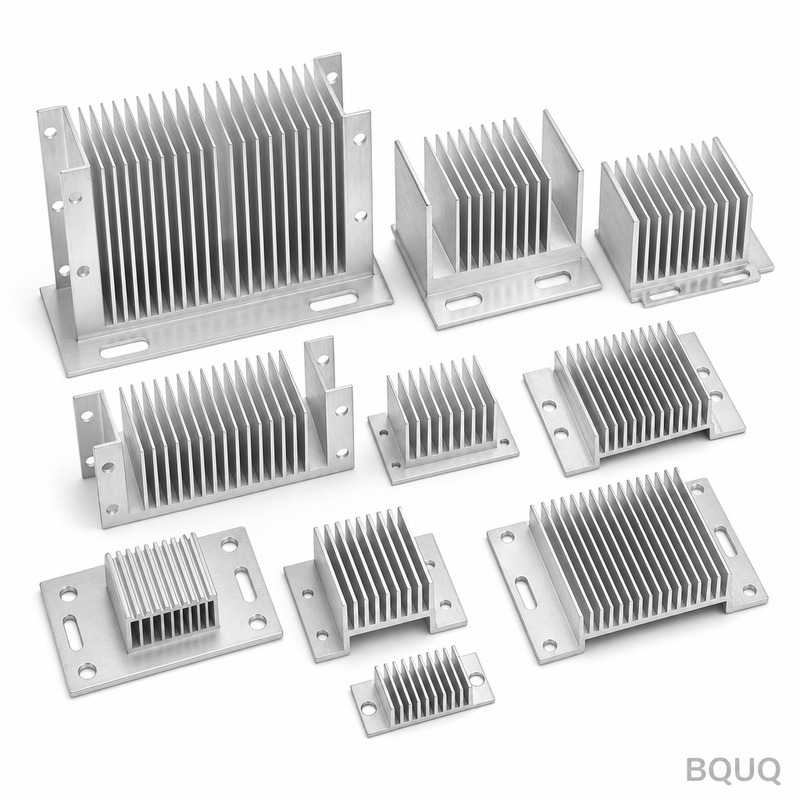
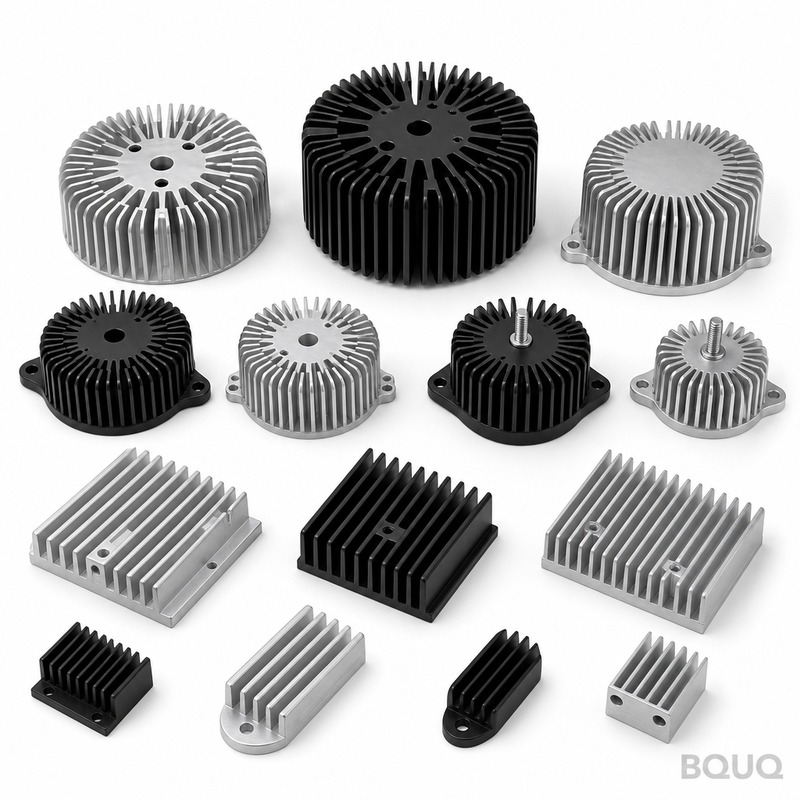
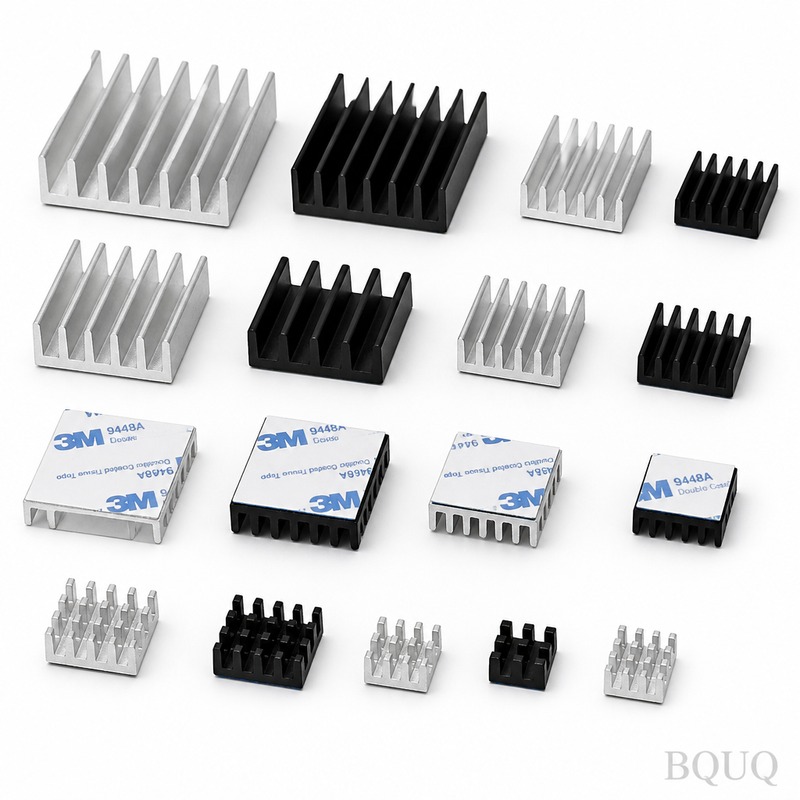
LED High Bay Stamped Aluminium Heatsink: 1050A aluminium, 0.5 mm fins at 3.0 mm pitch, 0.10 mm over 100 mm flatness, 0.62 K/W thermal resistance. MOQ 200 pcs...
LED High Bay Stamped Aluminium Heatsink
LED High Bay Stamped Aluminium Heatsink: 1050A aluminium, 0.5 mm fins at 3.0 mm pitch, 0.10 mm over 100 mm flatness, 0.62 K/W thermal resistance. MOQ 200 pcs...
Get a Fast Quote for This Part
Send us your drawing / quantity / material — reply within 24h.
The LED High Bay Stamped Aluminium Heatsink uses a 3.0 mm base and 0.5 mm fins pressed from 1050A aluminium on 250 T tooling. It holds 0.10 mm over 100 mm and delivers 0.62 K/W at ΔT = 75 K with forced air at 2.0 m/s. Monthly output reaches 120,000 pcs, with fin pitch held within ±0.05 mm across the run.
The LED High Bay Stamped Aluminium Heatsink uses a 3.0 mm base and 0.5 mm fins pressed from 1050A aluminium on 250 T tooling. It holds 0.10 mm over 100 mm and delivers 0.62 K/W at ΔT = 75 K with forced air at 2.0 m/s. Monthly output reaches 120,000 pcs, with fin pitch held within ±0.05 mm across the run.
A 3.0 mm base and 0.5 mm fins define this LED High Bay Stamped Aluminium Heatsink. Pressed from 1050A aluminium on 250 T tooling, it holds 0.10 mm over 100 mm and returns 0.62 K/W at ΔT = 75 K, forced air 2.0 m/s. Monthly output runs at 120,000 pcs.
Design Approach and Process
Stamping gives a repeatable 0.5 mm fin profile that extrusion cannot hold: the die forms every fin in one stroke, so pitch stays within ±0.05 mm across a 120,000 pcs run.
A single 250 T stroke forms the whole LED High Bay Stamped Aluminium Heatsink, so part cost stops scaling with complexity. Tooling runs ±0.05 mm, and the 18 s cycle feeds a 120,000 pcs line.
Low fin gauge is where stamping wins: 0.5 mm fins at 3.0 mm pitch give more surface per cubic millimetre than a machined or extruded profile of the same envelope.
Stamped construction tolerates batch variation better than extrusion: die wear shows up first as a measurable shift in fin pitch, which inspection catches at optical comparator plus CMM rather than in the field.
The sandblast + epoxy powder coating RAL 9005 finish is applied after forming, so corrosion protection does not get cut through at the fin roots the way it does on machined alternatives.
Material Selection and Surface Finish
The standard material is 1050A aluminium, supplied with sandblast + epoxy powder coating RAL 9005. For applications where LED high bay lighting exposure is a concern, we recommend the passivated route; where conductivity matters more than weight, copper C110 raises thermal performance and roughly doubles unit mass.
Tolerance Classes You Can Specify
General dimensions run to ±0.20 mm, with critical features such as ±0.05 mm on base thickness held separately. Formed geometry inherits tooling repeatability of ±0.05 mm, and hole position is held to ±0.15 mm. Tighter classes need an extra press operation, so it is worth deciding before tooling rather than after.
Inspection Before Every Shipment
Each batch carries a CMM report from optical comparator plus CMM. We record flatness, pitch, base thickness and hole position, and flag anything outside ±0.20 mm before it leaves the line.
Incoming 1050A aluminium is checked for thickness and hardness before it enters the press. After forming, optical comparator plus CMM confirms 0.10 mm over 100 mm and 3.0 mm against the drawing.
Flatness is measured on granite rather than on cast iron, because 0.10 mm over 100 mm at 200 x 100 x 50 mm reads differently on a plate that has not been lapped. Records keep both readings.
Final containment is Anti-static bag + wooden crate over 50 kg. Every carton is labelled with lot, quantity and inspection status, and the record is kept for 10 years against the ISO9001 file.
In LED high bay lighting, the 0.62 K/W rating determines how much airflow the enclosure still needs. At LED high bay lighting junction temperatures, 0.5 mm fins at 3.0 mm pitch keep the delta-T inside the sensor budget.
LED high bay lighting programs are the reason this geometry exists. Where the enclosure cannot grow taller, fin density is the only lever, and 3.0 mm pitch with 0.5 mm stock is the practical ceiling for aluminium.
In LED high bay lighting, the base usually doubles as the mounting interface. 3.0 mm with 0.10 mm over 100 mm flat gives a stable surface for the LED high bay lighting thermal pad.
Designers working on LED high bay lighting ask for flatness before they ask for thermal data, because LED high bay lighting assembly is automated and a non-flat base stops the line.
What is the lead time for the LED High Bay Stamped Aluminium Heatsink?
Prototype is 7 working days from drawing approval; production is 18 working days after the first article is signed off. Tooling for a new part takes 30 working days. We quote FOB Guangzhou, and sea freight to Europe runs about 25 to 30 days after booking.
Can the LED High Bay Stamped Aluminium Heatsink be powder coated or plated?
Yes. Standard is sandblast + epoxy powder coating RAL 9005. Powder coating to RAL 9005 adds about 0.1 mm to the base; zinc-nickel is better for grounding. Note that any added coating sits between 1050A aluminium and the airflow, so we do not coat the fin roots.
How long does tooling last before replacement?
On 1050A aluminium at normal press tonnage, expect a tooling life of roughly 300,000 strokes. At 120,000 pcs that is 6 to 12 months. We keep spare die sets on site for LED high bay lighting programs, which removes the wait if wear shows up in the flatness record.
Can you deliver without surface treatment?
Yes, we ship as-pressed for customers who do their own finishing. The risk is handling marks on 0.5 mm fins, so we pack those parts with interleaving sheets inside Anti-static bag + wooden crate over 50 kg.
Do you make the LED High Bay Stamped Aluminium Heatsink in different sizes?
The family covers 200 x 100 x 50 mm, with unit weights from 650 g. Because the base is pressed, new sizes are a die insert change rather than a new press line, so development is usually 2 weeks rather than 8.
How We Manufacture and Ship
The line sits in Dongguan in a single ISO9001 plant. 250 T presses cover the LED High Bay Stamped Aluminium Heatsink family, and 120,000 pcs per month is current committed output.
Tooling is built in-house, which is how ±0.05 mm is held across a 120,000 pcs programme rather than drifting part by part.
Production runs on 18 s cycles with in-line vision on 0.10 mm over 100 mm. That is what keeps a 120,000 pcs commitment credible in peak season.
Request a quote: sc@bquq.com | WhatsApp +86 13713157787 | Dongguan, China
Product Gallery
Key Specifications and Selection Guide
Spec comparison
Parameter
Value / Range
Material
1050A aluminium
Tolerance
0.10 mm over 100 mm; fin pitch ±0.05 mm
Lead time
Not specified in article
MOQ
Not specified in article
Capacity
120,000 pcs per month; 18 s cycle
Selection / comparison
Option
Best for
Trade-off
Stamped 0.5 mm fins
High surface area per cubic millimetre in a compact envelope
Requires 250 T tooling and die maintenance to hold ±0.05 mm pitch
Extruded profile
Simple constant cross-sections
Cannot hold a repeatable 0.5 mm fin profile; batch variation from extrusion is harder to catch early
Machined profile
Low-volume or prototype parts
Higher part cost that scales with complexity; coating can be cut through at fin roots
Sandblast + epoxy powder coating RAL 9005
Corrosion protection after forming
Applied post-forming, so fin roots are not cut through as on machined alternatives
Process / inspection
Stage
Control
Record
Stamping
Single 250 T stroke forms whole heatsink; 18 s cycle
Die wear tracked as measurable shift in fin pitch
Fin pitch
Held within ±0.05 mm across 120,000 pcs run
Optical comparator plus CMM inspection
Dimensional
0.10 mm over 100 mm
Inspection before every shipment
Surface finish
Sandblast + epoxy powder coating RAL 9005 after forming
Coating applied post-forming to protect fin roots
Thermal performance
0.62 K/W at ΔT = 75 K, forced air 2.0 m/s
Verified against specification
Frequently Asked Questions
What is the thermal resistance of this LED High Bay Stamped Aluminium Heatsink?
It returns 0.62 K/W at ΔT = 75 K with forced air at 2.0 m/s. The 3.0 mm base and 0.5 mm fins pressed from 1050A aluminium on 250 T tooling provide the surface area needed to hit that figure in a high bay envelope.
What tolerance can you hold on fin pitch and overall dimensions?
Fin pitch stays within ±0.05 mm across a 120,000 pcs run, and the part holds 0.10 mm over 100 mm. Tooling runs ±0.05 mm, and die wear shows up first as a measurable shift in fin pitch that inspection catches.
Why choose stamped aluminium instead of extruded or machined for this heatsink?
Stamping gives a repeatable 0.5 mm fin profile that extrusion cannot hold, because the die forms every fin in one stroke. At 3.0 mm pitch, 0.5 mm fins give more surface per cubic millimetre than a machined or extruded profile of the same envelope.
What is the monthly capacity and cycle time for this part?
Monthly output runs at 120,000 pcs. A single 250 T stroke forms the whole heatsink on an 18 s cycle, so part cost stops scaling with complexity and the line feeds 120,000 pcs per month.
How is the heatsink protected against corrosion?
The sandblast plus epoxy powder coating RAL 9005 finish is applied after forming. Because it goes on after the 250 T stroke, corrosion protection does not get cut through at the fin roots the way it does on machined alternatives.
What inspection is performed before shipment?
Inspection runs before every shipment using an optical comparator plus CMM. It catches die wear as a measurable shift in fin pitch, and verifies the 0.10 mm over 100 mm tolerance and the 0.5 mm fin profile across the 120,000 pcs run.
What material and tooling are used for this stamped heatsink?
It is pressed from 1050A aluminium on 250 T tooling. The 3.0 mm base and 0.5 mm fins are formed in a single 250 T stroke, with tooling running ±0.05 mm and an 18 s cycle feeding the 120,000 pcs line.
High-volume LED high bay cooling with 0.5 mm fins and 3.0 mm pitch
Requires 250 T tooling; fin geometry limited by stamping
Extruded heatsink
Simple constant cross-section profiles
Cannot hold 0.5 mm fin profile or ±0.05 mm pitch repeatably
Machined heatsink
Low-volume or complex 3D features
Higher part cost; less surface per cubic millimetre than stamped fins
Frequently Asked Questions
What is the fin pitch tolerance on this stamped aluminium heatsink?
Fin pitch is held within ±0.05 mm across a 120,000 pcs run. The 250 T die forms every fin in one stroke, so the 0.5 mm fin profile stays repeatable without the variation typical of extrusion.
What thermal resistance does this LED high bay heatsink deliver?
It delivers 0.62 K/W at ΔT = 75 K with forced air at 2.0 m/s. The 3.0 mm base and 0.5 mm fins pressed from 1050A aluminium provide more surface per cubic millimetre than machined or extruded profiles of the same envelope.
What material and thickness are used for the base and fins?
The base is 3.0 mm and the fins are 0.5 mm, both pressed from 1050A aluminium. This combination supports the 0.62 K/W thermal performance and the 0.10 mm over 100 mm dimensional hold.
What is the monthly production capacity for this part?
Monthly output reaches 120,000 pcs. The 18 s cycle on 250 T tooling feeds the line, and fin pitch stays within ±0.05 mm across the full run.
How does stamping compare to extrusion for this heatsink?
Stamping gives a repeatable 0.5 mm fin profile that extrusion cannot hold. The die forms every fin in one stroke, so pitch stays within ±0.05 mm across 120,000 pcs, and part cost stops scaling with complexity.
The process holds 0.10 mm over 100 mm. Tooling runs ±0.05 mm, and inspection before every shipment verifies the 3.0 mm base, 0.5 mm fins, and fin pitch within ±0.05 mm.
Where is this stamped aluminium heatsink typically used?
It is used in LED high bay lighting where forced air at 2.0 m/s is available and a 0.62 K/W at ΔT = 75 K thermal path is required. The 120,000 pcs monthly output supports high-volume fixture programs.