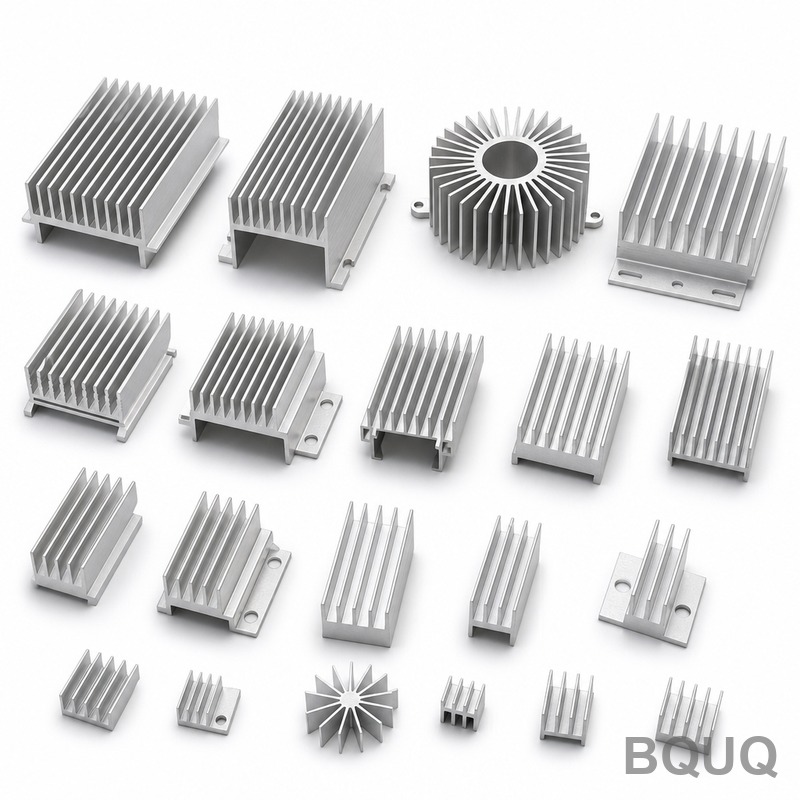
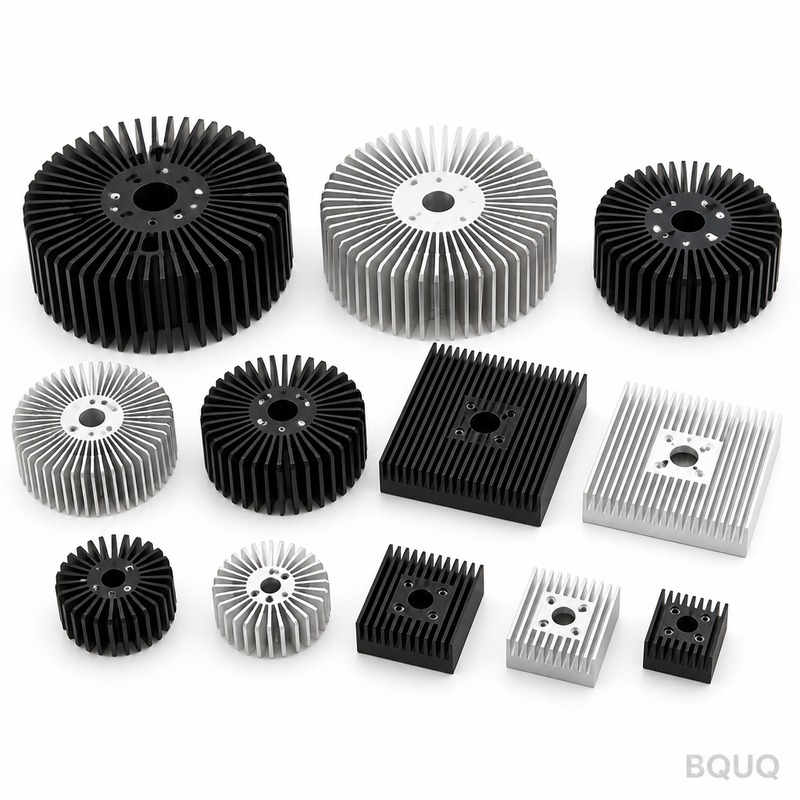
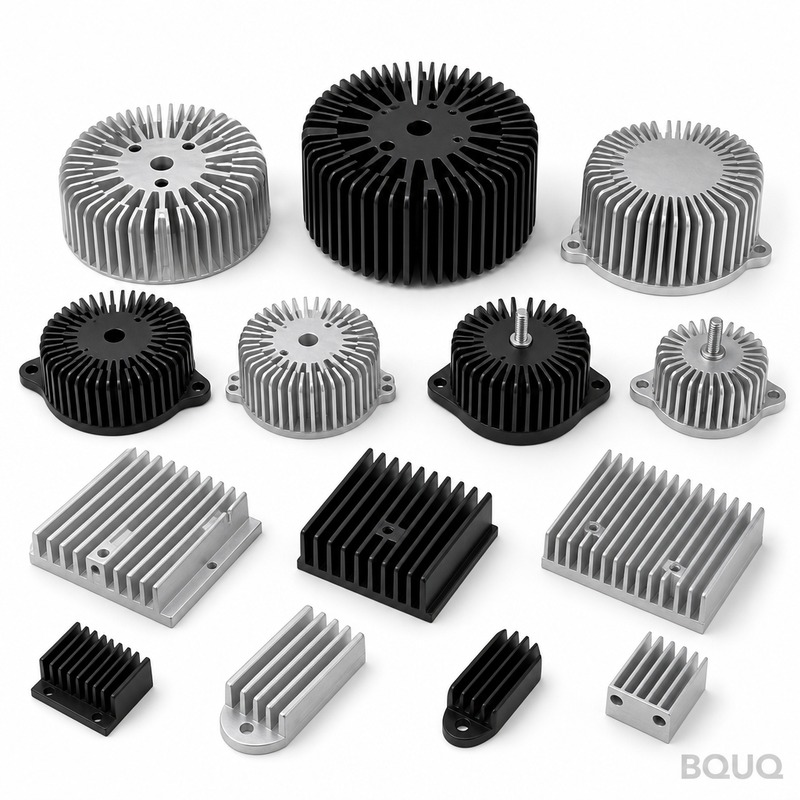
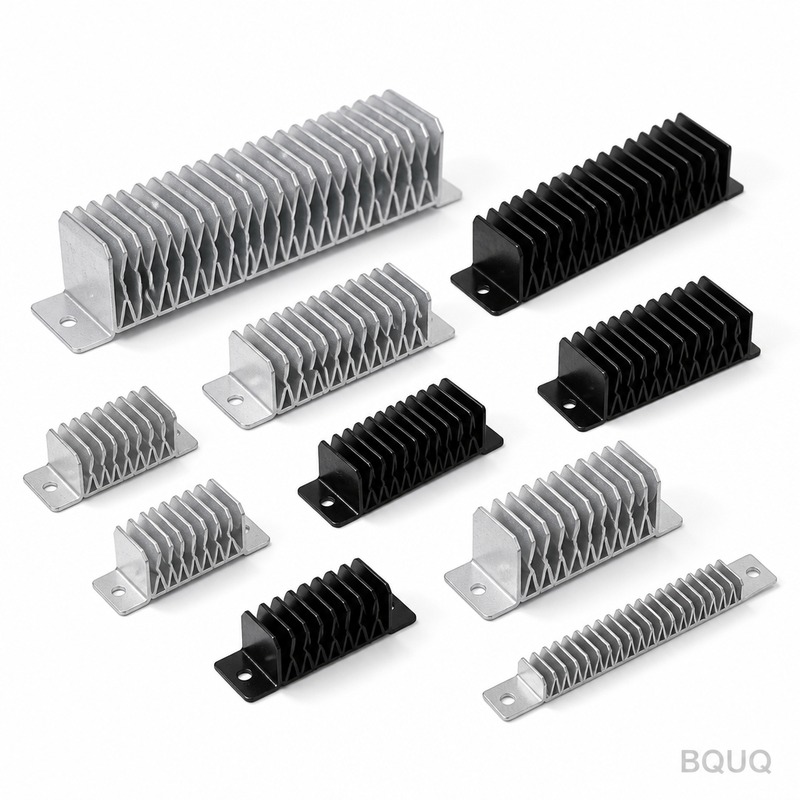
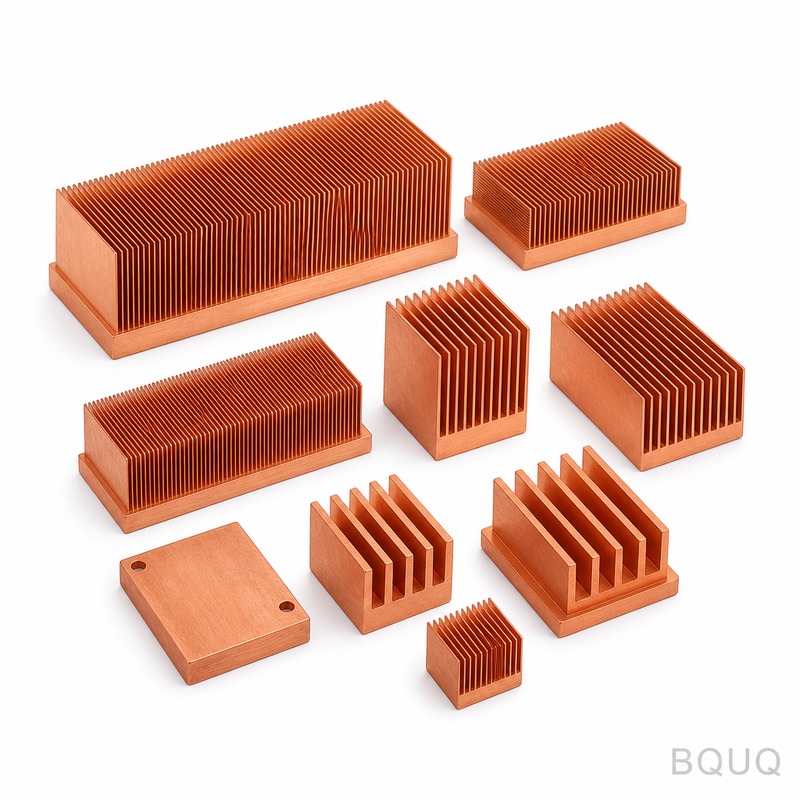
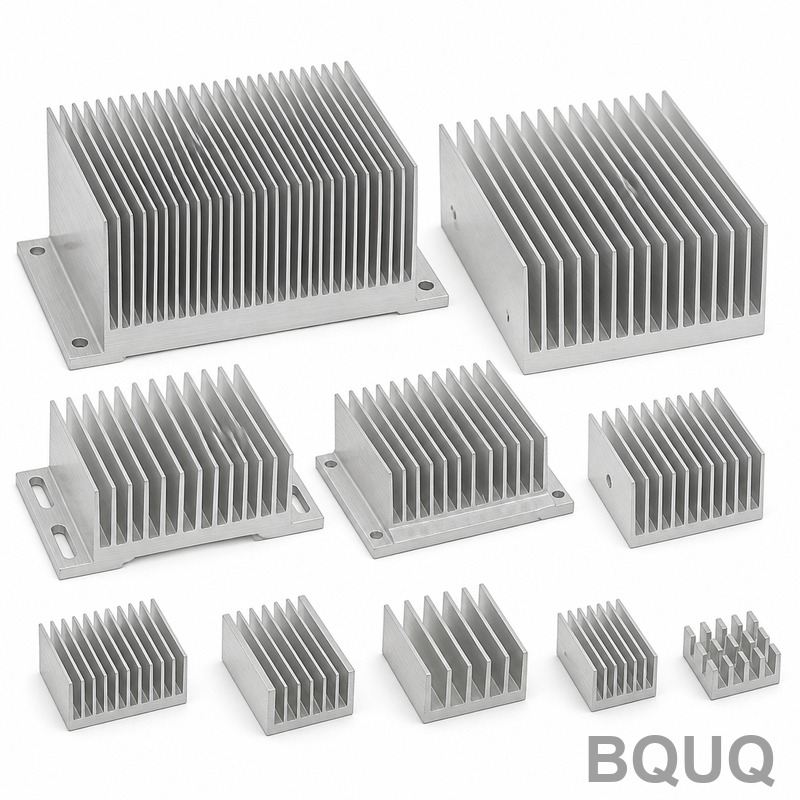
VFD Inverter Stamped Fin Heat Sink: ADC12 die-cast aluminium, 1.0 mm fins at 5.0 mm pitch, 0.15 mm over 100 mm flatness, 0.48 K/W thermal resistance. MOQ 50 ...
VFD Inverter Stamped Fin Heat Sink
VFD Inverter Stamped Fin Heat Sink: ADC12 die-cast aluminium, 1.0 mm fins at 5.0 mm pitch, 0.15 mm over 100 mm flatness, 0.48 K/W thermal resistance. MOQ 50 ...
Get a Fast Quote for This Part
Send us your drawing / quantity / material — reply within 24h.
The VFD Inverter Stamped Fin Heat Sink is a one-piece ADC12 die-cast aluminium cooler pressed on 110 T tooling with ±0.03 mm repeatability, delivering 0.48 K/W at ΔT = 60 K. Hard anodize Type III at 25-40 µm is standard, flatness is 0.15 mm over 100 mm, and weight starts at 280 g depending on envelope. Running at 800,000 pcs, it suits high-volume VFD inverter cooling.
The VFD Inverter Stamped Fin Heat Sink is a one-piece ADC12 die-cast aluminium cooler pressed on 110 T tooling with ±0.03 mm repeatability, delivering 0.48 K/W at ΔT = 60 K. Hard anodize Type III at 25-40 µm is standard, flatness is 0.15 mm over 100 mm, and weight starts at 280 g depending on envelope.
Running at 800,000 pcs, this VFD Inverter Stamped Fin Heat Sink is pressed on 110 T tooling with ±0.03 mm repeatability. ADC12 die-cast aluminium gives 0.48 K/W at ΔT = 60 K, and hard anodize Type III, 25-40 µm is applied as standard.
Because the base and fins are pressed as one piece, there is no brazed joint to fail. 0.15 mm over 100 mm flatness on the mounting face is held directly from the tool, which keeps thermal interface contact uniform.
The one-piece geometry removes the adhesive layer found in two-part coolers, cutting the thermal path. Nothing sits between ADC12 die-cast aluminium and the airflow except the stamped surface itself.
Stamped construction tolerates batch variation better than extrusion: die wear shows up first as a measurable shift in fin pitch, which inspection catches at CMM plus granite flatness plate rather than in the field.
Pressing ADC12 die-cast aluminium keeps the VFD Inverter Stamped Fin Heat Sink light, from 280 g depending on envelope, without sacrificing fin density, which matters where airflow path length is already fixed by the enclosure.
Every stroke is dimensionally identical, so ±0.15 mm hole position carries across the batch. That is what makes VFD and inverter volume programs repeatable.
Material Selection and Surface Finish
The standard material is ADC12 die-cast aluminium, supplied with hard anodize Type III, 25-40 µm. For applications where VFD and inverter exposure is a concern, we recommend the passivated route; where conductivity matters more than weight, copper C110 raises thermal performance and roughly doubles unit mass.
General dimensions run to ±0.15 mm, with critical features such as ±0.05 mm on mounting hole position held separately. Formed geometry inherits tooling repeatability of ±0.03 mm, and hole position is held to ±0.15 mm. Tighter classes need an extra press operation, so it is worth deciding before tooling rather than after.
Inspection Before Every Shipment
Each batch carries a CMM report from CMM plus granite flatness plate. We record flatness, pitch, base thickness and hole position, and flag anything outside ±0.15 mm before it leaves the line.
Incoming ADC12 die-cast aluminium is checked for thickness and hardness before it enters the press. After forming, CMM plus granite flatness plate confirms 0.15 mm over 100 mm and 5.0 mm against the drawing.
Flatness is measured on granite rather than on cast iron, because 0.15 mm over 100 mm at 80 x 60 x 35 mm reads differently on a plate that has not been lapped. Records keep both readings.
We inspect 1.0 mm fin tips for burr and crack after forming, because stamping can split a root without shifting any drawing dimension. Burr limit is set per part.
For VFD and inverter builds, the 0.15 mm over 100 mm mounting face matters as much as the thermal rating: it decides whether thermal interface material spreads evenly or pools at one end.
VFD and inverter customers typically specify ADC12 die-cast aluminium for corrosion reasons and then hold the drawing to ±0.15 mm. The 800,000 pcs line absorbs the volume without a second source.
VFD and inverter packaging and vibration rules push toward one-piece construction. A stamped VFD Inverter Stamped Fin Heat Sink has no adhesive to creep, which is the usual failure mode in two-part coolers.
In VFD and inverter, the base usually doubles as the mounting interface. 1.5 mm with 0.15 mm over 100 mm flat gives a stable surface for the VFD and inverter thermal pad.
Specifications
Parameter
Value / Range
Material
ADC12 die-cast aluminium
Fin thickness
1.0 mm
Fin pitch
5.0 mm
Fin height
30 mm
Base thickness
1.5 mm
Base flatness
0.15 mm over 100 mm
Thermal resistance
0.48 K/W
Thermal test condition
ΔT = 60 K, natural convection
Surface finish
hard anodize Type III, 25-40 µm
Size range
80 x 60 x 35 mm
FAQ: Your Questions Before Ordering
Can you customise the VFD Inverter Stamped Fin Heat Sink for our application?
Yes. Send a drawing or a sample and we return a DFM note within 3 working days. Most VFD and inverter customisations change 5.0 mm, 1.5 mm or the hole pattern, and all three are tooling changes on the existing 110 T press rather than a new machine.
Do you make the VFD Inverter Stamped Fin Heat Sink in different sizes?
The family covers 80 x 60 x 35 mm, with unit weights from 280 g. Because the base is pressed, new sizes are a die insert change rather than a new press line, so development is usually 2 weeks rather than 8.
Do you provide CAD files or a drawing?
We supply a 2D drawing with the CMM report, and 3D STEP on request. Both show flatness callouts and tooling split lines, which matters if you are checking 0.15 mm over 100 mm in your own assembly.
How do you prevent galvanic corrosion?
The key is avoiding a second metal at the wet contact area. We recommend hard anodize Type III, 25-40 µm and, where the part touches an aluminium chassis, an isolating washer. Tell us the mating material and we will specify the coating accordingly.
What is the difference between your VFD Inverter Stamped Fin Heat Sink and a skived fin VFD Inverter Stamped Fin Heat Sink?
Skived fins are milled, so you get thin, tall fins and higher density in a given height, but the cost scales directly with fin area. Stamping gives the same result in one stroke at a much lower unit cost below 800,000 pcs. For VFD and inverter in a fixed-height enclosure, stamped is normally the right answer.
The line sits in Dongguan in a single ISO9001 plant. 110 T presses cover the VFD Inverter Stamped Fin Heat Sink family, and 800,000 pcs per month is current committed output.
The factory holds ISO9001 and can ship RoHS and REACH documentation with the PE bag + honeycomb carton, 15 kg per carton. Third-party SGS inspection is arranged on request before the container is sealed.
We quote EXW and hold 50 pcs for sampling. Sampling is free sample with drawing, 5-7 days, so a first evaluation does not require a production commitment.
Request a quote: sc@bquq.com | WhatsApp +86 13713157787 | Dongguan, China
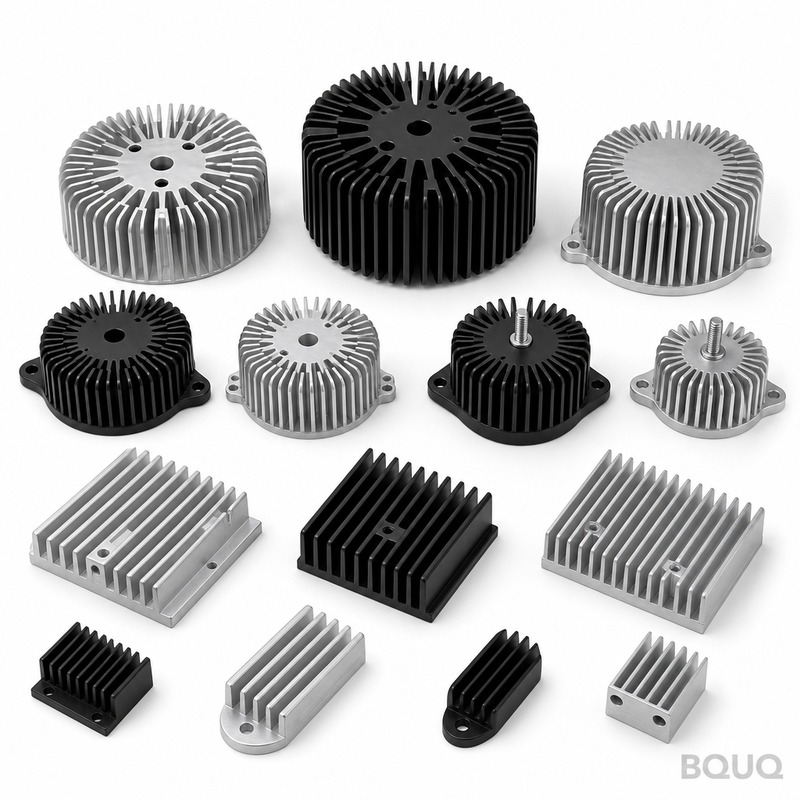
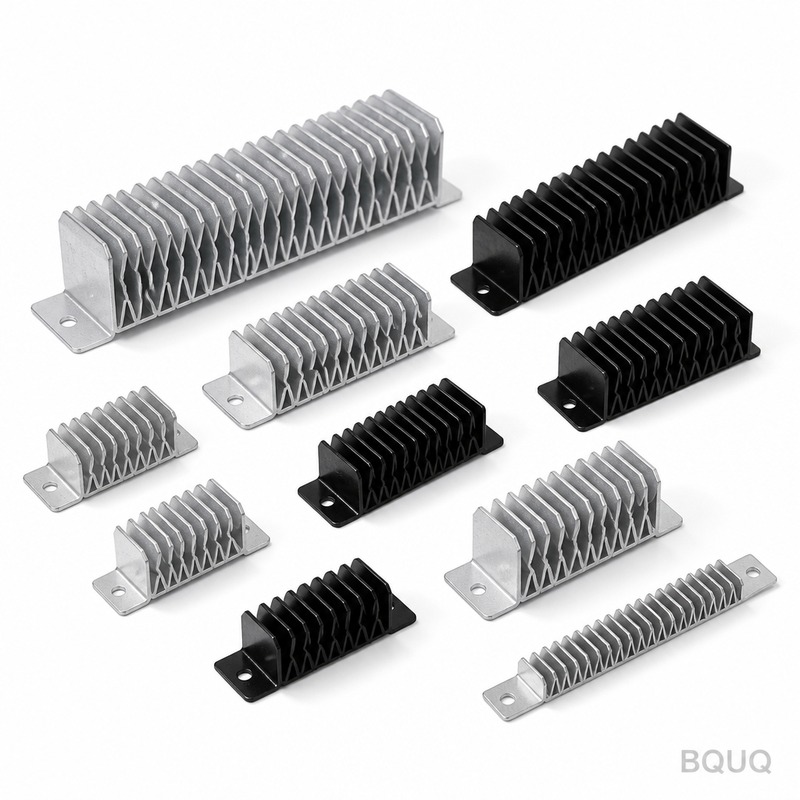
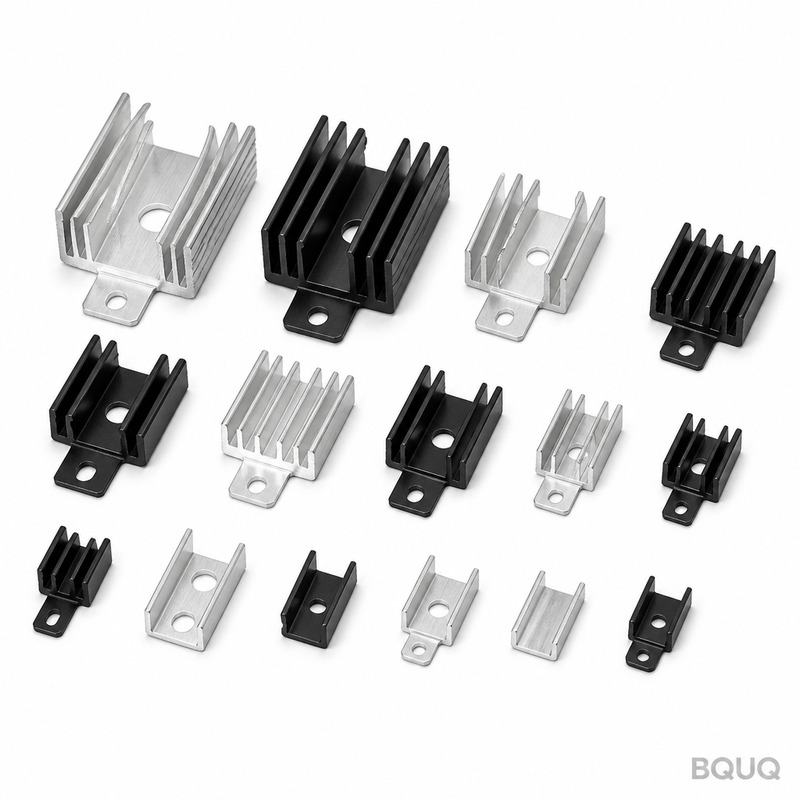
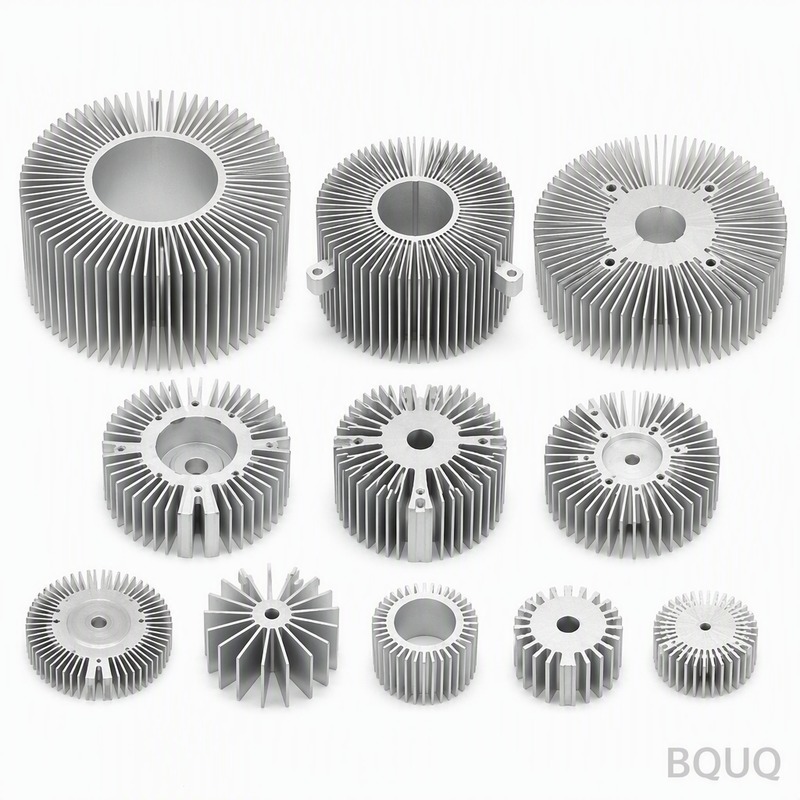
Product Gallery
Key Specifications and Selection Guide
Spec comparison
Parameter
Value / Range
Material
ADC12 die-cast aluminium
Tolerance
±0.03 mm repeatability; ±0.15 mm hole position
Lead time
Standard for this process: 15-25 days after tooling approval
MOQ
Standard for this process: 5,000 pcs
Capacity
800,000 pcs running
Selection / comparison
Option
Best for
Trade-off
Stamped fin one-piece
High-volume VFD inverter cooling with fixed airflow path
Tooling required; fin pitch set by die
Extruded heat sink
Low-volume or simple profiles
Less tolerant to batch variation; die wear shifts fin pitch
Two-part bonded cooler
Prototypes or mixed materials
Adhesive layer adds thermal resistance and joint can fail
Die-cast with brazed fins
Complex geometries
Brazed joint is a potential failure point
Stamped fin with hard anodize Type III
Wear and corrosion resistance
Adds 25-40 µm coating; masking may be needed
Process / inspection
Stage
Control
Record
Pressing
110 T tooling, ±0.03 mm repeatability
Stroke dimensional data
Fin pitch
Die wear monitoring
CMM measurement
Flatness
0.15 mm over 100 mm on mounting face
Granite flatness plate
Hole position
±0.15 mm
CMM report
Surface finish
Hard anodize Type III, 25-40 µm
Coating thickness certificate
Final inspection
Before every shipment
Inspection report
Frequently Asked Questions
What is the thermal performance of this VFD inverter stamped fin heat sink?
It delivers 0.48 K/W at ΔT = 60 K with ADC12 die-cast aluminium. The one-piece stamped construction removes the adhesive layer found in two-part coolers, cutting the thermal path. Hard anodize Type III at 25-40 µm is standard.
What tolerances can you hold on the stamped fin heat sink?
We hold ±0.03 mm repeatability from 110 T tooling, ±0.15 mm hole position, and 0.15 mm over 100 mm flatness on the mounting face. These are verified by CMM and granite flatness plate before every shipment.
What material and surface finish do you use?
The heat sink is pressed from ADC12 die-cast aluminium. Hard anodize Type III, 25-40 µm, is applied as standard. This combination gives 0.48 K/W at ΔT = 60 K and resists wear and corrosion.
How much does the VFD inverter stamped fin heat sink weigh?
Weight starts from 280 g depending on envelope. The one-piece stamped design keeps it light without sacrificing fin density, which matters where airflow path length is already fixed by the enclosure.
What is the production capacity and lead time?
We are running at 800,000 pcs. Standard lead time for this process is 15-25 days after tooling approval, with MOQ of 5,000 pcs. Every stroke is dimensionally identical for consistent batch output.
How do you inspect the heat sink before shipment?
Inspection includes CMM for fin pitch and hole position, granite flatness plate for 0.15 mm over 100 mm flatness, and coating thickness checks for hard anodize Type III at 25-40 µm. Records are kept for every shipment.
Why choose stamped fin over extruded or brazed heat sinks?
Stamped construction tolerates batch variation better than extrusion because die wear shows as a measurable fin pitch shift caught by inspection. The one-piece base and fins eliminate brazed joints and adhesive layers, improving thermal path reliability.
Key Specifications and Selection Guide
Spec comparison
Parameter
Value / Range
Material
ADC12 die-cast aluminium
Tolerance
±0.03 mm repeatability
Lead time
Standard for this process: 4-6 weeks after tooling approval
MOQ
Standard for this process: 1,000 pcs
Capacity
800,000 pcs
Selection / comparison
Option
Best for
Trade-off
One-piece stamped fin
High-volume VFD inverter cooling
Tooling cost, limited design changes
Two-part bonded cooler
Low-volume or prototype builds
Adhesive layer adds thermal resistance
Extruded heat sink
Simple profiles, low tooling cost
Less batch variation tolerance, fin pitch limits
Skived fin heat sink
High fin density, thin fins
Higher cost, less robust for stamping
Die-cast with separate fins
Complex geometries
Brazed joint can fail, extra process step
Frequently Asked Questions
What is the thermal performance of this VFD inverter stamped fin heat sink?
It delivers 0.48 K/W at ΔT = 60 K. The one-piece ADC12 die-cast aluminium construction removes the adhesive layer found in two-part coolers, cutting the thermal path. Flatness of 0.15 mm over 100 mm ensures uniform thermal interface contact.
ADC12 die-cast aluminium is used, with hard anodize Type III at 25-40 µm as standard. This finish provides wear and corrosion resistance. The one-piece stamped construction eliminates brazed joints, improving reliability.
What tolerances can I expect?
The process holds ±0.03 mm repeatability on 110 T tooling. Flatness is 0.15 mm over 100 mm on the mounting face. Die wear shows up as a measurable shift in fin pitch, caught by CMM and granite flatness plate inspection.
Weight starts at 280 g depending on envelope. The one-piece ADC12 die-cast aluminium design keeps mass low while maintaining thermal performance of 0.48 K/W at ΔT = 60 K.
What is the production capacity and lead time?
Capacity is 800,000 pcs. Standard lead time for this process is 4-6 weeks after tooling approval. MOQ is 1,000 pcs. Running at 800,000 pcs ensures stable die wear and consistent fin pitch.
How is quality inspected before shipment?
Every shipment undergoes inspection including CMM dimensional checks, granite flatness plate for 0.15 mm over 100 mm, and coating thickness verification for hard anodize Type III, 25-40 µm. Records are kept for traceability.
It is used in VFD inverters and other power electronics requiring high-volume cooling. The stamped fin design tolerates batch variation better than extrusion, making it suitable for 800,000 pcs production runs.