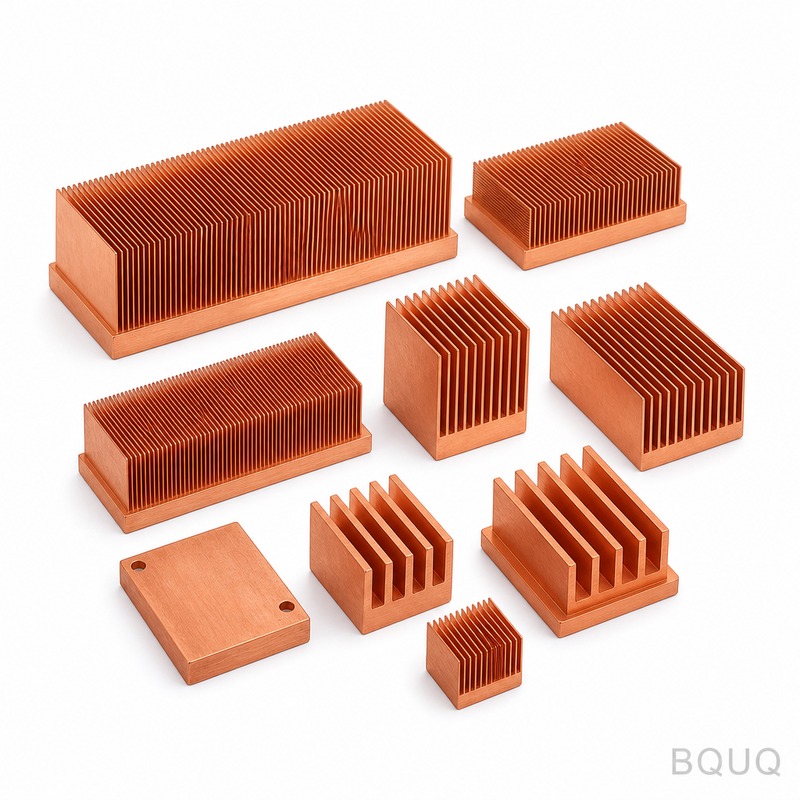
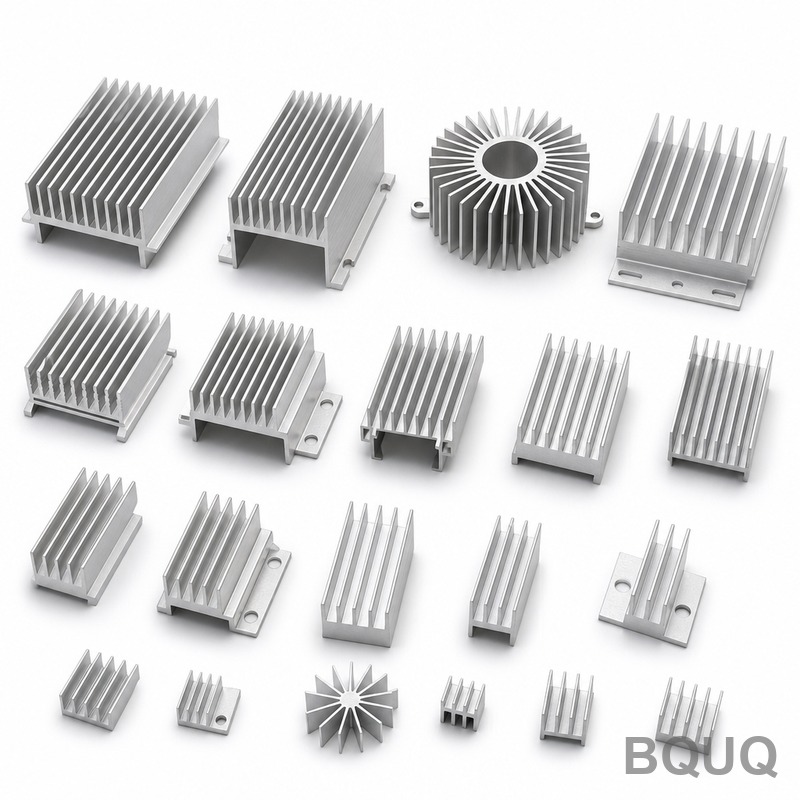
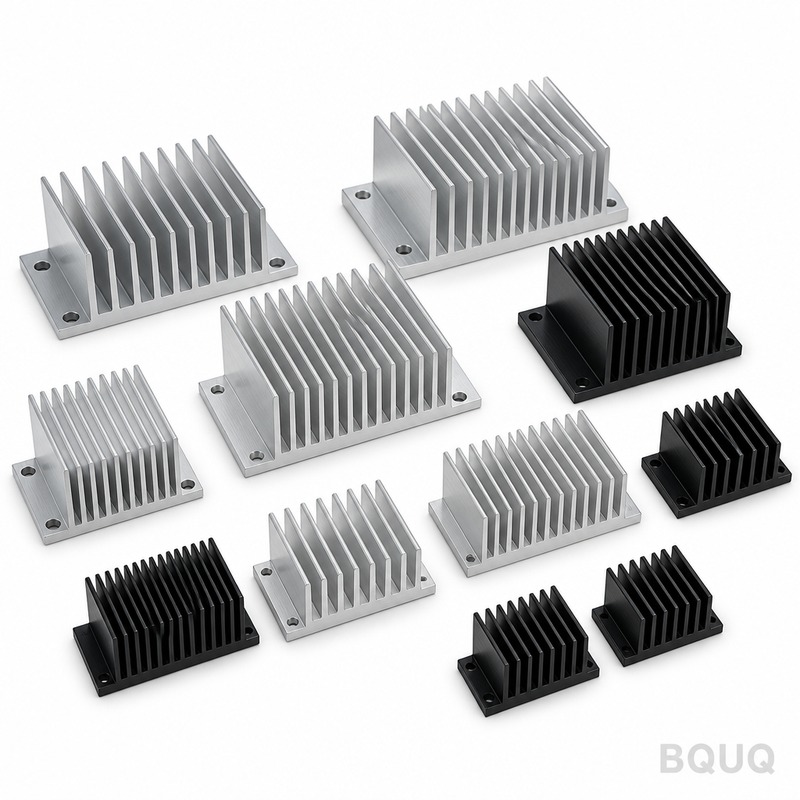
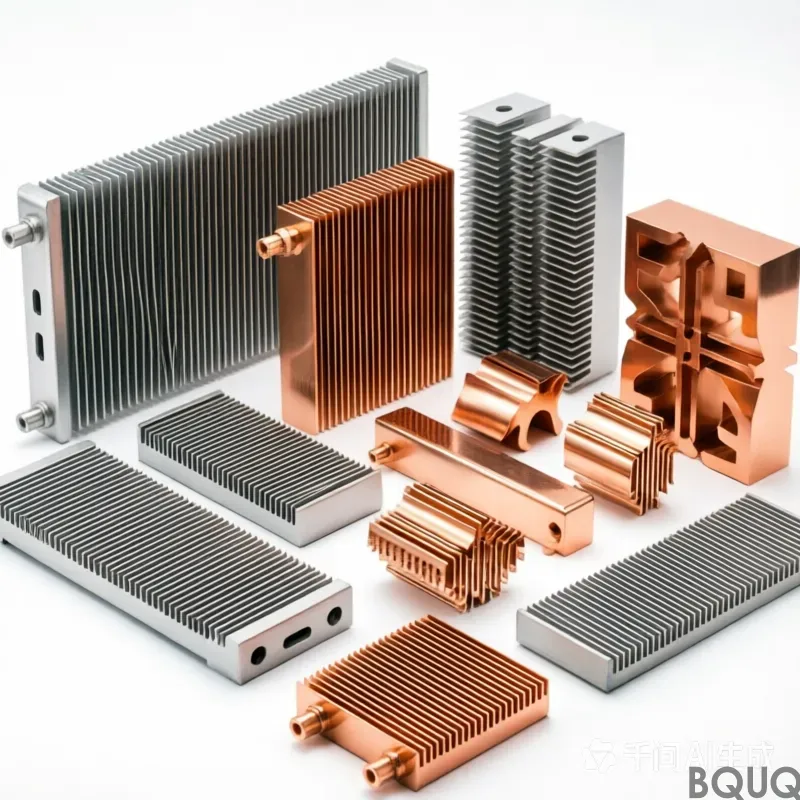
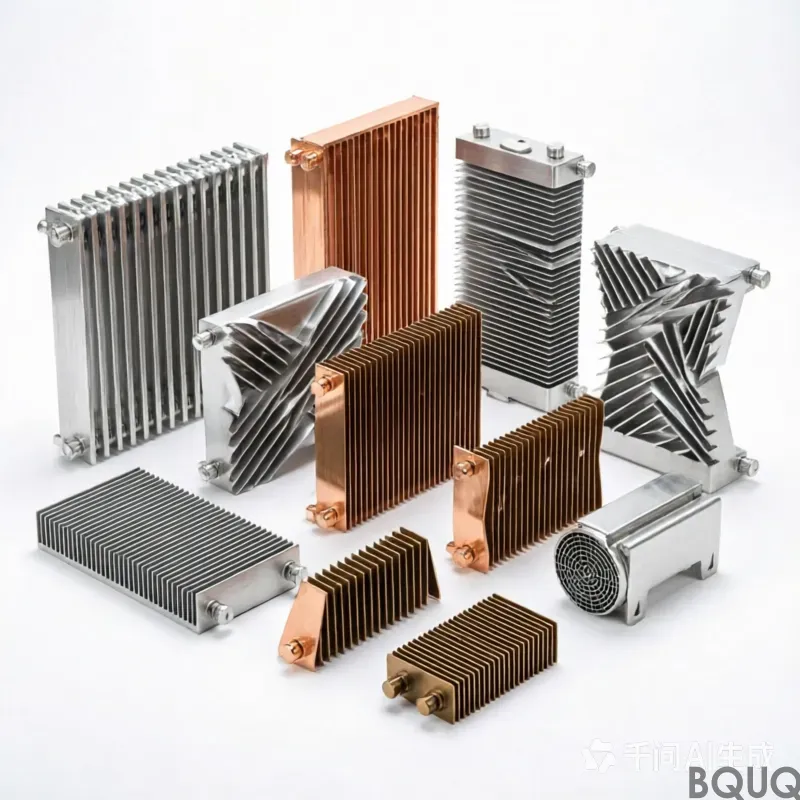
aluminum heat sink block: 6063-T5 aluminium, 1.0 mm fins at 3.0 mm pitch, 0.10 mm over 100 mm flatness, 0.62 K/W thermal resistance. MOQ 500 pcs, ships in 72...
aluminum heat sink block
aluminum heat sink block: 6063-T5 aluminium, 1.0 mm fins at 3.0 mm pitch, 0.10 mm over 100 mm flatness, 0.62 K/W thermal resistance. MOQ 500 pcs, ships in 72...
Get a Fast Quote for This Part
Send us your drawing / quantity / material — reply within 24h.
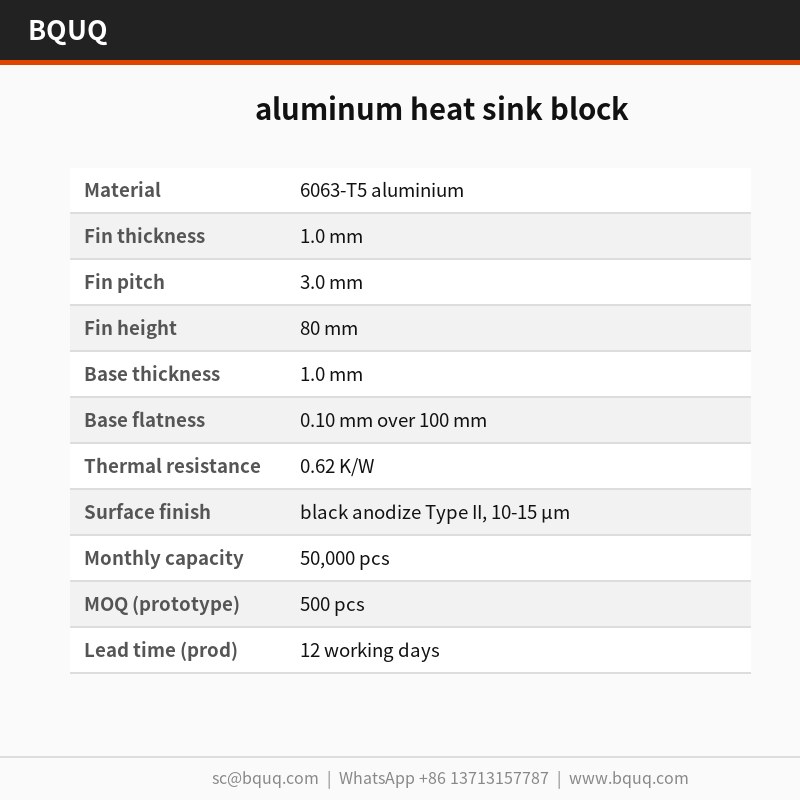
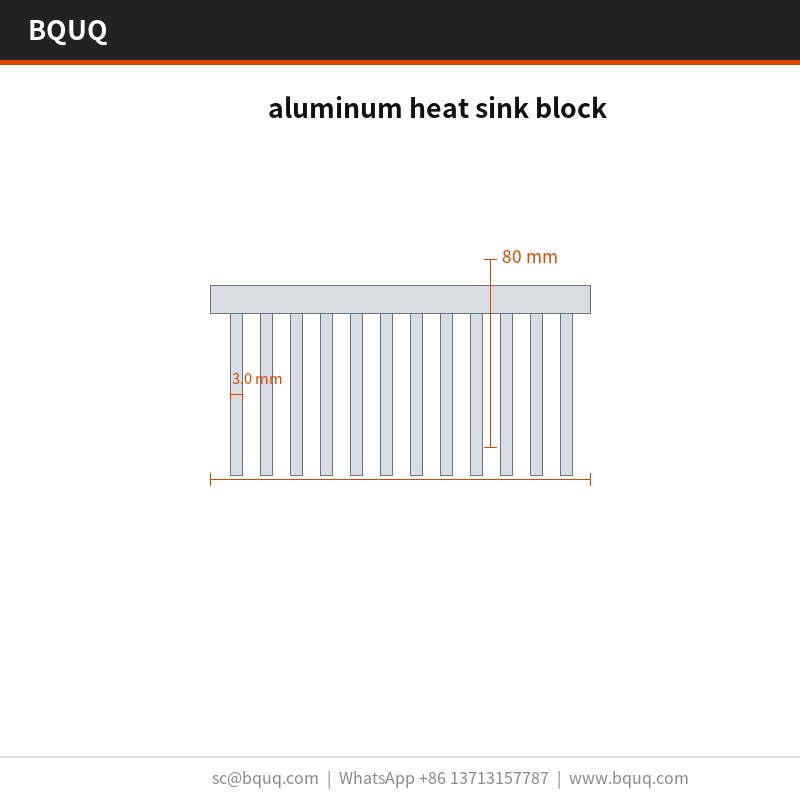
Aluminum heat sink block is a 1.0 mm base and 1.0 mm fin part stamped from 6063-T5 aluminium on 110 T tooling. It holds 0.10 mm over 100 mm and delivers 0.62 K/W at ΔT = 75 K, forced air 2.0 m/s. Monthly output runs at 50,000 pcs with fin pitch held within ±0.05 mm.
A 1.0 mm base and 1.0 mm fins define this aluminum heat sink block. Pressed from 6063-T5 aluminium on 110 T tooling, it holds 0.10 mm over 100 mm and returns 0.62 K/W at ΔT = 75 K, forced air 2.0 m/s. Monthly output runs at 50,000 pcs.
Design Approach and Process
Stamping gives a repeatable 1.0 mm fin profile that extrusion cannot hold: the die forms every fin in one stroke, so pitch stays within ±0.05 mm across a 50,000 pcs run.
Low fin gauge is where stamping wins: 1.0 mm fins at 3.0 mm pitch give more surface per cubic millimetre than a machined or extruded profile of the same envelope.
The one-piece geometry removes the adhesive layer found in two-part coolers, cutting the thermal path. Nothing sits between 6063-T5 aluminium and the airflow except the stamped surface itself.
Stamped construction tolerates batch variation better than extrusion: die wear shows up first as a measurable shift in fin pitch, which inspection catches at CMM plus 100% hydraulic press leak test rather than in the field.
The black anodize Type II, 10-15 µm finish is applied after forming, so corrosion protection does not get cut through at the fin roots the way it does on machined alternatives.
The standard material is 6063-T5 aluminium, supplied with black anodize Type II, 10-15 µm. For applications where LED high bay lighting exposure is a concern, we recommend the passivated route; where conductivity matters more than weight, copper C110 raises thermal performance and roughly doubles unit mass.
Tolerance Classes You Can Specify
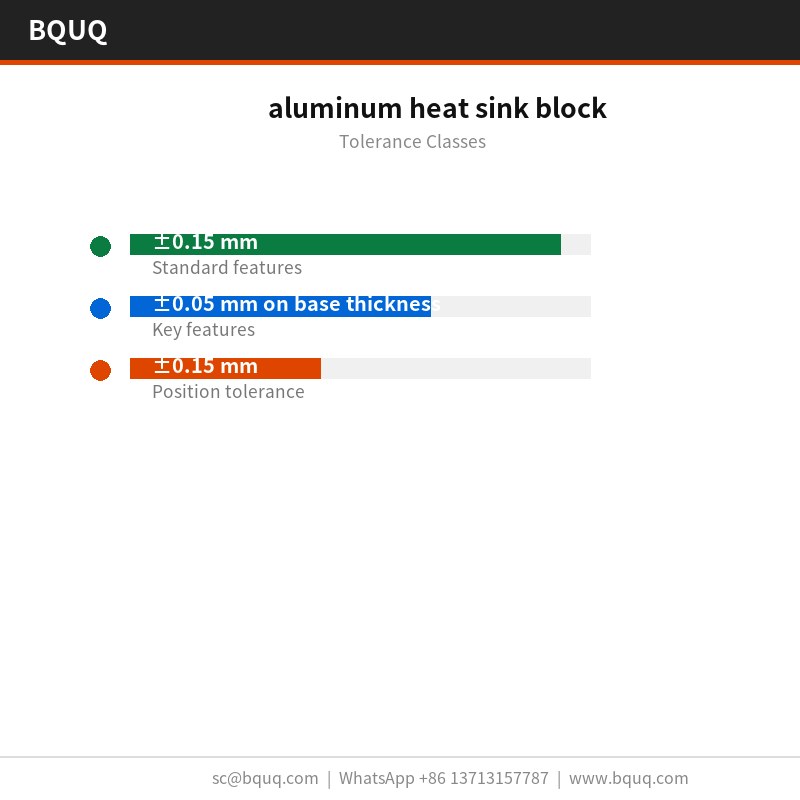
General dimensions run to ±0.15 mm, with critical features such as ±0.05 mm on base thickness held separately. Formed geometry inherits tooling repeatability of ±0.05 mm, and hole position is held to ±0.15 mm. Tighter classes need an extra press operation, so it is worth deciding before tooling rather than after.
Inspection Before Every Shipment
Each batch carries a CMM report from CMM plus 100% hydraulic press leak test. We record flatness, pitch, base thickness and hole position, and flag anything outside ±0.15 mm before it leaves the line.
Sampling is AQL 0.65 for critical dimensions and 1.5 for general, with CMM plus 100% hydraulic press leak test on every first article. Deviations beyond ±0.15 mm trigger a full-lot sort.
Flatness is measured on granite rather than on cast iron, because 0.10 mm over 100 mm at 20 x 20 x 10 mm reads differently on a plate that has not been lapped. Records keep both readings.
Final containment is PE bag + export carton, 20 kg per carton. Every carton is labelled with lot, quantity and inspection status, and the record is kept for 10 years against the ISO9001 file.
Where This Part Is Used
LED high bay lighting programs are the reason this geometry exists. Where the enclosure cannot grow taller, fin density is the only lever, and 3.0 mm pitch with 1.0 mm stock is the practical ceiling for aluminium.
For LED high bay lighting builds, the 0.10 mm over 100 mm mounting face matters as much as the thermal rating: it decides whether thermal interface material spreads evenly or pools at one end.
LED high bay lighting customers typically specify 6063-T5 aluminium for corrosion reasons and then hold the drawing to ±0.15 mm. The 50,000 pcs line absorbs the volume without a second source.
In LED high bay lighting, the base usually doubles as the mounting interface. 1.0 mm with 0.10 mm over 100 mm flat gives a stable surface for the LED high bay lighting thermal pad.
6063-T5 aluminium is the standard choice. For LED high bay lighting in a corrosive environment we specify 6063-T5 with black anodize Type II, 10-15 µm; for the highest conductivity we move to copper C110, which raises cost and weight but drops thermal resistance by roughly half at the same envelope.
How does this compare to an extruded aluminum heat sink block?
Extrusion is cheaper above roughly 500,000 pieces per year and gives a smoother profile. Stamping wins below that and wherever fin gauge drops below 0.5 mm, because extrusion cannot hold 1.0 mm consistently. For LED high bay lighting prototypes, tooling cost usually decides it.
Can the aluminum heat sink block be powder coated or plated?
Yes. Standard is black anodize Type II, 10-15 µm. Powder coating to RAL 9005 adds about 0.1 mm to the base; zinc-nickel is better for grounding. Note that any added coating sits between 6063-T5 aluminium and the airflow, so we do not coat the fin roots.
We supply a 2D drawing with the CMM report, and 3D STEP on request. Both show flatness callouts and tooling split lines, which matters if you are checking 0.10 mm over 100 mm in your own assembly.
Can you help with thermal simulation before sampling?
Yes. Send your enclosure airflow, inlet temperature and the heat load to be dissipated, and we will run a steady-state model and return a suggested 1.0 mm and 3.0 mm combination. That usually saves one tooling iteration.
How We Manufacture and Ship
Our LED high bay lighting experience runs back to the first tooling programme in 2015. That history is why the standard black anodize Type II, 10-15 µm and ±0.15 mm are conservative rather than optimistic.
Quality staff sit beside the press, not in a separate room. Deviations on 3.0 mm or 0.10 mm over 100 mm stop the run at the tool rather than at final inspection.
We quote EXW and hold 500 pcs for sampling. Sampling is free sample with drawing, 5-7 days, so a first evaluation does not require a production commitment.
Request a quote: sc@bquq.com | WhatsApp +86 13713157787 | Dongguan, China
Standard for stamped production; confirm with BQUQ
MOQ
Standard for 50,000 pcs/month capacity; confirm with BQUQ
Capacity
50,000 pcs per month
Selection / comparison
Option
Best for
Trade-off
Stamped 1.0 mm fin block
High surface area per cubic millimetre in a one-piece cooler
Requires 110 T tooling; fin pitch depends on die wear
Extruded profile
Simple constant cross-sections
Cannot hold a 1.0 mm fin profile as repeatably; pitch variation is higher
Machined profile
Low-volume or complex features
Lower surface area per cubic millimetre; higher cost per part
Two-part cooler with adhesive
Assemblies where bonding is acceptable
Adhesive layer adds thermal resistance to the path
Black anodize Type II, 10-15 µm
Corrosion protection after forming
Applied post-forming; fin roots are not cut through as on machined alternatives
Process / inspection
Stage
Control
Record
Stamping
110 T tooling forms every fin in one stroke; pitch within ±0.05 mm
Fin pitch measurement across the 50,000 pcs run
Dimensional inspection
CMM checks 0.10 mm over 100 mm and fin pitch
CMM inspection report
Leak test
100% hydraulic press leak test
Leak test result per part
Surface finish
Black anodize Type II, 10-15 µm applied after forming
Finish thickness and visual record
Final shipment
Inspection before every shipment
Shipment inspection record
Frequently Asked Questions
What is the thermal performance of this aluminum heat sink block?
It returns 0.62 K/W at ΔT = 75 K with forced air at 2.0 m/s. The 1.0 mm base and 1.0 mm fins on 3.0 mm pitch provide high surface area per cubic millimetre, and the one-piece stamped geometry removes the adhesive layer found in two-part coolers.
The block is pressed from 6063-T5 aluminium on 110 T tooling. Black anodize Type II, 10-15 µm is applied after forming, so corrosion protection does not get cut through at the fin roots the way it does on machined alternatives.
What tolerances can this stamped heat sink hold?
It holds 0.10 mm over 100 mm. Fin pitch stays within ±0.05 mm across a 50,000 pcs run because the die forms every fin in one stroke. Die wear shows up first as a measurable shift in fin pitch, which inspection catches at CMM.
Why choose stamping over extrusion for this heat sink block?
Stamping gives a repeatable 1.0 mm fin profile that extrusion cannot hold. The die forms every fin in one stroke, so pitch stays within ±0.05 mm across a 50,000 pcs run. Low fin gauge at 1.0 mm and 3.0 mm pitch gives more surface per cubic millimetre than a machined or extruded profile of the same envelope.
Inspection runs before every shipment. It includes CMM checks for 0.10 mm over 100 mm and fin pitch, plus a 100% hydraulic press leak test. Stamped construction tolerates batch variation better than extrusion because die wear appears as a measurable fin pitch shift caught in inspection.
What is the monthly production capacity and output?
Monthly output runs at 50,000 pcs. The 110 T tooling and one-stroke fin forming support this volume while holding fin pitch within ±0.05 mm. Confirm current lead time and MOQ with BQUQ for your order quantity.
Where is this aluminum heat sink block used?
It is used where a one-piece cooler with a 1.0 mm base and 1.0 mm fins is needed. The stamped 6063-T5 aluminium block returns 0.62 K/W at ΔT = 75 K, forced air 2.0 m/s, and removes the adhesive layer found in two-part coolers.