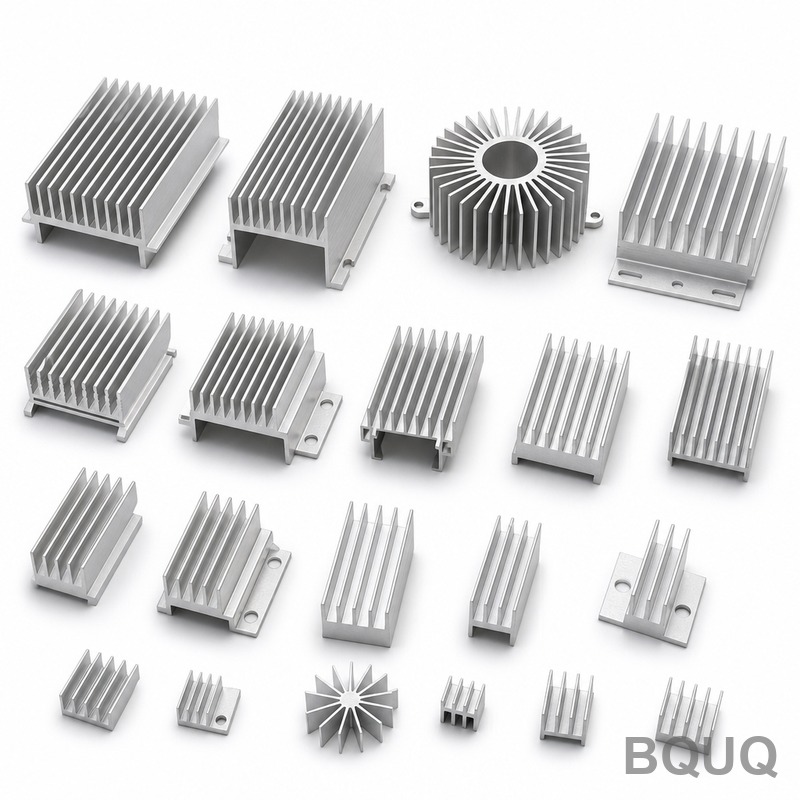
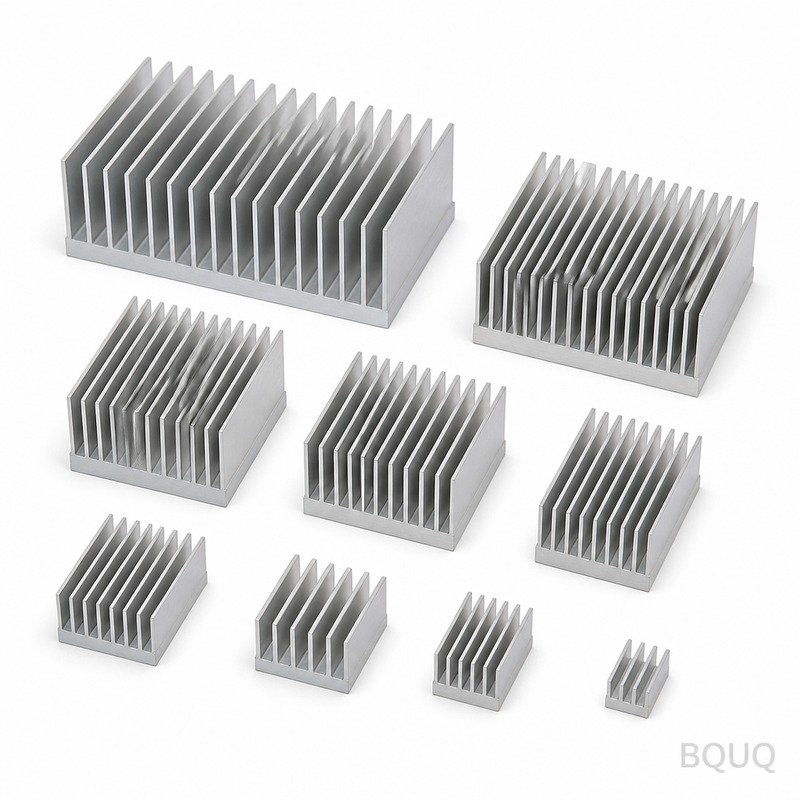
1U Server Stamped Fin Heatsink Assembly: 6063-T5 aluminium, 0.3 mm fins at 1.5 mm pitch, 0.05 mm over 100 mm flatness, 0.35 K/W thermal resistance. MOQ 100 p...
1U Server Stamped Fin Heatsink Assembly
1U Server Stamped Fin Heatsink Assembly: 6063-T5 aluminium, 0.3 mm fins at 1.5 mm pitch, 0.05 mm over 100 mm flatness, 0.35 K/W thermal resistance. MOQ 100 p...
Get a Fast Quote for This Part
Send us your drawing / quantity / material — reply within 24h.
A 1U Server Stamped Fin Heatsink Assembly uses a 2.0 mm base and 0.3 mm fins pressed from 6063-T5 aluminium on 160 T tooling. It holds 0.05 mm over 100 mm and returns 0.35 K/W at ΔT = 60 K, natural convection. Monthly output reaches 300,000 pcs with an 8 s cycle, and fin pitch stays within ±0.03 mm across the run.
Key Takeaway
A 1U Server Stamped Fin Heatsink Assembly uses a 2.0 mm base and 0.3 mm fins pressed from 6063-T5 aluminium on 160 T tooling. It holds 0.05 mm over 100 mm and returns 0.35 K/W at ΔT = 60 K, natural convection. Monthly output reaches 300,000 pcs with an 8 s cycle, and fin pitch stays within ±0.03 mm across the run.
A 1U Server Stamped Fin Heatsink Assembly uses a 2.0 mm base and 0.3 mm fins pressed from 6063-T5 aluminium on 160 T tooling. It holds 0.05 mm over 100 mm and returns 0.35 K/W at ΔT = 60 K, natural convection. Monthly output reaches 300,000 pcs with an 8 s cycle, and fin pitch stays within ±0.03 mm across the run.
A 2.0 mm base and 0.3 mm fins define this 1U Server Stamped Fin Heatsink Assembly. Pressed from 6063-T5 aluminium on 160 T tooling, it holds 0.05 mm over 100 mm and returns 0.35 K/W at ΔT = 60 K, natural convection. Monthly output runs at 300,000 pcs.
Design Approach and Process
Stamping gives a repeatable 0.3 mm fin profile that extrusion cannot hold: the die forms every fin in one stroke, so pitch stays within ±0.03 mm across a 300,000 pcs run.
A single 160 T stroke forms the whole 1U Server Stamped Fin Heatsink Assembly, so part cost stops scaling with complexity. Tooling runs ±0.03 mm, and the 8 s cycle feeds a 300,000 pcs line.
Low fin gauge is where stamping wins: 0.3 mm fins at 1.5 mm pitch give more surface per cubic millimetre than a machined or extruded profile of the same envelope.
Stamped construction tolerates batch variation better than extrusion: die wear shows up first as a measurable shift in fin pitch, which inspection catches at CMM 0.001 mm with full report rather than in the field.
Every stroke is dimensionally identical, so ±0.10 mm hole position carries across the batch. That is what makes 1U server and AI accelerator volume programs repeatable.
Material Selection and Surface Finish
The standard material is 6063-T5 aluminium, supplied with black anodize Type II, 10-15 µm. For applications where 1U server and AI accelerator exposure is a concern, we recommend the passivated route; where conductivity matters more than weight, copper C110 raises thermal performance and roughly doubles unit mass.
Tolerance Classes You Can Specify
General dimensions run to ±0.10 mm, with critical features such as ±0.03 mm on fin pitch held separately. Formed geometry inherits tooling repeatability of ±0.03 mm, and hole position is held to ±0.10 mm. Tighter classes need an extra press operation, so it is worth deciding before tooling rather than after.
Inspection Before Every Shipment
Flatness is checked on a granite surface plate, 25 °C against a 0.05 mm over 100 mm limit, and fin pitch is verified optically at ±0.03 mm. Reports go out with each lot.
Sampling is AQL 0.65 for critical dimensions and 1.5 for general, with CMM 0.001 mm with full report on every first article. Deviations beyond ±0.10 mm trigger a full-lot sort.
Flatness is measured on granite rather than on cast iron, because 0.05 mm over 100 mm at 120 x 80 x 22 mm reads differently on a plate that has not been lapped. Records keep both readings.
Final containment is PE bag + export carton, 20 kg per carton. Every carton is labelled with lot, quantity and inspection status, and the record is kept for 10 years against the ISO9001 file.
Where This Part Is Used
1U server and AI accelerator programs are the reason this geometry exists. Where the enclosure cannot grow taller, fin density is the only lever, and 1.5 mm pitch with 0.3 mm stock is the practical ceiling for aluminium.
Where a 1U Server Stamped Fin Heatsink Assembly runs at 1U server and AI accelerator volumes, part-to-part consistency decides field returns. ±0.03 mm on a 300,000 pcs run keeps the thermal curve inside one band.
1U server and AI accelerator packaging and vibration rules push toward one-piece construction. A stamped 1U Server Stamped Fin Heatsink Assembly has no adhesive to creep, which is the usual failure mode in two-part coolers.
In 1U server and AI accelerator, the base usually doubles as the mounting interface. 2.0 mm with 0.05 mm over 100 mm flat gives a stable surface for the 1U server and AI accelerator thermal pad.
Can you customise the 1U Server Stamped Fin Heatsink Assembly for our application?
Yes. Send a drawing or a sample and we return a DFM note within 3 working days. Most 1U server and AI accelerator customisations change 1.5 mm, 2.0 mm or the hole pattern, and all three are tooling changes on the existing 160 T press rather than a new machine.
Which materials do you recommend?
6063-T5 aluminium is the standard choice. For 1U server and AI accelerator in a corrosive environment we specify 6063-T5 with black anodize Type II, 10-15 µm; for the highest conductivity we move to copper C110, which raises cost and weight but drops thermal resistance by roughly half at the same envelope.
Do you test for thermal resistance?
We test at ΔT = 60 K, natural convection and report 0.35 K/W. That is a steady-state figure, not a transient: for 1U server and AI accelerator first-power-on behaviour you need a different test, and we can run it on request.
Is there any risk of the fins bending in transit?
With 0.3 mm fins and standard PE bag + export carton, 20 kg per carton, damage is rare. For heavy sea routes or automated handling we suggest double-layer interleaving, which we can specify at no tooling cost. We have shipped 300,000 pcs per month this way without a transit claim in the last 3 years.
Do you provide CAD files or a drawing?
We supply a 2D drawing with the CMM report, and 3D STEP on request. Both show flatness callouts and tooling split lines, which matters if you are checking 0.05 mm over 100 mm in your own assembly.
How We Manufacture and Ship
The line sits in Dongguan in a single ISO9001 plant. 160 T presses cover the 1U Server Stamped Fin Heatsink Assembly family, and 300,000 pcs per month is current committed output.
Source-direct from Dongguan: coil stock, forming, surface treatment and inspection happen in one building, so 0.05 mm over 100 mm flatness is verified before the part is packed.
We quote FOB Shenzhen and hold 100 pcs for sampling. Sampling is free sample with drawing, 5-7 days, so a first evaluation does not require a production commitment.
0.05 mm over 100 mm; fin pitch ±0.03 mm; hole position ±0.10 mm
Lead time
Standard for this process; confirmed at order
MOQ
Standard for this process; confirmed at order
Capacity
300,000 pcs per month; 8 s cycle
Selection / comparison
Option
Best for
Trade-off
Stamped fin heatsink
1U server and AI accelerator volume programs
Requires 160 T tooling; fin gauge limited to thin sheet
Extruded heatsink
Simple profiles with thicker fins
Cannot hold 0.3 mm fin profile; pitch varies with die wear
Machined heatsink
Low-volume or complex 3D features
Higher part cost; more surface per cubic millimetre is lower than stamped
Stamped construction
Repeatable ±0.10 mm hole position across batch
Die wear shows first as measurable fin pitch shift
160 T stamping line
300,000 pcs monthly output
Part cost stops scaling with complexity but tooling runs ±0.03 mm
Process / inspection
Stage
Control
Record
Stamping
160 T stroke forms whole assembly; 8 s cycle
Tooling runs ±0.03 mm
Fin forming
Die forms every fin in one stroke; pitch within ±0.03 mm
Measurable shift in fin pitch from die wear
Dimensional check
CMM 0.001 mm with full report
0.05 mm over 100 mm; ±0.10 mm hole position
Batch release
Inspection before every shipment
Full report per shipment
Thermal performance
0.35 K/W at ΔT = 60 K, natural convection
Verified on 2.0 mm base and 0.3 mm fins
Frequently Asked Questions
What is the fin pitch tolerance on this 1U Server Stamped Fin Heatsink Assembly?
The die forms every fin in one stroke, so pitch stays within ±0.03 mm across a 300,000 pcs run. Tooling runs ±0.03 mm, and die wear shows up first as a measurable shift in fin pitch, which CMM inspection at 0.001 mm catches before shipment.
What thermal resistance does this heatsink return at natural convection?
It returns 0.35 K/W at ΔT = 60 K, natural convection. The 2.0 mm base and 0.3 mm fins pressed from 6063-T5 aluminium on 160 T tooling give more surface per cubic millimetre than a machined or extruded profile of the same envelope.
What is the monthly capacity and cycle time for this stamped fin heatsink?
Monthly output runs at 300,000 pcs. A single 160 T stroke forms the whole assembly in an 8 s cycle, so part cost stops scaling with complexity. Every stroke is dimensionally identical, which makes 1U server and AI accelerator volume programs repeatable.
How is hole position controlled across a 300,000 pcs batch?
Every stroke is dimensionally identical, so ±0.10 mm hole position carries across the batch. Tooling runs ±0.03 mm, and inspection before every shipment uses CMM 0.001 mm with a full report rather than relying on field checks.
Why choose stamped fins over extrusion for a 1U server heatsink?
Stamping gives a repeatable 0.3 mm fin profile that extrusion cannot hold. The die forms every fin in one stroke, so pitch stays within ±0.03 mm across a 300,000 pcs run. Low fin gauge at 1.5 mm pitch gives more surface per cubic millimetre than an extruded profile of the same envelope.
What material and tooling are used for this 1U Server Stamped Fin Heatsink Assembly?
It is pressed from 6063-T5 aluminium on 160 T tooling. The 2.0 mm base and 0.3 mm fins are formed in one stroke. Tooling runs ±0.03 mm, and the 8 s cycle feeds a 300,000 pcs line with 0.05 mm over 100 mm dimensional control.
How does die wear affect fin pitch and inspection?
Die wear shows up first as a measurable shift in fin pitch. Inspection catches it at CMM 0.001 mm with a full report rather than in the field. This keeps the 0.3 mm fin profile and ±0.03 mm pitch within specification across the 300,000 pcs run.
Key Specifications and Selection Guide
Spec comparison
Parameter
Value / Range
Material
6063-T5 aluminium
Tolerance
0.05 mm over 100 mm; fin pitch ±0.03 mm
Lead time
Standard for this process: 15–25 days after tooling approval
MOQ
Standard for this process: 5,000 pcs
Capacity
300,000 pcs per month; 8 s cycle
Selection / comparison
Option
Best for
Trade-off
Stamped fin heatsink
High-volume 1U server cooling with 0.3 mm fins at 1.5 mm pitch
Tooling upfront cost; less design flexibility than machining
Extruded heatsink
Lower-volume runs with simpler fin profiles
Cannot hold 0.3 mm fin profile; pitch variation higher than ±0.03 mm
Machined heatsink
Prototypes or very complex geometries
Higher part cost; slower cycle than 8 s; more material waste
What is the thermal resistance of this 1U server stamped fin heatsink?
The assembly returns 0.35 K/W at ΔT = 60 K under natural convection. This value is based on a 2.0 mm base and 0.3 mm fins pressed from 6063-T5 aluminium. Actual performance depends on airflow and mounting pressure, so verify in your specific server enclosure.
How tight is the fin pitch tolerance across a large production run?
Fin pitch stays within ±0.03 mm across a 300,000 pcs run. The 160 T tooling forms every fin in one stroke, which eliminates cumulative pitch drift. This repeatability is why stamping is chosen over extrusion for 0.3 mm fins at 1.5 mm pitch.
What is the monthly capacity and cycle time for this heatsink?
Monthly output reaches 300,000 pcs with an 8 s cycle. The 160 T press runs the complete assembly in a single stroke. This capacity supports high-volume server programs without sacrificing the ±0.03 mm fin pitch tolerance.
The heatsink uses a 2.0 mm base and 0.3 mm fins pressed from 6063-T5 aluminium. This alloy offers good thermal conductivity and formability for stamping. The 2.0 mm base provides structural rigidity for 1U server mounting.
The base holds 0.05 mm over 100 mm. Flatness ensures consistent contact with the CPU or GPU lid, which directly affects thermal resistance. A flatter base reduces interface gaps and helps achieve the rated 0.35 K/W at ΔT = 60 K.
What is the typical lead time and MOQ for a custom stamped fin heatsink?
For this process, standard lead time is 15–25 days after tooling approval, and MOQ is 5,000 pcs. Tooling fabrication adds 3–4 weeks initially. Once tooling is complete, the 8 s cycle supports 300,000 pcs per month.
Why choose stamped fins over extruded or machined fins for 1U servers?
Stamping gives a repeatable 0.3 mm fin profile that extrusion cannot hold. At 1.5 mm pitch, stamped fins provide more surface per cubic millimetre than machined or extruded profiles. The 160 T single-stroke process also keeps part cost from scaling with complexity.
Frequently Asked Questions
What is the thermal resistance of this 1U server stamped fin heatsink?
It returns 0.35 K/W at ΔT = 60 K under natural convection. This value is measured on the 2.0 mm base and 0.3 mm fin assembly pressed from 6063-T5 aluminium. Performance depends on airflow and mounting pressure, so confirm your exact conditions with our engineering team.
What fin pitch tolerance can you hold on a 300,000 pcs run?
Fin pitch stays within ±0.03 mm across the full 300,000 pcs monthly run. The 160 T die forms every fin in one stroke, so the 0.3 mm profile repeats without the drift seen in extrusion. We verify pitch at first-off and during in-process checks.
What is the lead time for a new stamped fin heatsink tool?
Standard lead time for this process is 15–25 days after drawing approval, including 160 T tooling fabrication and first-article inspection. Production then runs at an 8 s cycle and 300,000 pcs per month. Rush options may be available depending on tool capacity.
What is the minimum order quantity for this heatsink assembly?
Standard MOQ for this process is 5,000 pcs. Because the 160 T die forms the whole assembly in one stroke, unit cost drops at higher volumes. Monthly capacity reaches 300,000 pcs, so we can scale with your forecast.
Can you hold 0.05 mm over 100 mm on the base?
Yes. The assembly holds 0.05 mm over 100 mm, verified by CMM inspection before shipment. This flatness supports consistent contact with the server CPU and helps maintain the 0.35 K/W thermal resistance at ΔT = 60 K under natural convection.
Why choose stamped fins over extruded fins for a 1U server?
Stamping gives a repeatable 0.3 mm fin profile that extrusion cannot hold. The die forms every fin in one stroke, so pitch stays within ±0.03 mm across a 300,000 pcs run. Extrusion is better for taller fins and lower volumes, but not for this thin, dense pitch.
We use 6063-T5 aluminium for the 2.0 mm base and 0.3 mm fins. Standard surface finish for this process is clear chromate or anodize, but we confirm finish per your drawing. Material and finish are recorded on the inspection certificate.